AI demand forecasting in pharma supply chains becomes valuable only when fragmented operational data is first translated into a reliable analytical structure. In this project, a pharmaceutical organization wanted to explore whether machine learning could predict medicine purchases across hospitals and related healthcare units. What initially appeared to be a modeling task quickly proved to be a data interpretation challenge — and that is exactly where Stermedia delivered the greatest business value.
Executive Summary
Stermedia joined a time-boxed forecasting challenge focused on predicting drug purchases across healthcare entities. The dataset included historical orders placed by hospitals and related units, but the information was heavily anonymized and structurally inconsistent. Instead of approaching the project as a purely modeling exercise, our team began by uncovering the logic behind the data, clarifying procurement relationships, and identifying quality issues that could affect the credibility of the forecasts. This approach created a practical foundation for AI demand forecasting and helped Stermedia stand out in the challenge.
The Challenge: Why AI Demand Forecasting Was Difficult Here
The client wanted to forecast medicine demand across multiple institutions over time. However, the source data did not behave like a clean time-series dataset. Hospital and unit names were hashed for security reasons, there was no reliable data dictionary, and the purchasing structure itself was multi-layered: some hospitals purchased centrally, some internal pharmacies operated independently, and certain units belonged to larger groups while others functioned separately. Without understanding that hierarchy, any pharmaceutical demand forecasting model risked aggregating the wrong entities and producing misleading results.
AI Demand Forecasting Starts with Data Understanding
Stermedia treated data analysis as a key stage of the entire project. The team focused on organizing the information structure, verifying aggregation logic, and identifying inconsistencies that could affect forecast quality. An important part of the work was also clarifying the relationships between individual units so that the data could become a reliable basis for further analysis.
This approach made it possible to separate real business signals from apparent patterns present in the dataset. As a result, forecasting could be built on stronger analytical foundations and the risk of drawing incorrect conclusions was significantly reduced.
Data Quality Issues That Shaped the Forecast
One of the most important parts of the project was verifying whether observed purchasing patterns actually reflected business reality. During the analysis, it became clear that some visible trends were influenced not only by operational behavior, but also by the way the dataset had been prepared and described. This included inconsistencies in naming, structural ambiguities, and formatting differences — such as date conventions that required careful interpretation to avoid false assumptions about seasonality or order timing.
By validating the structure of the dataset, the consistency of input records, and the logic used to group entities, Stermedia was able to build a more trustworthy basis for demand prediction. In practice, this reduced the risk of treating technical noise as a meaningful business signal.
The Modeling Approach: Practical Machine Learning Over Hype
Once the structure of the data became clearer, Stermedia applied practical machine learning methods rather than forcing the problem into an unnecessarily complex deep learning stack. The team worked with established ML approaches, including gradient-boosting-based models such as XGBoost, and presented the analytical structure, model logic, and key metrics in Jupyter notebooks.
Although the project was carried out at an earlier stage of the AI market, the key lesson remains current: successful forecasting depends less on technological hype and more on choosing methods that fit the data, business context, and delivery constraints.
Outcome: A Stronger Foundation for Pharmaceutical Demand Forecasting
Because the engagement was short and challenge-based, the project was less about deploying a finished enterprise platform and more about proving analytical readiness. Stermedia’s advantage came from understanding the data better than competing teams, not from overstating model sophistication or performance. The outcome was a credible foundation for further forecasting work, greater visibility into the client’s data landscape, and a practical demonstration that successful AI demand forecasting begins with structure, validation, and business-aware interpretation.
What This Case Says About Stermedia’s Approach
This case reflects a pattern that matters across AI projects in healthcare, pharma, and other data-intensive industries: the highest-value work often takes place before production modeling even begins.
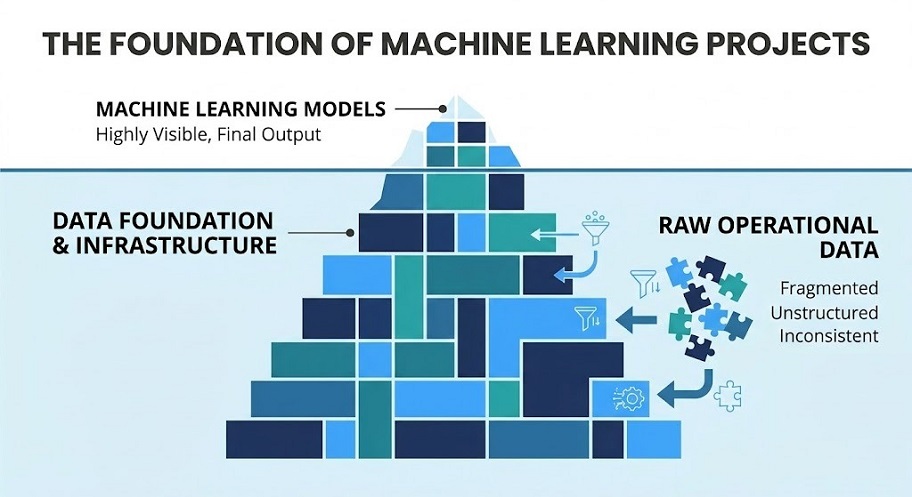
Stermedia’s role was not just to test algorithms, but to reduce delivery risk by uncovering hidden data logic, correcting misleading patterns, and selecting methods appropriate to the maturity of the dataset. For organizations considering AI demand forecasting, that is often the difference between an impressive proof of concept and a truly usable business capability.
Summary
AI demand forecasting creates the greatest value when it is grounded in data reality rather than model hype. In this pharmaceutical forecasting challenge, Stermedia showed how strong analytical thinking, reconstruction of fragmented data structures, and pragmatic machine learning can form the basis for better forecasting decisions. Before organizations scale predictive models, they need a partner that can first make their data understandable. That is where Stermedia delivers.
Next Steps & Further Reading
If you want to explore how AI demand forecasting can support better planning, procurement visibility, and operational decision-making, the best place to start is a focused pilot built around real data readiness — not a large-scale modeling initiative launched too early.
At Stermedia, we help CEOs, startups, and established organizations deliver AI solutions end to end — from data analysis and proof of concept to production-grade deployment.
Want to discuss your project? Contact our AI team.
Continue reading:
- How to use simple math models for major business challenges – A case study showing how a lightweight mathematical solution enabled remote damage-size estimation, reduced manual work, and delivered fast, precise results without the need for on-site visits.
- System for Planning Scenarios of Clinical Trials – A case study on using NLP and BERT to structure large volumes of clinical trial protocols, support scenario planning, and build tools for named entity recognition, text classification, and analytical workflow automation.
- Working with Stermedia – AI Software Development Guide – An overview of how Stermedia approaches AI delivery, from use-case discovery and data readiness to implementation and long-term support.