AI for Clinical Trial Planning begins with a major challenge: turning thousands of complex medical PDFs into structured, trustworthy data.
Client Context
A healthcare technology company was building a product designed to support pharmaceutical and research teams in preparing future clinical trial scenarios. The business goal was clear: instead of relying on experts to manually review large archives of historical documentation, the client wanted a system that could process clinical trial protocols automatically, extract the most important information, and convert it into structured data ready for downstream analysis.
This was not the first attempt to solve this type of challenge. Earlier work in this area had shown both the value of automated protocol analysis and the limitations of the technologies available at the time. With the emergence of more capable AI approaches, the client decided to revisit the problem and build a more scalable solution.
Why AI for Clinical Trial Planning Needed Structured Data
The core problem was scale.
Clinical trial protocols are long, detailed, and highly inconsistent documents. Some are in vector format, while others are raster-based, which makes the dataset highly diverse.
Many contain nested information about study objectives, patient populations, hypotheses, phases, inclusion criteria, and sponsor context. For AI for Clinical Trial Planning to work in a meaningful way, all of that information first had to become searchable, comparable, and machine-readable.
The client already had domain experts who knew exactly what should be extracted from each document. Their knowledge was captured in a detailed ontology — a structured representation of the key concepts and relationships relevant to clinical trial protocol analysis. Stermedia’s task was to turn that expert knowledge into an automated document processing workflow.
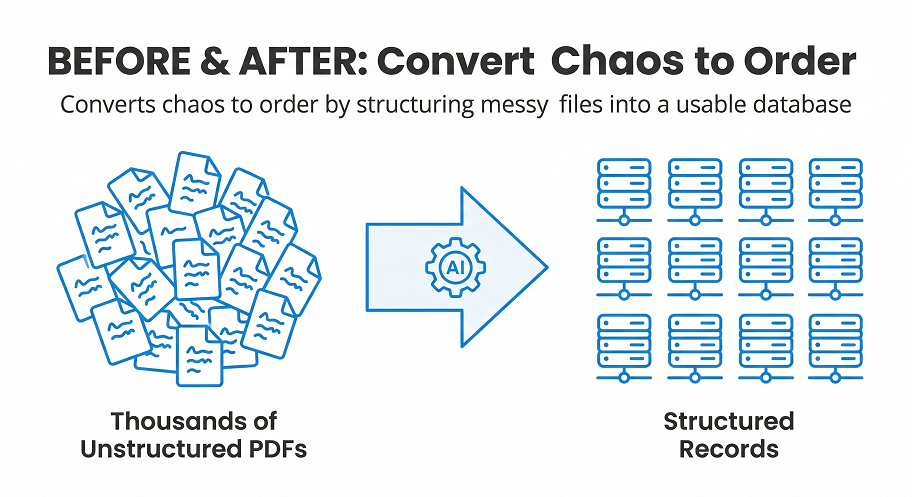
In practical terms, the challenge was to transform unstructured medical documents into structured records that could later feed recommendation engines and decision-support systems. Without that layer, the client would be left with thousands of PDFs and no scalable way to use the knowledge hidden inside them.
AI for Clinical Trial Planning with Agentic AI
In the newer phase of the project, Stermedia built a more mature AI architecture around agentic workflows.
Instead of asking one model to solve the whole problem, we designed a network of specialized AI agents supported by deterministic processing steps. Each agent handled a clearly defined task in the extraction pipeline. Some focused on identifying relevant sections, others extracted field values, while additional agents classified and structured the output according to the client’s ontology.
The workflow begins with OCR and document normalization. Once the content is converted into machine-readable text, the system breaks it into smaller fragments and routes them through specialized agents. Between AI stages, deterministic logic manages orchestration, schema enforcement, data transfer, and validation. This hybrid approach made the process much more robust than pure rule-based extraction or one-shot prompting.
That mattered because clinical trial protocol analysis depends heavily on context. A system may detect a valid hypothesis statement, yet still misclassify it if the text refers to another study rather than the protocol currently being processed. In medical document processing, those contextual mistakes are not minor edge cases — they directly affect the reliability of all downstream systems.
By combining agentic AI with structured outputs and classical controls, Stermedia created a more production-ready foundation for document intelligence in healthcare.
Technology Approach
The final solution was not based on “AI only” thinking. It was built as a pragmatic hybrid system.
At a high level, the solution combines:
- OCR and document normalization,
- agentic AI for contextual extraction,
- structured output generation,
- deterministic orchestration and validation layers,
- human review for high-trust approval.
This matters because enterprise AI projects rarely fail due to lack of intelligence alone. They fail when outputs cannot be validated, reused, or safely passed to the next system component. Stermedia’s role was to design the extraction layer so it could operate at scale and still remain usable in a production environment.
Human-in-the-Loop Quality for Clinical Trial Protocol Analysis
Speed was never the final objective on its own.
The extracted data is meant to feed future recommendation systems that will help pharmaceutical and medical organizations prepare better trials. That means data quality is critical. If incorrect information enters the knowledge layer, it can reduce the usefulness of every downstream recommendation.
The long-term direction was clear: the process had to become highly automated to handle the scale of thousands of protocols. At the current stage, however, automatically extracted data still required expert approval before it could be used by downstream recommendation systems.
This gives the client a practical path to scale AI for Clinical Trial Planning without pretending the system is already fully autonomous. It also allows the team to improve extraction quality iteratively using real feedback instead of abstract benchmarks.
Another important part of the work involved building better quality evaluation workflows. In this model, the output produced by the agentic system can be compared against expert-prepared examples, helping the team identify where errors occur and which parts of the process need further refinement.
Results of AI for Clinical Trial Planning at Scale
At the current stage, the project has already delivered a significant improvement in processing speed and scalability.
One medical document that previously required roughly half a day to a full day of expert work can now be processed automatically in about 5 minutes. Overall extraction quality is currently around 65–70%, with selected fields already approaching 90%. The system is also cost-efficient enough to support high-volume processing across thousands of protocols.
From a business perspective, this changes the economics of the problem.
Manual extraction can work for dozens or even hundreds of documents. It does not work for thousands. Stermedia helped the client move from an expert-dependent, low-scale workflow toward a scalable medical document processing foundation that can support future commercial products.
Just as importantly, the team did not optimize for speed alone. The real value came from building a safe operational model: automate what is ready to automate, keep experts where trust still matters, and improve the most complex fields without causing regressions elsewhere in the system.
What Makes This Collaboration Valuable
This project required more than technical implementation.
The value of the collaboration came from revisiting a strategically important problem with a more mature technical approach. Earlier efforts in this area had shown the potential of automated protocol analysis, but had not yet made it possible to achieve the desired level of scalability and reliability. Stermedia brought the engineering pragmatism needed to redesign the solution as AI technology became capable of supporting it effectively at scale.
That combination of persistence, engineering pragmatism, and domain-sensitive AI delivery is what made the collaboration work. Stermedia helped build the layer that matters first: a reliable engine for turning unstructured medical documentation into structured assets.
That foundation is what makes larger clinical trial planning and recommendation products possible.
Future Development Potential
The natural next milestone for this type of solution is not simply “more automation.” It is better precision across the most complex extraction areas without weakening the areas that already perform well.
In agentic systems, improving one part of the workflow can easily create regressions elsewhere. Any future development would therefore need to focus on refining specific parts of the process, improving evaluation, and moving more key data points toward the target quality range.
If further developed, this type of solution could be scaled across thousands of protocols and extended to other classes of medical documents, including guidelines and regulatory materials. In other words, it is not a standalone final product — it is an operational data layer that can support broader use of AI in healthcare products.
Next steps & further reading
If you want to explore how AI for Clinical Trial Planning can improve feasibility analysis, patient recruitment and study timelines, the best starting point is a small, controlled pilot.
At Stermedia, we help CEOs, startups, and established organizations conduct full AI integration — from needs analysis and proof of concept to production deployment.
Want to discuss your project? Contact our AI team.
Continue reading:
- AI in Healthcare for Medical Question Answering – a related healthcare AI case study showing how Stermedia turned complex medical documentation into a searchable knowledge base with accurate, explainable answers and referenced sources.
- Why Quality Assurance is Essential in AI Projects – a practical look at why validation, statistical evaluation, production monitoring, and expert review remain essential when AI systems operate in real business environments.
- AI in Software Engineering: Real Benefits of Generative AI – an article on where generative AI creates measurable value, especially in repetitive, documentation-heavy workflows where teams need faster delivery without losing control over quality.