Stermedia supported ecommerce performance optimization for a multinational retailer, helping it meet product-page performance targets, resolve a major bottleneck in review management and reduce unnecessary processing across its product-data integrations.
In 2023, a Stermedia software engineer joined the retailer’s established development team to improve critical parts of an ecommerce platform operating across multiple countries, languages and currencies.
Rather than rebuilding a functioning system, we focused on targeted improvements that made the platform faster, easier to manage and better prepared to handle ongoing changes.
Results at a Glance
The project delivered three practical improvements:
- Product-page performance targets achieved: Optimized image-loading priorities helped the platform meet the client’s defined performance requirements.
- A major database bottleneck removed: Optimized SQL queries and a new database index eliminated delays that had made parts of the review management system nearly unusable.
- Lower processing overhead and controlled deployment risk: Filtering product-update events reduced redundant work, while a staged rollout allowed the team to validate the changes before retiring the previous integration.
These improvements contributed to the continued development of an existing enterprise ecommerce platform without requiring a major architectural overhaul.
Project Context: Performance Optimization for an International Ecommerce Platform
For a global retailer, an ecommerce website is more than an online product catalog. It is a continuously evolving business system that must accommodate different markets, currencies, languages, product information requirements, and applicable local regulations.
The platform was already fully operational when Stermedia joined the project. It served the retailer’s international markets and integrated with other components of the company’s ecommerce ecosystem.
Our work focused on three key areas.
Product detail pages: These customer-facing pages display product images, specifications, pricing and other purchase-related information. Fast loading and reliable presentation support a consistent shopping experience.
Product ratings and reviews: A separate system for managing customer reviews, including database operations and an administrative interface used by the retailer’s internal teams.
Product data integrations: The mechanisms responsible for exchanging product updates between interconnected ecommerce systems. Efficient handling of these updates helps reduce unnecessary processing and limit the load on shared infrastructure.
The review infrastructure also supported an international customer experience, allowing users to access opinions originating from different markets.
All three areas required ongoing development. Changes in business processes, technical infrastructure and regulatory requirements could all affect how product information appeared or how supporting systems operated.
The goal was to improve selected components without disrupting an established international platform.
The Challenge: Performance Bottlenecks in a Live System
Even a mature ecommerce platform can develop performance issues as its functionality and integrations evolve.
In this project, three challenges required particular attention.
Product Pages Needed More Efficient Resource Loading
Product detail pages contained multiple images and other assets competing for browser resources.
Loading resources earlier was not automatically better. Downloading unnecessary assets could consume bandwidth and delay the content customers needed to see first.
The team needed to improve how the browser prioritized product-related resources while meeting predefined performance criteria.
Slow Database Queries Disrupted Review Management
The product review system faced a different performance problem.
Certain database queries used for reporting took so long to execute that parts of the internal review management interface became difficult to use. In some situations, the interface appeared almost frozen.
The platform already had multiple caching layers, so this bottleneck primarily affected internal administration rather than the customer-facing experience.
Nevertheless, the administrative bottleneck created unnecessary friction for the teams managing product feedback.
Product Updates Generated Unnecessary Processing
The retailer’s broader ecommerce ecosystem continuously communicated changes in product information between interconnected systems.
The product detail system received notifications about changes, including updates that did not affect the information it needed.
Processing these irrelevant updates created avoidable overhead.
Because the platform supported multiple international markets, excessive load on shared infrastructure also represented a potential operational risk.
The team needed a more selective way to process product updates without disrupting existing operations.
Ecommerce Performance Optimization: Three Targeted Improvements
Our ecommerce performance optimization approach combined frontend performance tuning, database optimization and more efficient communication between systems.
Each improvement addressed a specific bottleneck rather than introducing unnecessary complexity.
1. Ecommerce Product-Page Performance Optimization and Core Web Vitals
Our engineer adjusted the preloading and prefetching settings that controlled how product-related resources were retrieved.
The objective was not to load as many assets as possible in advance.
Instead, we prioritized resources needed for the visible part of the page so relevant content could appear sooner without competing with unnecessary downloads.
This required more than changing configuration settings.
The work involved repeated performance tests, comparison of results and evaluation against the client’s defined goals.
We used Lighthouse performance audits and relevant Core Web Vitals metrics to evaluate the changes against the client’s defined performance requirements.
As explained in Google’s Core Web Vitals documentation, loading performance, responsiveness and visual stability are key dimensions of the user experience.
The result: The updated loading configuration met the performance targets set for the task.
This demonstrated the value of measuring improvements rather than relying on assumptions about how quickly a page appeared to load.
2. Eliminating a Database Performance Bottleneck
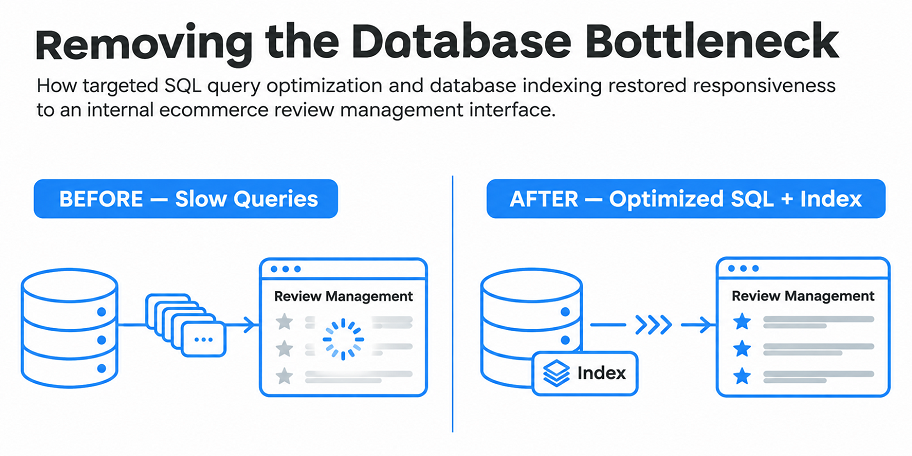
Another major improvement involved optimizing SQL reporting queries and adding a supporting database index for the product review management system.
The existing reporting queries caused substantial delays in the internal review management interface.
Our engineer analyzed the database performance bottleneck, optimized the relevant SQL queries, and added a database index to reduce execution time.
Together, these changes substantially reduced query execution time and removed the delays affecting review management.
Importantly, this work addressed the internal management system rather than a customer-facing page-loading problem.
The result: The review management interface became responsive again, removing a significant operational bottleneck.
Surgical schema and query-level adjustments resolved the issue without replacing the application or its database infrastructure.
3. Reducing Unnecessary Product Data Processing
The third improvement addressed how the platform reacted to product information updates from other parts of the retailer’s ecommerce ecosystem.
Previously, the system consumed a broad category of product-change notifications, even when many updates had no practical impact on its functionality.
Working with the retailer’s engineering organization, the team established which specific types of updates were necessary.
We then adapted the integration to process only the relevant types of product-change events.
This reduced unnecessary work and helped address the risk of excessive load on shared infrastructure.
The deployment strategy was equally important.
Before switching the production integration to the new mechanism, we tested it in a separate environment. The previous configuration remained available during the transition so the team could roll back if necessary.
Only after verifying the new mechanism could the old configuration be retired.
The result: More efficient product-update processing, with a controlled transition designed to limit operational risk.
Rather than treating deployment as a single irreversible event, the team made the transition a sequence of controlled, verifiable changes.
Beyond Performance: Maintaining a Complex Ecommerce System
Performance optimization was a key focus, but our engineer also addressed day-to-day issues within the existing platform.
Our engineer supported work involving:
- Resolving issues with duplicated product reviews.
- Correcting country-based filtering in the review management system.
- Adjusting data exchanged between interconnected components.
- Updating product-related information used in analytics and reporting.
- Investigating software behavior and technical compatibility issues.
Keeping an enterprise ecommerce platform reliable requires ongoing maintenance, careful integration work and the flexibility to adapt as business requirements change.
Collaboration: Integrating Into an Existing Enterprise Team
Our engineer joined the retailer’s established international development team, working alongside backend and frontend specialists, testers, technical leads and business analysts.
The team worked iteratively, with agile planning and regular communication supporting the ongoing development of the platform.
This arrangement allowed us to contribute technical expertise while working within established engineering processes.
Collaboration was particularly important when changes affected several systems. Optimizing product-update processing, for example, required coordination with people responsible for other parts of the ecommerce infrastructure.
The engagement also demonstrated how external specialists can contribute to an established technical organization without disrupting its internal ownership of the product.
Using AI as a Supporting Engineering Tool
During the engagement, our engineer used conversational AI tools to investigate selected technical problems and explore potential solutions.
To protect confidentiality, prompts were formulated in general terms without including client-specific code or confidential implementation details.
The tools helped speed up the investigation of certain software issues, while engineering expertise remained essential to evaluate and implement the solutions.
The broader lesson remains relevant: effective engineering depends not simply on the availability of tools, but on knowing when and how to use them responsibly.
What Ecommerce Performance Optimization Delivered
The project’s value came from solving specific problems in an already operational system.
Product-page performance targets met: Adjustments to resource-loading priorities helped achieve the client’s performance goals.
More efficient internal operations: Optimized reporting queries and a new database index eliminated a severe bottleneck affecting the internal review management interface.
Less unnecessary processing: Selective handling of product-change notifications reduced redundant work within the platform’s integrations.
Controlled deployment: A staged rollout allowed the team to validate the updated integration before retiring its predecessor.
Continued platform development: The improvements were delivered within an existing international ecommerce ecosystem rather than through a disruptive rebuild.
Together, these improvements strengthened the performance, efficiency and day-to-day management of an established ecommerce platform serving multiple international markets.
Why Ecommerce Performance Optimization Requires Continuous Attention
Enterprise ecommerce systems are never truly finished.
New markets introduce additional localization requirements. Business rules change. Integrations evolve and technical dependencies create new challenges.
In this environment, effective ecommerce performance optimization involves more than making a page load faster.
It requires understanding how individual components behave, how information moves between them and where small inefficiencies could create wider operational problems.
This case also shows why a complete rebuild is not always necessary.
When the underlying platform is already established, targeted improvements supported by careful testing and experienced engineering judgment can resolve important bottlenecks while protecting business continuity.
At Stermedia, we approach existing software systems with that perspective: understand the problem, identify the most effective intervention and validate the result.
Next Steps & Further Reading
If your ecommerce platform is experiencing slow page loads, database bottlenecks or growing pressure from interconnected systems, the best starting point is a focused technical performance assessment.
At Stermedia, we help companies improve and extend existing software platforms — identifying performance bottlenecks, optimizing complex integrations, and providing experienced engineers who integrate seamlessly with internal development teams.
Facing slow product pages, database bottlenecks, or inefficient integrations? Talk to Stermedia about improving your ecommerce platform without an unnecessary rebuild.
Continue reading:
- Extending the Java Team for the Enterprise Project. Striped Giraffe Case Study — a related case study showing how Stermedia provided experienced Java developers for an enterprise retail mobile application project.
- External Development Team: Stabilize Delivery — how experienced external engineers can support an internal team and reduce technical and delivery risks.
- Custom Software Development Company Supports Global QA for 5 Years — a case study of international collaboration, quality assurance and ongoing support for an established digital product.