Do you know how a Recruitment Management System helps professional recruitment agencies work from the inside and analyze tons of CVs in such a short time?
The secret lies not only in supporting the recruitment and retention process through artificial intelligence and machine learning but also in improving the operation of an RMS — Recruitment Management System. It is recruitment software or recruitment CRM as some prefer. It provides a faster and more efficient process for both recruiters and job applicants.
The dynamically changing labor market forces recruitment agencies to constantly look for ways to optimize processes. They face the challenge of improving the recruitment process. Our client, Work Service, had a similar challenge.
Work Service is the largest HR company in Poland that provides innovative solutions in the field of human resources and cooperates with over 3,000 employers. It also specializes in services in the field of personnel consulting and restructuring in the area of HR, recruitment, and employee outsourcing.
Work Service wanted the recruitment management system (RMS) — developed with Stermedia since 2013 — to be more intuitive and easier to use not only for candidates but, above all, for internal recruitment teams.
Recruitment Management System Challenges
Our team could implement most RMS improvements iteratively and release them directly into the production environment, so users could access them immediately. However, some tasks required our team to develop a larger set of extensions. We made those extensions available to users only after the entire company prepared for them. At the same time, we continued working on improvements that we could deliver to users on an ongoing basis.
Our development team faced the difficult task of simultaneously meeting the following requirements:
- Ongoing development and delivery of most functions to users
- Ongoing development of larger functions without providing them to users immediately, and enabling them only when the entire organization prepared for implementation and gave us the green light
- Creating an easy way to turn off selected functions if they caused unintended effects in the system or the organization’s operations
- Dynamic introduction of system changes when legal requirements changed, for example, when GDPR was introduced
- Easy integration of all work results
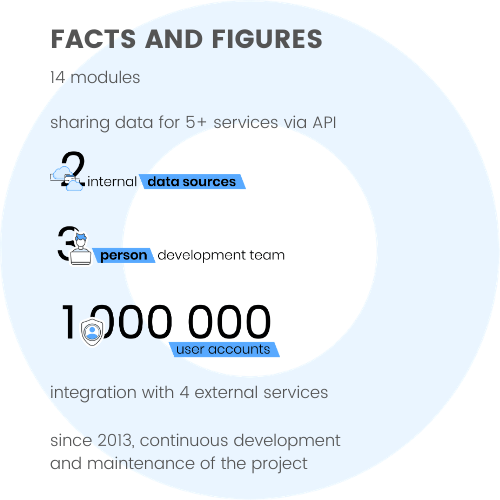
Recruitment Management System Solutions
Our team gradually modified subsequent elements of the recruitment system while keeping it operational throughout the entire project.
Modular Development Without Disruption
“When we started cooperation, our client already had an IT system for accepting and analyzing job applications,” says Maciej Michoń, software developer, Stermedia. “So we introduced the first changes with the help of technologies that were previously used in the project. However, when the changes were to cover a larger area of the system, we separated these areas into separate modules. This is how we were able to use newer tools that allowed us to achieve the desired results faster without affecting the rest of the system.”
With the first module that we thoroughly reworked, we thought about what tools to choose. We took into account, among others, JavaServer Faces (JSF). At that time, before the critical assessment from ThoughtWorks experts, this framework was quite popular and belonged to the Java EE standard managed by Oracle. Ultimately, however, we decided on a completely different solution.

We combined the Google-supported AngularJS library that allows you to build Single-page application (SPA) applications with a comprehensive set of tools included in the Spring Framework from Pivotal Software. We would certainly like all application modules to use the latest toolset. Thanks to this, our work would be as effective as possible.
Tomasz Kozakiewicz, Software Developer, Java Tech Leader, Stermedia
In the end, we used only the new Angular framework. Compared to its predecessor — AngularJS — it allows you to achieve more in a much easier way.
When we worked on the first modules, we could use only the older version of this tool.Luckily, the modular architecture of the recruitment software allows you to change it piece by piece. When making changes in one of the modules, you can use the new Angular in it.
Feature Toggles and Mobile Access
A technique called Feature Toggles was used in the software development process. It provides an alternative to keeping multiple versions of the program simultaneously. This allows a software feature to be tested even before it is completed and ready for release. In the project for Work Service, this made it possible to easily turn on or off selected functions as needed. At the same time, the ease of coordination of all introduced changes has been maintained. Our development team also adapted the application to work on mobile devices.
The Stermedia team stayed in constant contact with the client. We used a shared communicator, which helped everyone involved in the project cooperate asynchronously. Communication remained effective regardless of the client’s availability and ours.
Results of Improving the Recruitment Management System
The cooperation of Work Service and Stermedia brought the following results:
- Customization, module by module, of the entire application to better meet business goals
- Availability on mobile devices
- System integration with external websites, such as the Facebook application, mobile application, external websites implementing customer marketing campaigns
- Implementation of the possibility to publish job offers on one of the popular websites directly from the level of the application being developed
- Integration with machine learning matching system
- Ensuring continuous development of the application in accordance with the client’s further needs
- Future cooperation on new projects
Are you inspired?
Let’s talk about your idea.
Let’s talk
Next steps & further reading
If you want to explore how a Recruitment Management System or custom HR software can improve your recruitment process, the best starting point is a small, controlled analysis of your current workflows, system limitations, and integration needs.
At Stermedia, we help CEOs, HR companies, startups, and established organizations improve business-critical software — from needs analysis and system modernization to production deployment and long-term development.
Continue reading:
- Pros of a Machine Learning Matching System for HR — how machine learning can support matching candidates with recruitment needs.
- Revolutionizing the Recruitment Process Using Machine Learning — practical insight into how ML can improve recruitment workflows.
- 8 Ways to Use Artificial Intelligence and Automation to Support HR — broader examples of AI and automation in HR processes.