AI Consulting and Integration are no longer experimental add-ons reserved for innovation teams. For many organizations, artificial intelligence has become a practical tool for building products faster, scaling operations, and reshaping how work is done. As a result, AI consulting and integration are shifting from technology-focused discussions to strategic conversations about value, priorities, and long-term impact.
This change is particularly visible in how companies approach product development, internal processes, and decision-making at the leadership level—often with the support of a dedicated consulting team and clearly defined AI solutions.
How AI Consulting and Integration Are Changing the Meaning of MVP 2.0
The concept of an MVP has evolved significantly over the past decade. What was once a simple proof of concept has gradually turned into a complex, resource-intensive project. Expectations around speed, quality, and scope have grown—often to the point where “minimum” products are no longer minimal at all.
AI introduces a reset to this dynamic. With the right tooling, AI consulting services, and expertise in AI development, teams can once again build meaningful MVPs faster and at a lower cost. AI-assisted development enables a small team—or even a single experienced developer—to leverage AI tools to support and speed up the creation of code scaffolding, templates, test data, and early content, dramatically shortening the path from idea to a working product.
This shift is often described as MVP 2.0: not a more complex MVP, but a more efficient one. The goal is not to build more features, but to validate assumptions faster while maintaining high-quality outcomes.
Speed and Cost: What AI Really Changes
One of the most tangible effects of AI integration and AI implementation is the reduction of time and cost in early product stages. AI-supported workflows can realistically cut development effort by a significant margin, particularly in repetitive and standardized tasks supported by machine learning and generative AI.
However, the real advantage is not automation alone. AI changes team composition. Instead of assembling large teams upfront, organizations can rely on smaller, highly skilled teams supported by AI tools. This approach lowers initial investment and reduces risk while keeping the option to scale later.
Importantly, these gains only materialize when organizations implement AI deliberately. Without clear priorities, faster development can easily lead to feature creep and over-engineered MVPs that fail to validate the core idea.
Common Mistakes When Using AI for MVP Development
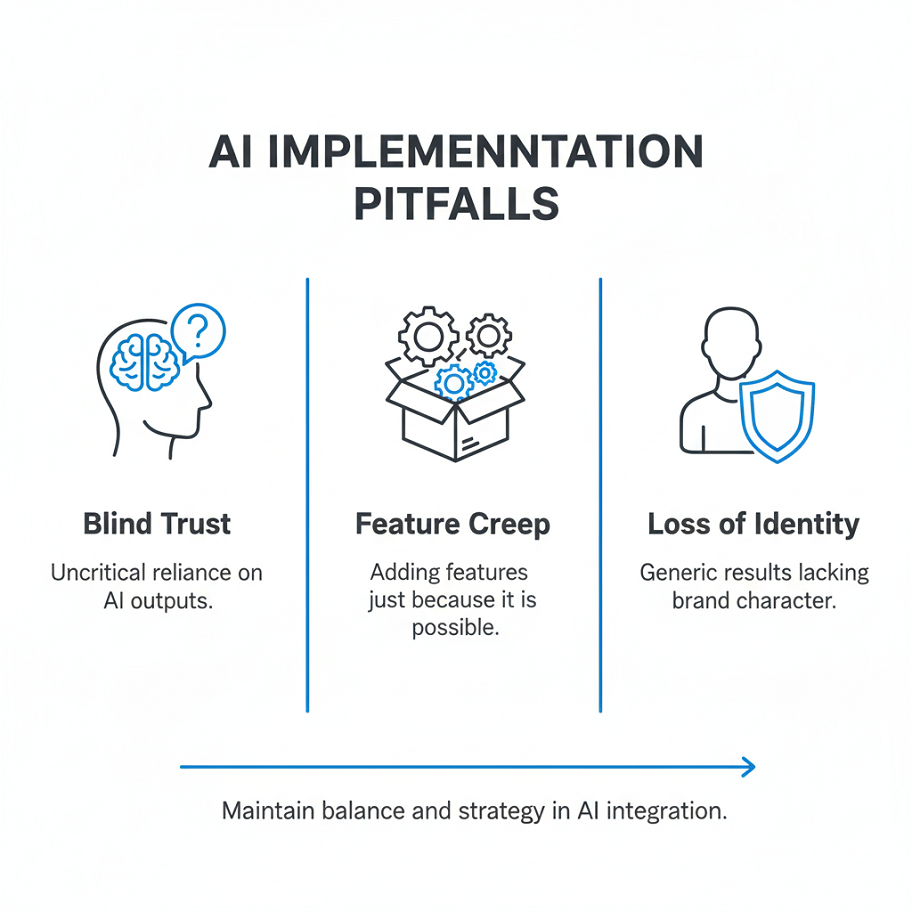
One of the most frequent mistakes organizations make is treating AI output as unquestionable. AI-generated code, content, or analysis still requires critical review. Blind trust leads to quality issues, technical debt, and misguided product decisions.
Another common pitfall is overusing AI simply because it is available. When every feature can be generated quickly, MVPs tend to grow beyond what is necessary. Instead of validating a hypothesis, teams end up building products that look complete but lack focus.
There is also a subtler risk: loss of identity. Products created entirely through generic AI outputs may feel interchangeable, lacking character or differentiation. Over time, users notice when products feel templated rather than thoughtfully designed.
Where AI Supports MVPs — and Where Human Expertise Remains Essential
AI excels at accelerating foundational work. Generating boilerplate code, initial tests, mock data, translations, and early drafts of content are all areas where AI provides immediate value. These tasks follow predictable patterns and benefit from automation powered by machine learning.
Human expertise becomes critical where judgment, strategy, and empathy are required. Defining product vision, designing complex interactions, setting quality standards, and understanding user behavior remain deeply human responsibilities. AI can support analysis, but it cannot replace the nuanced understanding required to build meaningful user experiences.
The most effective MVPs emerge from this balance: AI handles the repeatable groundwork, while people focus on decisions that shape the product’s direction.
From Experimentation to Strategic AI Integration
Many organizations begin their AI journey through experimentation. Individuals use AI tools ad hoc—to draft emails, summarize documents, or generate ideas. While useful, this approach does not create lasting value on its own.
Strategic AI integration starts when AI becomes part of defined processes and existing systems. Instead of occasional use, AI operates continuously within workflows: generating reports, supporting customer service, enriching data, or monitoring operations. At this stage, AI usage can be measured, optimized, and aligned with business objectives.
The key difference lies in intent. Experimentation explores possibilities. Integration delivers outcomes.
AI Consulting: Starting with Problems, Not Technology
A common misconception is that AI initiatives should begin with selecting models or tools. In practice, the most effective AI integrations start earlier – with identifying concrete friction points in everyday work across existing and legacy systems.
A typical example often seen in organizations is manual reporting – data is pulled from multiple systems, copied into spreadsheets, checked, and reformatted on a regular basis. While the process works, it consumes significant time from skilled employees and slows down decision-making.
Instead of starting with the question “Which AI model should we use?”, a more effective approach is to first map this workflow and identify repetitive, low-value steps. Only then does AI come into play—supporting data collection, generating draft reports, or highlighting anomalies for human review. The outcome is not full automation, but a more efficient process where people focus on interpretation and decisions rather than manual work.
This is where artificial intelligence consulting delivers real value: helping organizations frame the right problems first, define clear priorities, and apply AI deliberately – before any discussion about specific tools or technologies begins.
Organizational Readiness and Skills Matter More Than Tools
Technical barriers to AI adoption are lower than ever. Models and platforms are widely accessible. The real challenges are organizational.
Teams need the ability to critically evaluate AI outputs, adapt to rapid change, and translate business needs into technical requirements. Many organizations address this by establishing an internal AI center or competence hub that coordinates governance, standards, and knowledge sharing.
Without shared principles and processes, AI adoption can create confusion, resistance, or unintended consequences – even when the technology itself works well.
AI as a Sustainable Element of Business Strategy
For many organizations, the real shift happens when AI as a business strategy becomes a leadership priority rather than a purely technical initiative. Effective AI integration requires more than technical expertise. A reliable partner begins by understanding the business context before proposing specific solutions. Conversations focused solely on models, tokens, or tools are a warning sign – technology that is not anchored in business objectives rarely delivers lasting value.
At Stermedia, this approach means working at the intersection of strategy, technology, and real organizational needs. Consulting teams focus on business outcomes—user experience, operational efficiency, risk control, and scalable growth—treating technology as a means to an end rather than an end in itself.
Strong AI partners speak the language of results. This perspective ultimately determines whether AI becomes a one-off experiment or a sustainable part of a company’s long-term growth strategy.
Choosing the Right AI Partner
Effective AI integration requires more than technical expertise. One of the simplest ways to assess a potential AI partner is by looking at the questions they ask—and the questions they are able to answer.
Before committing to any collaboration, leaders should consider asking the following:
- What specific business problem are we trying to solve and how will success be measured?
A credible partner should be able to translate AI initiatives into concrete KPIs, such as reduced processing time, improved customer response rates, or lower operational costs. - Where will the data come from, and how reliable is it?
AI solutions are only as good as the data behind them. A strong partner will ask about data structure, ownership, quality, and existing sources of truth before proposing any implementation. - How will this solution fit into existing processes and systems?
AI should support workflows, not disrupt them unintentionally. Partners who understand organizations look beyond a single team or use case and consider downstream effects across departments. - What are the risks and who is responsible when something goes wrong?
Legal, compliance, and reputational risks cannot be an afterthought. Serious partners openly discuss governance, human oversight, and fallback procedures. - How will this scale or be adjusted over time?
Instead of one-off experiments, AI should evolve with the organization. A reliable partner thinks in terms of incremental rollout, measurement, and continuous improvement.
Partners who focus primarily on models, tokens, or tools often miss these questions entirely. The strongest AI partners start with outcomes, constraints, and accountability—using technology as a means to support business goals, not as an end in itself.
Looking Ahead: The Future of AI Consulting
As AI becomes embedded in everyday work, the role of AI consultants is evolving. Consultants increasingly act as orchestrators – managing not only teams of people, but also networks of AI agents performing research, analysis, and operational tasks.
The future of AI consulting lies in this hybrid model: humans setting direction and judgment, supported by AI systems that amplify their reach.
Conclusion
AI consulting and integration are no longer about adopting the latest tools. They are about redesigning how organizations build products, operate internally, and scale responsibly. When applied with discipline and clarity, AI enables faster MVPs, leaner teams, and more resilient strategies.
The real challenge is not whether to use AI but how to use it with purpose.
Next Steps & Further Reading
Turn AI strategy into measurable business outcomes.
At Stermedia, we help organizations move beyond experimentation and embed AI into real-world products, processes, and decision-making frameworks—safely, pragmatically, and at scale.
If you want to deepen your understanding of how AI delivers value in practice, explore these related insights:
- How Integrating a Chatbot into Your Website Will Turnaround Your Business
A practical look at how conversational AI and chatbots improve customer engagement, reduce operational load, and create scalable interaction layers in digital products. - Why Quality Assurance Is Essential in AI Projects
An in-depth perspective on why AI systems require rigorous validation, governance, and testing to remain reliable, explainable, and trustworthy in production environments. - AI Development – Your Strategic Partner in Building Modern Digital Products
How AI development, when aligned with business strategy, accelerates MVPs, supports long-term scalability, and enables sustainable product growth.