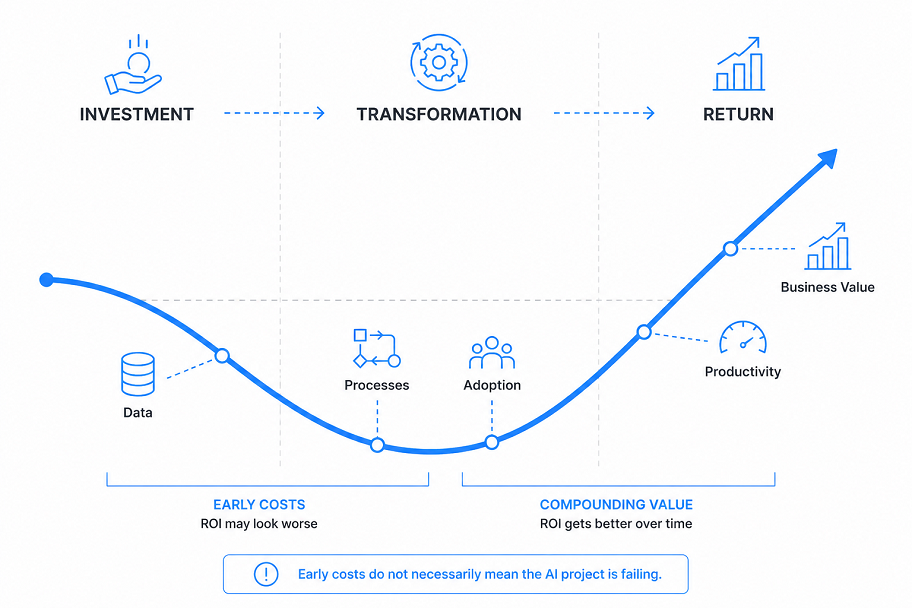
AI ROI is difficult to estimate when an AI project starts creating operational value months or even years before that value appears in the P&L.
This is increasingly common. Deloitte’s 2025 survey of 1,854 executives found that most organizations report a two-to-four-year timeframe for achieving satisfactory ROI from a typical AI use case. Only 6% reported payback in less than a year.
Does that mean companies should keep investing for years and simply hope the return arrives? No — it means they need a better way to measure whether the investment is moving toward a credible return.
Instead of asking only, “How much money has this system saved us so far?” leaders should track whether the project is moving through a credible chain of value:
Technical performance → adoption → operational improvement → financial impact
If that chain is visible, you can estimate return before the final number reaches the income statement.
Why AI ROI Often Looks Worse Before It Gets Better
AI is not usually a plug-and-play investment.
A company may need to improve data quality, redesign workflows, integrate the solution with existing systems, train employees, introduce human review and establish monitoring or governance.
All of this costs money before the organization captures the full benefit.
Economists describe a similar pattern as the productivity J-curve. New general-purpose technologies often require complementary investments before productivity accelerates.
Electricity provides a classic example. Early factories replaced steam engines with electric motors but initially kept almost the same production processes. Large productivity gains came later, when companies redesigned factories around what electricity made possible.
AI creates a similar challenge.
Adding an LLM to an inefficient workflow may make one task faster. Redesigning the workflow around AI can change the economics of the entire process.
That distinction matters when estimating AI ROI.
Start With the Business Baseline, Not the AI Model
Before estimating return, define what happens without AI.
For one specific process, measure:
- Current processing time
- Number of cases, documents or requests
- Labor involved
- Cost per transaction
- Error and rework rates
- Customer or employee waiting time
- Revenue or capacity constraints
- Existing outsourcing or infrastructure costs
Without this baseline, even a technically impressive pilot tells you very little about business value.
For example, saying an AI system has 90% accuracy is not a return calculation.
Saying it reduces the average review time from four hours to 30 minutes, while maintaining acceptable quality, gives you something you can translate into capacity and eventually money.
The use case comes first. The model comes second.
This is also why a structured discovery process matters. Before building the solution, teams need to understand the data, current workflow, technical feasibility and business outcome they actually want to improve. Our AI Software Development Guide describes how this can work in practice, from data audit and discovery to deployment and monitoring.
A Practical AI ROI Framework: Measure Four Layers
When financial benefits are delayed, use several layers of measurement instead of waiting for one final ROI number.
| Layer | What to Measure | What It Tells You |
|---|---|---|
| 1. Technical | Accuracy, completion rate, latency, human intervention, cost per run | Can the AI reliably perform the task? |
| 2. Adoption | Active users, usage frequency, successful workflows, user feedback | Is the organization actually using it? |
| 3. Operational | Cycle time, throughput, rework, quality, time to market | Is AI improving the business process? |
| 4. Financial | Cost per case, avoided hiring, incremental revenue, margin, revenue per employee | Is operational value reaching the P&L? |
The first three layers are often leading indicators.
Financial results are usually lagging indicators.
That does not make the early metrics less important. It makes them evidence that your financial assumptions are becoming more or less credible.
Convert Productivity Into Economic Value
One of the easiest mistakes in an AI business case is assuming that every hour saved translates directly into financial savings.
Imagine an AI workflow saves employees 2,500 hours per year.
That number represents potential capacity. The financial value depends on what happens to those hours.
Are they used to:
- Process more customer requests?
- Avoid hiring additional employees?
- Reduce overtime?
- Launch a product sooner?
- Perform higher-value work?
- Improve customer experience?
Or do employees simply have more unused capacity?
A useful way to make the estimate more realistic is to introduce a realization rate.
For example:
Potential capacity saved: 2,500 hours
Expected adoption: 70%
Expected realization of productive capacity: 60%
That gives you:
2,500 × 70% × 60% = 1,050 economically useful hours
You can then translate those hours into an estimated financial benefit using fully loaded labor cost, additional throughput, avoided hiring or avoided headcount growth, depending on the use case.
This prevents the business case from treating theoretical efficiency as guaranteed savings.
Do Not Reduce AI ROI to Headcount Reduction
Headcount reduction is easy to quantify, which makes it tempting as the default ROI metric, but it represents only one form of business value.
If AI allows the same team to process twice as many cases, shorten time to market, provide better customer service or reduce employee turnover, the business may create significant value without eliminating a single role.
Productivity is ultimately about output relative to input.
That means leaders should ask:
What can this team deliver with AI that it could not deliver before?
Depending on the project, relevant outcomes may include:
- More transactions per employee
- Higher customer retention
- Shorter product development cycles
- Faster document processing
- Better decision quality
- Lower error rates
- More sales capacity
- Reduced outsourcing
- Avoided future hiring
This is particularly important in AI projects designed to augment specialists rather than replace them.
Count the Full Investment Side of AI ROI
Delayed benefits are only half of the equation.
Organizations can also overestimate ROI because they underestimate the I — the investment.
The cost of an AI project is rarely limited to model licenses or development.
A realistic calculation should include:
- Discovery and feasibility analysis
- Data preparation and labeling
- Software development
- Model or API costs
- Cloud and infrastructure
- Integration with existing systems
- Testing and evaluation
- Human review
- Monitoring
- Security and governance
- Employee training
- Workflow redesign
- Change management
- Maintenance and further optimization
These costs also change as usage scales.
A pilot serving 20 people and a production system processing millions of requests have very different economics.
This is why AI cost visibility should extend down to individual use cases whenever possible.
Match AI ROI Expectations to the Project Phase
You should not expect the same evidence from a proof of concept as from a production deployment.
A better approach is to change the question at each stage.
| Project Stage | Main ROI Question |
|---|---|
| Discovery | Is the use case valuable and technically feasible? |
| Proof of concept | Can AI perform the task at an acceptable quality and unit cost? |
| Pilot | Do real users adopt it and does the workflow improve? |
| Production | Does the improvement create measurable financial value at scale? |
This creates natural stage gates at which the organization can decide whether to continue, modify or stop the initiative. Importantly, stopping early can also create value.
A relatively small discovery project that proves the available data is insufficient may prevent a company from spending hundreds of thousands of dollars on a system that would never work reliably.
In that case, the return comes not from new revenue but from avoiding further investment in a solution that is unlikely to deliver value.
From a Successful AI Pilot to Real ROI
A proof of concept can demonstrate that AI is capable of solving a task. It does not prove that the organization can generate value from it at scale.
Production introduces real data, users, exceptions, security requirements, integrations and operational constraints.
This is where many projects encounter the gap between AI capability and business capability.
The model may work, while the business case fails because:
- Employees do not use it consistently
- Human review takes longer than expected
- Integration creates additional work
- Infrastructure costs increase at scale
- The AI optimizes one task but not the end-to-end process
- Nobody owns adoption and workflow redesign
This is why enterprise AI needs more than a model. Turning a successful prototype into business value requires engineering, integration, process design, evaluation and continuous iteration.
Estimate Return Over the Right Time Horizon
For projects with delayed benefits, a 12-month ROI calculation can be misleading.
Consider forecasting value across a longer horizon, such as 24 or 36 months.
A simplified model is:
Expected benefit = potential business benefit × expected adoption × realization rate
Then compare the expected benefits across the selected period with the total cost of building, integrating, operating and improving the system.
For larger investments, future cash flows can also be discounted to present value using an NPV model.
The purpose of the exercise is not to manufacture a precise ROI figure, but to make the assumptions behind it visible and testable.
A useful AI business case should show:
- What must happen for the return to materialize
- Which assumptions are already validated
- Which assumptions remain uncertain
- How long the organization expects validation to take
- What would cause the project to stop
This turns ROI from a one-time spreadsheet into an ongoing management tool.
How to Know Whether Delayed AI ROI Is Still on Track
A project does not need immediate financial payback to be healthy, but it does need measurable evidence that it is progressing toward the expected business outcome.
Good signals include:
- Adoption is increasing
- Human intervention is decreasing
- Quality is stable or improving
- Processing time is falling
- Unit economics improve with scale
- Users incorporate AI into real workflows
- Operational KPIs are moving toward the original business target
Warning signs include:
- Employees rarely use the system
- AI works in a demo but not in the real workflow
- Costs grow faster than usage
- Human correction eliminates the expected efficiency
- Nobody established a baseline
- The project has technical metrics but no business metric
- No one can explain how productivity gains will become revenue, savings or capacity
The distinction is simple:
Delayed ROI is acceptable. Unmeasured ROI is not.
Manage AI as an Investment Portfolio
Not every AI initiative will succeed, and that is normal. The problem begins when organizations run dozens of disconnected experiments without comparing business value, risk, cost and implementation complexity.
A better approach is to manage AI initiatives as a portfolio and prioritize projects that combine:
High business value + usable data + realistic adoption + manageable risk
The portfolio can then be reviewed regularly as evidence, costs and priorities change.
Some projects should move from pilot to production. Some need another iteration. Others should be stopped so that budget and engineering capacity can move to higher-value opportunities.
Over time, successful AI projects can also make future projects cheaper.
Shared infrastructure, cleaner data, reusable integrations, organizational know-how and stronger governance become assets that the next implementation can use.
That indirect value is easy to miss in a single-project ROI calculation.
AI ROI Is an Estimate Before It Becomes a Result
The objective is not to prove in advance that every AI project will generate a return, but to reduce uncertainty systematically as evidence accumulates.
Start with a measurable business problem. Establish the baseline. Track technical performance and real-world adoption. Connect operational gains to financial outcomes. Include the full cost of implementation and update your assumptions as the project moves from discovery to production.
Most importantly, do not wait for the final P&L number before asking whether AI creates value.
By the time financial ROI becomes obvious, the operational evidence should have been visible for months.
Next Steps & Further Reading
If you want to estimate AI ROI before committing to a full-scale implementation, the best starting point is a small, controlled discovery or pilot with a clear baseline, measurable outcomes and predefined stage gates.
At Stermedia, we help leadership teams identify high-value AI use cases, build a realistic business case, validate technical feasibility and move the strongest opportunities from discovery to production.
Learn more about our approach to AI consulting and integration.
Want to discuss your project? Contact our AI team.
Continue Reading:
- AI Consulting and Integration as a Business Strategy — how to move from AI experimentation toward measurable business outcomes inside real workflows.
- Working With Stermedia – AI Software Development Guide — how we approach AI projects from data audit and discovery through prototyping, deployment and continuous improvement.
- Forward Deployed Engineering: Why Enterprise AI Needs More Than a Model — why production AI depends on integration, workflow design and implementation rather than model capability alone.