Healthcare AI development is moving fastest where medicine is already text-heavy: patient questions, symptom intake, inbox messages and follow-up support.
That does not mean the “AI doctor” has arrived. It means large language models are becoming useful enough to support selected parts of healthcare communication — if teams define what the system can do, where it must stop and when a clinician takes over.
For HealthTech founders and healthcare organizations, that distinction matters. A model that can answer a medical exam question is not automatically ready to advise a worried patient. A chatbot that sounds empathetic is not necessarily safe. And a system that performs well in a controlled benchmark may behave differently when it meets incomplete histories, ambiguous symptoms and real clinical workflows.
The practical opportunity is less dramatic than the hype, but much more useful: build AI that helps collect information, retrieve trusted knowledge, prepare responses, identify cases that need attention and support clinicians without hiding uncertainty.
Where Healthcare AI Development Creates Value Today
Healthcare is particularly well suited to language-based AI because so much work revolves around unstructured information.
Patients describe symptoms in their own words. Clinicians review long charts, search guidelines, respond to messages and translate medical terminology into understandable explanations. Care teams also need to decide which request can wait, which needs a clinician and which may require urgent escalation.
Modern clinical AI solutions can support each of these steps. The real question is not whether an LLM can produce a convincing response. It is whether the entire product can produce a useful, controlled and reviewable outcome inside a real workflow.
That is why lower-risk communication and information tasks are usually a better starting point than autonomous clinical decisions.
Healthcare AI Development for Medical Q&A: Beyond a Chatbot
Medical question answering may seem straightforward, but the term covers at least two distinct use cases.
The first is knowledge retrieval. A clinician, researcher or patient asks a question, and the system searches a controlled medical knowledge base, identifies relevant information and generates an answer based on those materials.
This is a natural fit for retrieval-augmented generation. Instead of expecting the language model to rely only on information encoded during training, the system can retrieve current protocols, internal documents, clinical guidelines or other approved sources before generating its response.
Retrieval-augmented generation can reduce unsupported answers by grounding responses in approved materials, but it cannot guarantee clinical accuracy. Teams still need to check the quality and currency of source documents, retrieval relevance and whether an answer is appropriate to the specific task.
The second use case is harder: patient-specific medical Q&A.
A patient rarely presents a complete case. They may type, “Do I need to worry about this headache?” or “Can I get a referral?” The system does not yet know what a clinician would normally establish through history taking: onset, duration, severity, associated symptoms, medications, previous conditions and possible red flags.
A useful patient-facing system therefore cannot simply answer. It may need to ask before it answers.
Healthcare AI Must Handle the Full Conversation
Traditional AI benchmarks often give a model most of the relevant information upfront. Real medicine works differently. Clinicians have to discover information through conversation, decide which follow-up question matters and update their thinking as new details appear.
Patient-facing AI has to support a similar process.
It needs to understand an initial complaint, ask relevant follow-up questions, preserve context across multiple turns and communicate in language the patient understands. At the same time, it must recognize uncertainty rather than force every conversation toward a confident conclusion.
That makes conversation quality part of clinical quality.
A technically correct answer can still create a poor patient experience if the system asks confusing questions or ignores what the patient has already said. Likewise, a fluent conversation can become dangerous if the system sounds confident while missing clinically important information.
For healthcare AI development, evaluating only the final answer is therefore not enough. Teams also need to evaluate how the system gathers information and when it decides that a human should take over.
AI Triage Is a Routing Problem Before It Is a Diagnosis Problem
Triage is one of the most attractive applications of AI in HealthTech because it addresses a real operational challenge.
Digital healthcare channels create enormous volumes of requests. Some are administrative. Some can be handled asynchronously. Some require a routine appointment. A smaller number may contain signals that justify rapid clinical attention.
AI can help organize that traffic, but triage does not need to solve the entire diagnostic problem to create value.
Clinical triage assesses urgency and appropriate care pathways; it is not simply administrative message routing. An AI-assisted triage process therefore needs clinically validated warning criteria, explicit escalation rules and a safe handoff to qualified professionals.
Consider two patients asking for the same specialist referral. One may have a routine issue. The other may describe an apparently similar problem that, after several follow-up questions, reveals warning signs requiring a different pathway.
The most valuable role of AI is not necessarily to identify a diagnosis. It may be to identify that these conversations should not follow the same workflow.
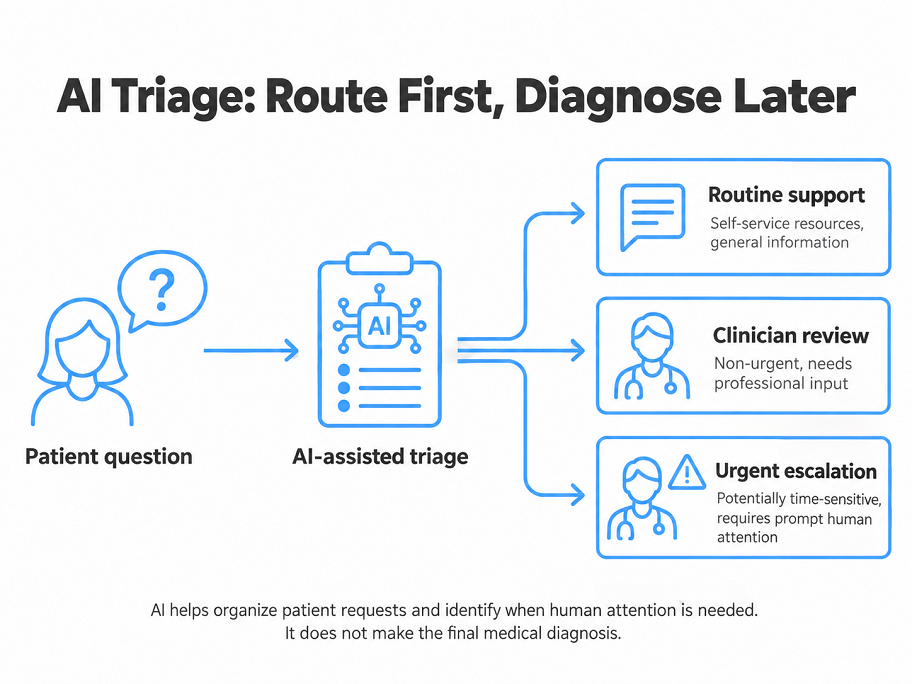
A well-designed system can gather structured information, detect predefined warning patterns, classify the request and escalate cases that exceed its safe operating boundary. The clinician remains responsible for clinical judgment.
That is much more realistic than positioning every symptom checker as a virtual physician.
Why Patient-Facing AI Needs Clear Escalation Rules
The cost of an error changes dramatically depending on the task.
If an AI assistant writes an awkward administrative draft, a human can fix it. If it summarizes a chart incorrectly, a clinician reviewing the summary may catch the problem. But if a patient-facing tool incorrectly reassures someone who needs urgent care, the consequences can be much more serious.
Risk should therefore shape autonomy.
A practical architecture can combine several controls:
- Defined task boundaries: Specify exactly which workflows the AI can handle.
- Grounded answers: Use approved medical content and relevant patient context.
- Structured escalation: Define rules for red flags, ambiguity and high-risk situations.
- Human review: Keep clinicians involved where incorrect output could cause harm.
- Traceability: Log inputs, retrieved information, outputs, edits and escalations.
- Continuous evaluation: Monitor failure patterns and model behavior after deployment.
The goal is not to pretend every error can be eliminated. It is to understand failure modes, reduce preventable risk and make sure the workflow reacts safely when the AI reaches its limits.
Patient Support: A Near-Term Opportunity for Healthcare AI Development
Some of the strongest near-term opportunities sit between administrative automation and clinical decision-making.
Patient portal messages are a good example. A patient may ask what a laboratory result means, whether a medication should be renewed, how to prepare for an appointment or what to do after a visit.
An AI-powered patient support system can analyze the message, incorporate available context and prepare a first draft for the care team. The clinician then reviews, edits and sends it.
This sounds less revolutionary than an autonomous medical chatbot. Operationally, it may be far more valuable.
The benefit is also not limited to minutes saved. Creating an answer from scratch and reviewing a useful draft are different cognitive tasks. In a five-week, single-group quality-improvement study at Stanford Medicine involving 162 clinicians (73 of whom completed both before-and-after surveys), AI-generated reply drafts were associated with lower survey-reported task load and work exhaustion scores, but no measurable reduction in message-handling time. Because there was no concurrent control group, the study cannot establish that AI caused those improvements.
That is an important lesson for HealthTech teams: do not measure value only through time saved. Cognitive load, adoption, quality, patient experience and workflow fit can matter just as much.
“Empathetic” AI Still Needs Human Judgment
Language models are very good at producing text that sounds patient, supportive and empathetic.
That can improve communication. Medical terminology can be translated into plain language, and instructions can be adapted to different levels of health literacy.
But sounding empathetic and being empathetic are not the same thing.
Patients may react badly to generic emotional language when they are frightened or trying to reach a clinician. Overly polished responses can also create false confidence in the system itself.
Good patient-facing AI needs more than a tone prompt. Teams should test whether messages are clear, appropriate and useful in context. They should also make the role of AI transparent enough that patients understand where clinical responsibility sits.
Trust is part of the product.
Where Healthcare AI Development Gets Risky
The biggest risk is often not an obviously absurd hallucination. Those are relatively easy to notice.
A more difficult failure is a response that looks reasonable.
A model may overlook one detail in a long chart, interpret a symptom without enough context or generate advice that is broadly correct but inappropriate for one patient. Because the language is fluent, users can become less likely to challenge it.
That creates automation bias.
The same problem can affect clinicians. Human review only protects the workflow if the reviewer is actually reviewing. As teams become accustomed to consistently useful outputs, there is a natural temptation to approve them faster. A meaningful review workflow should expose supporting evidence, highlight uncertainty, allow the clinician to edit or reject suggestions and record the final decision rather than encourage one-click approval.
For HealthTech companies, “human in the loop” cannot be a checkbox in a presentation. The product has to make meaningful review practical.
Build Grounding, Context and Guardrails Around the Model
A production healthcare AI product is much more than an API call to a language model.
A medical Q&A system may need retrieval from validated documents. A patient-support assistant may need controlled access to relevant EHR data. A triage workflow may combine generative conversation with deterministic clinical rules. A clinician dashboard may need to show why a case was escalated.
This surrounding architecture often determines whether the product is usable and safe.
It also creates a sensible division of labor. LLMs can handle natural language, summarize complex information and generate drafts. Traditional software can enforce permissions, workflow states, validation rules and escalation logic.
In safety-sensitive products, combining probabilistic AI with deterministic software is often more practical than asking one model to manage the entire process.
Healthcare AI development also requires early consideration of privacy, security and regulatory requirements. Depending on its intended purpose, a clinical AI system may fall within medical device regulations, while processing patient health data requires appropriate legal grounds, access controls and safeguards. In the European market, teams should assess the applicability of GDPR, the Medical Device Regulation and the EU AI Act before deployment.
Measure the Workflow Before You Scale It
In healthcare AI development, an impressive demo should not lead directly to broad deployment.
A controlled pilot should address clearly defined business and clinical questions.
For a patient-message assistant, that might mean testing whether clinicians find drafts useful, how much editing is required, whether workload feels lower and whether message quality remains acceptable.
For triage, teams need to know whether high-risk cases are escalated correctly, how often the system over-escalates routine requests and what happens when information is incomplete. For safety-critical pathways, teams should track sensitivity, false-negative rates and time to escalation against clinician-reviewed cases, and examine performance across relevant patient subgroups.
For medical Q&A, teams may prioritize factual accuracy, grounding, clinical relevance, traceability and the system’s ability to say that it does not have enough information.
The metrics should match the workflow. Longer term, organizations should also track adoption, patient experience, clinician well-being, operational costs, error patterns and patient outcomes where relevant.
A model score alone does not tell you whether the product works.
Start With the Lowest-Risk Valuable Workflow
For a HealthTech startup, it can be tempting to make the most autonomous feature the centerpiece of the product.
The safer strategy is often the opposite.
Start where AI provides meaningful value but errors remain detectable and recoverable. Gather real feedback. Learn where clinicians and patients ignore the system, where they trust it too much and where it creates extra work instead of reducing it.
Then expand autonomy only where the evidence supports it.
Instead of trying to solve “AI healthcare” as one enormous problem, validate a specific question: Can the system produce useful patient-message drafts? Can it collect a structured history before a visit? Can it route selected requests without increasing safety risk?
These are questions a pilot can answer.
The Opportunity Is Better Care Infrastructure, Not an AI Doctor
The most realistic future of healthcare AI may not be one chatbot replacing a clinician.
It may be a set of specialized capabilities embedded throughout the patient journey.
Before an appointment, AI can gather symptoms and prepare a concise summary. During the visit, it can support documentation and retrieve relevant information. After the visit, it can help generate understandable instructions. Between visits, it can assist with routine questions, organize inbox traffic and escalate cases that need professional attention.
Clinicians retain responsibility for clinical decisions, while technology providers and healthcare organizations have their own accountability obligations. Software can handle more of the information work surrounding those decisions.
That model is less spectacular than the promise of autonomous medicine. It is also much closer to something HealthTech companies can design, evaluate and deploy today.
For teams building these systems, the FUTURE-AI framework for trustworthy and deployable healthcare AI is a useful external reference. Developed through international expert consensus, it organizes healthcare AI around six principles: fairness, universality, traceability, usability, robustness and explainability.
Next Steps & Further Reading
If you want to explore how healthcare AI development can improve medical Q&A, patient communication or triage, the best starting point is a small, controlled pilot with a clearly defined workflow, risk boundary and success criteria.
At Stermedia, our healthcare AI development team helps CEOs, HealthTech startups and established organizations move from an AI concept to a working product — from needs analysis and proof of concept to integration, validation and production deployment.
Planning a medical Q&A, AI triage or patient support solution? Talk to our AI development team about validating your use case, defining safety requirements and building a focused pilot.
Continue Reading
- AI in Healthcare for Medical Question Answering — see how Stermedia built a domain-specific Q&A engine for complex medical documentation.
- AI Healthcare Platform Transforms Primary Care in Saudi Arabia — explore a patient-facing HealthTech MVP built around symptom collection and AI-assisted health information.
- Why Quality Assurance Is Essential in AI Projects — learn why testing, expert review and monitoring need to accompany AI throughout development.