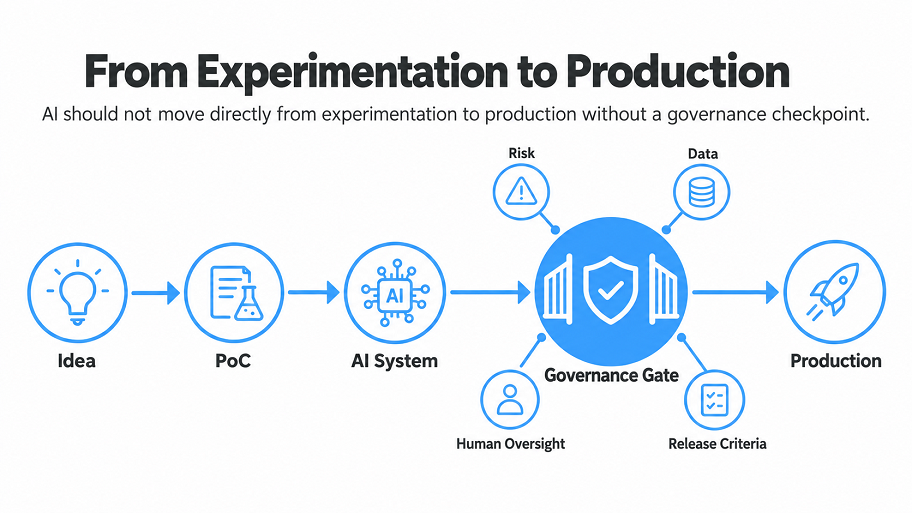
An AI governance framework should exist before your first production use case — not as a final compliance review, but as part of how the system is designed.
This matters as companies move from experiments to AI systems that interact with customers, access internal data, recommend decisions or perform actions.
A proof of concept can rely on temporary manual workarounds. A production system needs documented, repeatable and monitored fallback procedures instead.
Before deployment, organizations need clear answers to questions such as:
- Who owns the system and its outcomes?
- What data can it access?
- Which actions can it perform independently?
- When must a human intervene?
- What happens when the system produces an unacceptable result?
If these questions appear only during a final production review, many important architectural decisions have already been made.
The better approach is to define a lightweight AI governance framework early and make controls proportionate to the actual risk of the use case.
Why an AI Governance Framework Starts Before Production
AI governance is often treated as something that follows innovation.
First, the team proves that AI works. Then security, legal and compliance review the solution before release.
That sequence often exposes important design constraints too late.
Imagine an AI agent designed to analyze customer requests, access internal systems and perform selected actions. After development, the organization decides that some actions require human approval.
That is no longer just a policy change. It may require changes to orchestration, permissions, integrations, logging and the user interface.
The same applies to data.
If a solution is designed around broad access to corporate information and data restrictions are introduced later, the architecture may have to be redesigned.
Many governance decisions are therefore architecture decisions in disguise.
The earlier they are defined, the easier and cheaper they are to implement.
What an AI Governance Framework Needs to Control
Enterprise AI governance does not need to start with a large committee or dozens of policies.
It should start with clarity.
For every AI system moving toward production, an organization should be able to define:
| Area | What Needs to Be Clear |
|---|---|
| Purpose | What the AI should and should not do |
| Ownership | Who owns the business outcome, technology and risk |
| Risk | What can go wrong and what level of risk is acceptable |
| Data | What information the system can access and process |
| Autonomy | What it can do without human confirmation |
| Quality | What conditions must be met before release |
| Traceability | What inputs, outputs, decisions and changes are recorded |
| Incidents | Who acts when something goes wrong |
| Monitoring | What is monitored after deployment |
This is the foundation of a practical AI governance operating model.
The objective is not to eliminate every possible risk. It is to understand which risks the company accepts, which it reduces and which should stop a system from entering production.
Build an AI Inventory
You cannot govern AI systems you do not know exist.
This becomes increasingly difficult as teams adopt AI independently.
Marketing may use generative AI for content. Legal may analyze contracts with an external tool. Developers may use coding agents. Customer service may experiment with an AI assistant.
None of these initiatives necessarily looks like a formal AI project.
An AI governance framework should therefore include a simple AI inventory.
For each system, track information such as:
- business purpose,
- owner,
- users,
- model or provider,
- data sources,
- integrations,
- level of autonomy,
- risk category,
- production status,
- last review date.
The inventory should provide visibility, not create unnecessary administration.
For third-party services, also record model versions, provider dependencies and relevant data-handling arrangements so a material provider change can trigger reassessment.
Leadership should be able to answer basic questions:
- How many AI systems are in use?
- Which ones interact with customers?
- Which ones access sensitive data?
- Which ones can execute actions?
- Which ones depend on third-party AI providers?
Without this information, governance becomes reactive.
Define Ownership and Decision Rights
Every production AI system needs clear ownership.
There may be a business owner responsible for the outcome, a technical owner responsible for architecture and additional stakeholders responsible for data, security or compliance.
The exact organizational structure matters less than clear decision rights.
Teams should know:
- Who approves production deployment?
- Who can accept a known limitation?
- Who approves access to new data?
- Who decides where human approval is required?
- Who can suspend the system?
- Who decides whether a model update requires new validation?
Clear ownership prevents two common problems: decisions becoming stuck between departments or being made informally by whoever happens to be closest to the project.
Governance should define escalation paths before the difficult case appears.
How to Match an AI Governance Framework to Risk
Not every AI system needs the same level of control.
An internal assistant summarizing public information creates a very different risk profile from an AI system making recommendations that affect patients, customers or financial decisions.
Using the same process for both creates bureaucracy.
Using minimal controls for both creates unnecessary exposure.
A practical AI governance framework applies controls according to the risks of each use case.
A low-risk internal use case may require basic documentation, approved data sources and periodic review.
A customer-facing AI system may require stronger testing, transparency, monitoring and escalation mechanisms.
A system involved in consequential decisions or autonomous actions may require independent validation, tighter access controls, human oversight and formal production approval.
Risk tiers used for internal governance should not be confused with legal classifications. For EU deployments, assess whether the application falls within the EU AI Act and its specific requirements; where personal data is processed, GDPR obligations apply independently. A customer-facing interface alone does not automatically make a system legally “high-risk”.
The principle is simple:
Governance effort should increase with potential impact.
This also helps delivery teams. Instead of discovering new requirements before launch, they know the expected controls from the beginning.
Define What AI Can Do Without a Human
Early generative AI initiatives often focused on the quality of answers.
With AI agents, another question becomes critical:
What can the system do without a person confirming the action?
An assistant may only generate information.
An agent can potentially retrieve data, update records, call APIs, create tickets or trigger business processes.
As autonomy grows, so does the potential impact of failure.
Before production, define:
- which systems the AI can access,
- which tools it can use,
- which data it can modify,
- which actions require human approval,
- when a case must be escalated,
- what execution or transaction limits apply,
- what conditions stop the process automatically.
Human-in-the-loop also needs to mean more than displaying an “Approve” button.
The reviewer needs enough context and authority to challenge the AI when judgment matters.
For sensitive actions, approval should be bound to the specific operation before it executes, with a record of the approver, the requested change and the final outcome.
Make Responsible AI a Release Gate
Statements such as “the AI should be safe and accurate” are too vague for production.
An AI governance framework needs measurable release criteria, not just general principles.
Before deployment, determine what must be demonstrated in several areas.
Accuracy and groundedness: Are outputs reliable enough for the intended purpose? Can important information be linked to trusted sources?
Privacy and security: Does the AI respect access restrictions and protect sensitive information?
Safety: How does it respond to unexpected, harmful or adversarial input?
Transparency: Do users understand that they are interacting with AI and what its limitations are?
Human oversight: Can important decisions or actions be reviewed and overridden?
Operational reliability: What happens when the model provider, API or retrieval system fails?
Make the release gate auditable: test on a representative evaluation dataset, define quality and error thresholds for the intended workflow, verify that unauthorized tool calls are blocked, and rehearse escalation and rollback. There is no universal accuracy threshold that makes every AI system safe for production.
The objective is not to create perfect AI.
It is to define what “good enough for production” means before the team becomes committed to shipping the system.
The practical consequence is that model behavior, data sources, access boundaries and human approval workflows should be defined during system design rather than added at the final release review.
Keep the System Traceable
When an AI system produces an unexpected result, the organization needs to understand what happened.
Depending on the application, useful records may include:
- model and model version,
- prompt or workflow version,
- retrieved information,
- tools or APIs used,
- actions executed,
- human approvals,
- errors,
- escalations.
This is especially important because production AI systems rarely consist of only one model.
A wrong answer may come from incorrect source data, retrieval, permissions, integration logic or an external API.
Audit logs also require governance: restrict access, minimize personal and confidential data, and define a retention period appropriate to the purpose and applicable obligations.
Traceability turns “the AI made a mistake” into an issue that can be investigated.
Maintain Your AI Governance Framework After Go-Live
Production approval is not the end of an AI governance framework.
Models change. Data changes. Usage patterns change. Providers release new versions. Teams add integrations. Users discover new ways to use the system.
An AI solution that passed review at launch may behave differently several months later.
Organizations therefore need to define:
- production metrics,
- acceptable thresholds,
- review frequency,
- escalation triggers,
- incident ownership,
- change management,
- revalidation rules,
- rollback procedures.
The international standard ISO/IEC 42001:2023 specifies requirements for establishing, maintaining and continually improving an AI management system. It supports organization-wide governance but does not replace system-specific validation or applicable legal requirements.
For low-risk applications, basic operational monitoring combined with periodic review may be sufficient.
For high-autonomy systems, organizations may need real-time monitoring, strict permission boundaries and technical mechanisms capable of stopping execution quickly.
Agentic AI Raises the Governance Bar
AI agents make governance more important because they introduce execution risk.
A model can generate a wrong answer.
An agent can act on one.
The more autonomy an agent receives, the more important identity, permissions and technical safeguards become.
An agent should not automatically receive broad system access simply because the person using it has those permissions.
Access should match the specific task.
For highly autonomous agents, governance may also require execution limits, dedicated identities, circuit breakers and kill switches. OWASP guidance on agent and MCP security emphasizes least agency: each agent should receive only the access, tools and autonomy needed for its task.
A useful principle is:
Autonomy should not grow faster than governance.
If an AI moves from suggesting an action to performing it, the controls around that system should change as well.
A Practical AI Governance Framework Checklist
Before an AI system moves into production, teams should be able to answer:
What is the intended use?
Define what the system should and should not do.
Who owns it?
Name the business and technical owners.
What is the risk level?
Consider operational, financial, security, regulatory and human impact.
What data can it access?
Define sources, permissions and sensitive data boundaries.
What can it do autonomously?
Document actions it can execute without confirmation.
Where must a human intervene?
Define approval and escalation points.
What are the release criteria?
Set measurable quality, safety and operational thresholds.
Can we reconstruct what happened?
Ensure important actions and decisions are logged.
What happens when something goes wrong?
Define incident ownership, rollback and escalation.
How will the system be monitored?
Assign metrics, thresholds and responsible people.
Who can stop it?
For higher-risk AI, the answer should be explicit.
The NIST AI RMF Playbook (Govern function) recommends defining AI risk responsibilities, maintaining an inventory of AI systems and matching governance activities to organizational risks.
Start Small, but Govern From the Start
You do not need to build an enterprise-wide governance organization before testing your first AI use case.
Start with one project.
Define its purpose.
Assign ownership.
Classify the risk.
Set data and autonomy boundaries.
Agree on release criteria.
Design human oversight.
Define monitoring and incident procedures.
Then build.
With each use case, reuse the controls that work and improve the ones that do not.
Over time, these practical decisions become your enterprise AI governance model.
The goal is not to slow AI adoption.
It is to make it easier to move AI from experimentation into production without losing control.
Next Steps & Further Reading
If your organization is preparing to move an AI solution into production, start with one use case and define the minimum controls required to operate it safely, measure its value and scale it if it works.
At Stermedia, we help companies move from AI ideas to production systems — including discovery, proof of concept, architecture, integration, evaluation and deployment.
For teams looking for a practical, vendor-neutral reference, the NIST AI Risk Management Framework provides a useful structure for identifying, measuring and managing AI risks across the full system lifecycle. It is especially helpful when defining ownership, risk tolerance, monitoring and governance processes before an AI system moves into production.
Want to discuss your project? Contact our AI team.
Continue Reading:
- AI Readiness Assessment: Process Before Model Choice — how to determine whether your processes, data and organization are ready for production AI.
- How to Scope an AI Proof of Concept That Drives a Decision — how to design an AI pilot around evidence and measurable success criteria.
- AI Implementation Roadmap: From Ideas to Delivery — how to prioritize AI opportunities and move them from experimentation to production.