AI Consulting for NLP Solutions has become one of the most reliable ways for technology leaders to move beyond experimental NLP prototypes and build conversational AI or recommendation systems that actually work in production.
Natural Language Processing is no longer a differentiator by itself. The real challenge today is not whether NLP can be built, but how it can be delivered safely, scaled responsibly, and maintained without burning budget or organizational trust.
For founders and CEOs developing AI-driven products, NLP success depends far less on model choice — and far more on infrastructure, operational maturity, and the right delivery approach.
NLP in Practice: Where It Truly Delivers Value Today
Despite the hype around large language models, the most successful NLP implementations remain surprisingly pragmatic.
In production environments, NLP delivers consistent value in areas such as:
- Conversational AI for customer support, onboarding, and internal knowledge access
- Recommendation systems that personalize content, products, or next-best actions
- Text classification and routing, enabling automation at scale
- Semantic search and document understanding for complex knowledge bases
What these use cases share is not cutting-edge research, but robust system design — especially in areas such as optimizing NLP processing pipelines, intent handling, and real-time text understanding integrated into production systems.
Why Most NLP Projects Never Make It Past Proof of Concept
One recurring theme from experienced practitioners is clear:
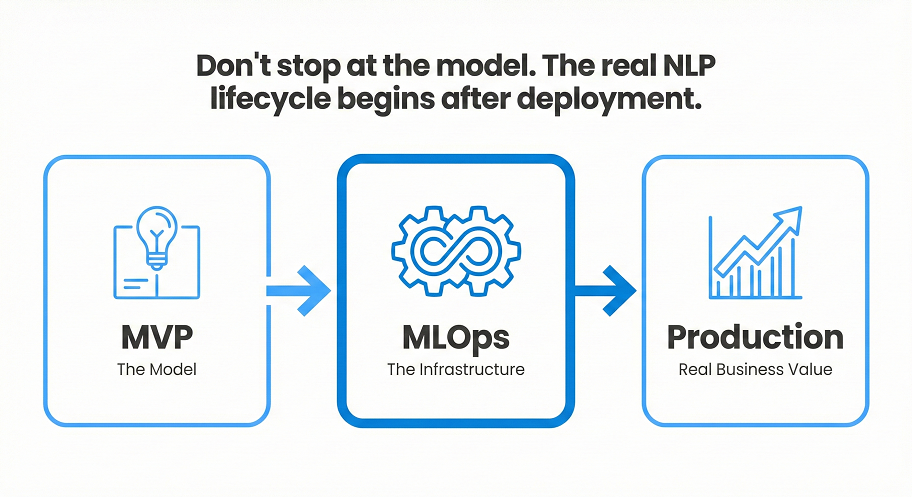
the lifecycle of an NLP system begins after deployment, not after training.
Many NLP initiatives fail because they stop at the model level. In practice, production NLP systems must handle:
- data drift and changing language patterns,
- evolving user behavior,
- cost constraints from inference at scale,
- compliance, security, and auditability requirements.
Another common mistake is the search for the “AI unicorn” — a single engineer expected to master NLP modeling, cloud infrastructure, DevOps, security, and domain expertise. This role does not exist at scale. Mature organizations separate responsibilities across engineering, data, and operations, aligning effort with the risk and impact of the use case.
A poorly deployed NLP system can be more damaging than no system at all. Incorrect predictions, biased outputs, or system outages can undermine user trust and business credibility — sometimes permanently.
AI Infrastructure & MLOps: The Foundation of Production NLP
To understand why many NLP projects stall, it helps to reverse the usual thinking.
NLP does not come first. Infrastructure does.
Modern NLP systems rely on the same operational principles as production-grade machine learning:
- automated data pipelines,
- reproducible training and deployment,
- model versioning and rollback,
- monitoring for performance and concept drift,
- security and access control by design.
Without these foundations, NLP systems become brittle and expensive to maintain — which is exactly why AI Consulting for NLP Solutions must include infrastructure design, governance, and long-term operational planning.
This operational reality is well described in Google’s overview of MLOps practices, which highlights continuous delivery, monitoring, and governance as core requirements for production-grade machine learning systems.
This is where MLOps becomes critical — not as tooling, but as an organizational discipline. MLOps brings together software engineering, machine learning, and operations to ensure that NLP systems can evolve safely over time. It enables teams to manage not one model, but dozens or hundreds, each with its own data dependencies and risk profile.
From a leadership perspective, this is less about technology and more about governance. High-impact NLP decisions should not fall on individual engineers alone; they require accountability structures embedded into delivery processes.
AI Consulting for NLP Solutions: Building MVPs Without Losing Control
Conversational AI is often the first NLP use case founders pursue — and the one most likely to fail when rushed. In practice, AI Consulting for NLP Solutions helps teams validate MVP assumptions while designing the technical and operational foundations required for production deployment.
Successful teams avoid overengineering early on. They focus on:
- clearly defined intents and fallback paths,
- retrieval-based approaches before generative ones,
- cost-aware model selection,
- monitoring failure cases rather than optimizing benchmarks,
- sentiment analysis to better understand user intent, escalation signals, and conversational quality in real-world interactions.
Large language models can add value, but only when integrated thoughtfully into existing systems. Without safeguards such as rate limiting, prompt validation, and output monitoring, conversational AI quickly becomes unpredictable and costly.
The most effective MVPs are those designed with production constraints in mind from day one.
NLP in Recommendation Systems: Small Teams, Real Impact
Recommendation systems are often associated with large-scale platforms, but smaller organizations can achieve meaningful results with simpler approaches.
The key is not model complexity, but iteration speed and feedback loops. Lightweight NLP models, combined with clean data pipelines and consistent evaluation, often outperform more advanced systems that lack operational support.
For early-stage products, recommendation systems should evolve alongside the business — not ahead of it. This requires infrastructure that supports experimentation without sacrificing reliability.
AI Partner or In-House Team? A Strategic Decision
For many CEOs, the most difficult question is not what to build, but how to build it.
Hiring an internal AI team at an early stage can slow progress and increase risk. NLP systems require cross-functional expertise that is hard to assemble quickly. In contrast, an experienced AI consulting partner brings:
- proven delivery patterns,
- established MLOps practices,
- realistic cost and timeline expectations,
- accountability for production outcomes.
The most successful collaborations are not transactional. They are partnerships where responsibility for architecture, quality, and long-term scalability is clearly defined.
A CEO’s Checklist: Is Your Organization Ready for NLP?
Before committing to NLP development, leadership teams should be able to answer:
- Do we have access to reliable, relevant data?
- Is the business problem clearly defined?
- Are we prepared to operate and monitor models in production?
- Do we understand the cost implications at scale?
- Do we have the right partner or internal structure to sustain delivery?
If any of these answers are unclear, the risk lies not in NLP itself — but in how it is approached.
Final Thoughts
NLP is no longer an experimental technology. It is an operational capability that demands the same rigor as any other critical system.
Organizations that succeed treat NLP as part of a broader AI infrastructure strategy — grounded in MLOps, governance, and realistic delivery models. Those that do not often find themselves trapped in proof-of-concept cycles with little to show for their investment.
AI Consulting for NLP Solutions is ultimately about shortening the path from idea to impact — without losing control along the way.
Next Steps & Further Reading
If you want to explore how NLP, AI infrastructure, and MLOps can support real business outcomes, the best next step is to start with focused, production-oriented use cases rather than large-scale experiments.
At Stermedia, we help CEOs, startups, and established organizations deliver AI solutions end to end — from needs analysis and MVP development to production-grade deployment and long-term operational support.
Want to discuss your project? Contact our AI team.
Continue reading:
- Working with Stermedia – AI Software Development Guide – A practical guide for executives outlining how AI projects are delivered end to end — from data readiness and use-case definition to deployment, monitoring, and long-term ownership of production AI systems.
- Navigating the Future of AI Software Development Outsourcing – An overview of current trends, benefits, and risks in AI outsourcing, helping leaders decide when external AI expertise accelerates delivery and how to structure partnerships without losing strategic control.
- Why Quality Assurance is Essential in AI Projects – An in-depth look at why traditional QA is not enough for AI systems and how quality assurance, validation, and monitoring become critical once models operate in real-world, high-impact environments.