An AI readiness assessment should begin with the way your business works, not with a shortlist of models.
It is easy to start an AI initiative by comparing GPT, Claude, Gemini or specialized open-source models. Benchmarks are visible, APIs are accessible and new releases appear constantly. Model selection therefore feels like an important strategic decision.
But it is rarely the decision that determines whether AI creates business value.
A capable model placed inside a poorly defined process still has to deal with fragmented data, unclear ownership, unnecessary approvals, legacy integrations and users who do not know when to trust its output.
That is why AI readiness is primarily a process question.
Before asking which model to use, you need to understand what work should change, where AI can create measurable value and what must happen around the model for the new workflow to operate reliably.
Why AI Readiness Starts With Process Design
A model can summarize a document, classify a request, generate an answer or recommend the next action.
But a model is not a business process.
Imagine a customer request that moves through intake, verification, data retrieval, approval, execution and documentation. Adding AI to one step may make that individual task faster without improving the entire workflow.
An employee can generate an answer in seconds and still wait hours for approval.
A document can be classified automatically and still enter the same manual queue.
An AI assistant can recommend an action while an employee still copies the result between several systems.
This is the difference between task automation and process redesign.
The better question is:
If we designed this workflow today, knowing what AI can do, would we build it in the same way?
In many cases, the answer is no.
That question can reveal steps that should disappear, handoffs that can be removed and decisions that can happen earlier. It can also show where deterministic automation is safer than AI and where human judgment still creates essential value.
This is why simply adding AI to an existing workflow can be the wrong starting point. If the underlying process is inefficient, automation may only make that inefficiency move faster.
What an AI Readiness Assessment Should Test
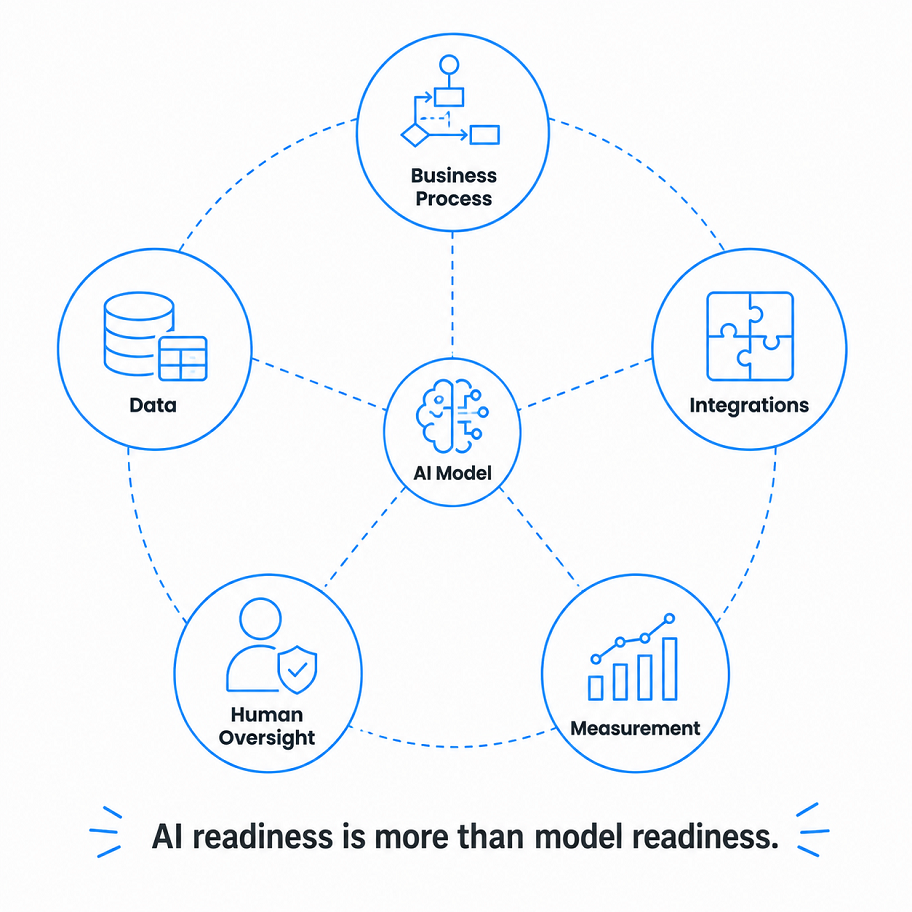
A useful AI readiness assessment should look beyond technology. It should test whether the business problem, workflow, data and operating model create the conditions for AI to deliver value.
1. Business Outcome and Workflow
Start with the result you want to change.
It could be reducing document processing time, increasing conversion, improving forecasting, shortening customer response times or allowing employees to handle more cases without increasing headcount.
The objective needs to be measurable.
“Use AI in customer support” is not a business outcome.
“Reduce the average time required to resolve a specific category of support requests while maintaining quality” is much closer.
Once the outcome is clear, map how the process works today.
Who starts it? What information do they need? Which systems are involved? Where are the handoffs? Who approves decisions? What happens when something goes wrong?
Then challenge the workflow itself.
Some steps may benefit from AI. Some should remain deterministic. Some require human judgment. Others may no longer be necessary.
The objective is not to apply AI to every possible step.
The objective is to create a better process.
2. Data and Integrations
Once you understand the target workflow, you can ask a more useful question:
What data does this process actually need?
Companies sometimes reverse this logic. They try to clean every dataset, consolidate every source and build a perfect data foundation before defining a use case.
That can turn AI readiness into an endless infrastructure project.
A better approach is to work backward from the business outcome. Identify the information needed to support the process, check whether it exists and determine what must improve before implementation.
The same principle applies to integrations.
A production AI solution may need to retrieve information from internal databases, CRM, ERP, document repositories or existing applications. It may also need to validate inputs, trigger actions and write results back to those systems.
If AI produces a useful result but employees still have to manually move it between applications, much of the potential value disappears.
3. Governance and Human Responsibility
AI introduces uncertainty.
The same model can produce different responses to similar inputs. Agents may execute multiple actions before producing a final result. Sensitive information may travel through several components.
Governance therefore cannot be something added after a successful pilot.
Teams need to determine early:
- what AI is allowed to do,
- which decisions require human approval,
- who owns the final outcome,
- how exceptions are handled,
- what should be logged,
- how errors are detected,
- when the system should stop and escalate.
A human-in-the-loop approach should not mean adding an employee at the end of the process just to click “approve.”
The person needs a meaningful role.
A domain expert may need to challenge an AI recommendation, verify an unusual result, add missing context or decide whether an exception can safely continue.
The more autonomy AI receives, the more clearly the organization should define responsibility.
4. Measurement and Architecture
Model accuracy may matter, but it is rarely enough.
A business-oriented evaluation can include processing time, cost per case, employee capacity, conversion, error rates, customer satisfaction or revenue impact.
The right metric depends on the workflow.
The important point is to define it before development.
Otherwise, a technically impressive pilot can reach the end of the project without answering the most important question:
Did it improve the business?
Architecture matters for another reason.
The model that gives you the best balance of quality, latency and cost today may not be the right choice next year. It may not even be the right choice for another task inside the same workflow.
A production AI architecture should therefore make individual components replaceable.
The durable advantage is not loyalty to a particular model provider. It is the ability to evaluate technologies against your own tasks and replace components as quality, pricing and capabilities change.
Data Readiness Follows the Use Case
Our work on AI Demand Forecasting in Pharma Supply Chains shows why this order matters.
At first, the challenge looked like a forecasting problem.
The client had historical data on medicine purchases and wanted to determine whether machine learning could predict future demand.
It would have been easy to start comparing algorithms immediately.
But the real challenge appeared earlier.
The data was heavily anonymized, documentation was incomplete and relationships between hospitals, pharmacies and purchasing units were difficult to reconstruct.
Before serious modeling could begin, we had to understand what the data actually represented.
Only then did model selection become useful.
Once the problem was properly understood, the solution did not require the most complex technology available. Established machine learning methods such as gradient boosting were appropriate for the task.
This illustrates an important principle of AI implementation readiness:
Do not ask how advanced the model can be. Ask what level of technology the process actually requires.
Sometimes the right answer is a large language model.
Sometimes it is classical machine learning.
Sometimes it is deterministic automation.
And sometimes AI is not necessary at all.
A mature readiness process should be able to reach each of those conclusions.
AI Readiness Means Building for Model Change
There is another reason not to organize your AI strategy around model selection.
Models change quickly.
New versions improve reasoning, reduce latency and change the economics of individual use cases. A workflow designed around one specific model can therefore become unnecessarily difficult to maintain.
Instead, treat the model as one component of a larger system.
One step may require a powerful reasoning model for a complex decision. Another may use a smaller and cheaper model for classification. A repetitive validation step may work better with deterministic rules.
This modular approach also makes experimentation safer.
You can compare models against real business tasks instead of generic benchmarks. You can change one component without redesigning the entire workflow. You can optimize cost without sacrificing quality where quality matters most.
The important capability is not choosing the perfect model once.
It is building a system that allows you to keep choosing the right model as technology changes.
Human Responsibility Is Part of Enterprise AI Readiness
AI does not remove accountability.
If an agent makes a poor recommendation, misses an important exception or sends the wrong information to a customer, the organization deploying it still owns the outcome.
That makes enterprise AI readiness a management issue as much as a technical one.
Business leaders need to define where AI can make decisions, where employees need to intervene and what level of risk the organization accepts.
Technology teams can design architecture, integrations and safeguards. But they should not have to decide alone which business processes deserve to change.
CEOs, COOs, Heads of Innovation, product leaders and domain owners need to participate because they understand the strategic objective, operational constraints and economics of the process.
Our AI for Clinical Trial Planning at Scale project demonstrates this hybrid model.
The solution does not rely on a single AI model to understand an entire clinical trial protocol and produce an unquestioned final answer.
Instead, specialized agents handle specific extraction tasks. Deterministic logic manages orchestration, schemas, validation and data transfer. Experts review outputs where human judgment remains critical.
The result is not “AI instead of people.”
It is a redesigned workflow in which different components handle the tasks they are best suited to perform.
A medical document that previously took an expert roughly half a day to a full day to process can now be processed automatically in about 5 minutes, while expert review remains part of the quality process.
This is the type of improvement an AI readiness assessment should prepare for: not automation for its own sake, but a measurable redesign of how work gets done.
A Practical AI Readiness Checklist
Before committing to an AI project, an AI readiness assessment should help leadership answer a few practical questions.
What business outcome are we changing?
Start with value, not a feature.
Which workflow produces that outcome today?
Understand the current process before redesigning it.
Which steps should disappear, change or remain human-led?
Automation is not valuable simply because it is possible.
What data does the new workflow require?
Focus data work around the use case.
Which systems must the solution interact with?
Plan integrations from the beginning.
Where do we need deterministic controls?
Not every step should depend on a probabilistic model.
Who remains accountable for the result?
Human responsibility should remain explicit.
How will we measure business impact?
Define KPIs before the pilot begins.
Can we replace the model later?
The architecture should survive changes in vendors and technology.
If several of these questions do not have clear answers, comparing models is probably premature.
That does not mean you should delay AI.
It means your next step should be discovery rather than deployment.
Process First, Model Second
Model choice still matters.
Different models offer different capabilities, costs, latency profiles and security options.
But model selection is a downstream decision.
The more important work happens earlier.
Define the business outcome. Redesign the workflow. Understand the data. Establish accountability. Plan integrations. Set evaluation criteria. Build an architecture that can change.
Then select the technology that fits those conditions.
Not the other way around.
That is what a useful AI readiness assessment should accomplish.
Companies do not create durable AI value by choosing the best model available today.
They create it by building processes that can keep using the best technology available tomorrow.
Next Steps & Further Reading
If you want to understand whether your organization is ready to move from AI experimentation to a production solution, the best starting point is a focused AI readiness assessment or a small, controlled pilot built around one measurable business process.
At Stermedia, we help CEOs, innovation leaders and established organizations move from business needs to production AI — from workflow and data analysis to proof of concept, integration, evaluation and deployment.
Want to discuss your project? Contact our AI team.
Continue Reading:
- Forward Deployed Engineering: Why Enterprise AI Needs More Than a Model — why production AI requires workflow discovery, integration, governance and close cooperation between engineering and business teams.
- AI Demand Forecasting in Pharma Supply Chains — how understanding fragmented data and business relationships became more important than selecting a more sophisticated forecasting model.
- AI for Clinical Trial Planning at Scale — a real-world example of a hybrid AI workflow combining specialized agents, deterministic controls and human review.
For broader context on how workflow redesign affects enterprise AI adoption, see McKinsey’s research on organizations rewiring their operations around AI.