AI in Software Engineering is becoming the foundation of modern digital product development. Solutions based on generative AI are transforming the way engineering teams work, streamlining project management, and enabling companies to deliver value to customers faster. This is no longer hype — these are practical tools that truly increase productivity, improve software quality, and shorten development cycles.
AI in Software Engineering: from hype to real results of generative AI
Mature organizations increasingly rely on AI-powered tools such as GitHub Copilot, intelligent code generators, automated documentation systems, and AI agents supporting integrations. In practice, these tools give engineering teams:
- faster creation of code-based solutions thanks to AI-generated code,
- automatic improvements to existing lines of code,
- shorter and more efficient code reviews,
- better documentation and change descriptions,
- faster prototyping of new features,
- relief from repetitive tasks.
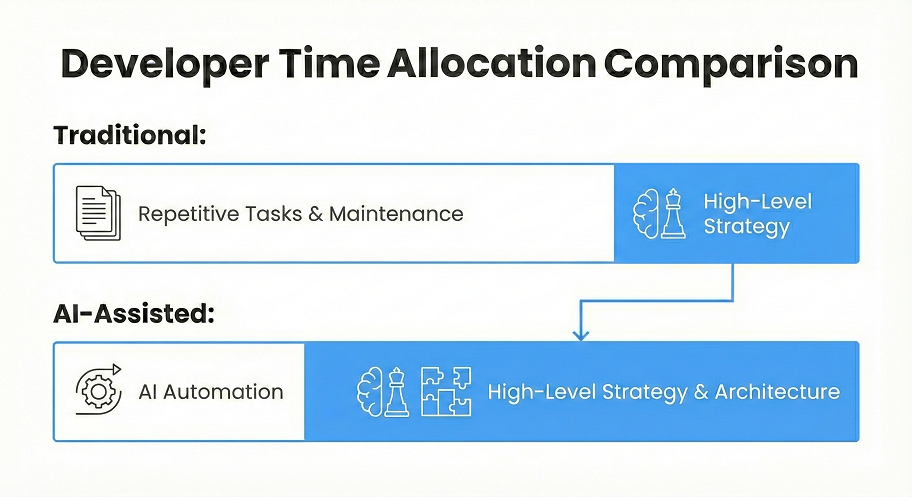
The key benefit? Developers can focus on what truly matters — architecture, feature design, requirement analysis, and solving complex business problems.
Where generative AI delivers the fastest return on investment
Generative AI brings the highest value where processes are repetitive and data is easily accessible:
1. Software development
This is the domain where AI in Software Engineering has the highest ROI. High code volume, repeated tasks, and cyclical testing make it easy for AI to enhance software and accelerate development.
2. Digital products in the MVP stage
Generative AI can significantly speed up the creation of early product versions — provided the company has its data and processes in order.
3. Documentation-driven industries
Transforming content, reports, protocols, and data between systems are tasks AI performs faster and more accurately.
It’s important to remember that AI does not replace technological leadership. It doesn’t create your product vision — it processes, organizes, and transfers knowledge so people can work faster and more strategically.
Why generative AI requires a shift in team mindset
The biggest challenge in adopting GenAI isn’t technology — it’s people.
Introducing generative AI into a team means shifting the mindset from:
“I perform the task myself” → “I delegate part of the work to an AI agent and oversee the outcome.”
This shift is especially visible in engineering teams. Senior developers adopt this model quickly because it resembles mentoring younger team members. Junior developers, who are used to executing tasks rather than defining them, must learn a more “leadership-oriented” approach.
This change requires:
- greater focus on precise requirement descriptions,
- conscious delegation of tasks to AI agents,
- supervision of results and iterative refinements,
- new competencies related to AI integration and workflow orchestration.
The result is a team that builds faster — but also requires a new approach to process design.
Hidden side effects: faster development creates pressure on QA
Higher productivity brings benefits, but also new organizational challenges.
When generative AI speeds up development and increases the number of features produced, the bottleneck often becomes… testing. Quality assurance must prepare for:
- more features delivered in less time,
- the need for real-time testing,
- more complex regression paths,
- integration of testing tools with AI systems.
This is one of the aspects companies often overlook at the beginning — but it can determine the success of the entire implementation.
Common mistakes in generative AI adoption
Organizations starting their AI journey often fall into predictable traps:
1. Unprepared data
AI does not guess — it needs access to your documentation and knowledge bases. Without properly connected data sources, the model lacks context and is forced to hallucinate instead of performing tasks accurately.
2. Leaving AI unsupervised too early
Treat an AI agent like a junior employee who needs verification . A common failure occurs when developers apply AI code suggestions without testing if the application still functions correctly after the changes.
3. Too much manual work, too little automation
If using AI requires copy-pasting between tools, it creates friction and slows down work . One of the emerging approaches is Model Context Protocol (MCP), which integrates AI directly with your tools (such as Jira or GitHub) to enable more automated, context-aware workflows.
How to effectively implement AI in Software Engineering
A successful generative AI implementation requires a structured approach:
1. Start with a small pilot
A 1–3 person team tests tools, integrations, and workflows.
2. Iterate and refine
Adopting AI agents is a process — prompts, workflows, and procedures require continuous improvement.
3. Scale only after confirming results
In the first weeks, productivity often… drops.
Real results appear after 1–3 months.
4. Choose the right technology partner
A good partner:
- asks the right business and technical questions,
- understands your industry,
- proposes an iterative and phased approach,
- anticipates organizational implications,
- delivers concrete plans instead of “AI magic.”
Cost alone should never be the main factor — a poorly executed AI implementation can multiply expenses.
The future: AI will reshape roles in organizations more than expected
Generative AI increasingly takes over repetitive and operational tasks, which means the value of people who can:
- create a long-term product vision,
- think strategically,
- design processes,
- leverage AI in team workflows
will only continue to rise.
The role of specialists will shift to higher levels of abstraction.
AI will not replace leaders — but it will redefine what is expected from them.
Why Stermedia is the right AI partner
Stermedia combines strong expertise in software engineering with practical experience delivering generative AI solutions in real products. We work iteratively — no “AI magic,” just reliable integrations, security, and quality. We use open protocols and modern AI technologies to avoid vendor lock-in, ensuring solutions are scalable, long-lasting, and adapted to clients’ business processes. This makes Stermedia a partner that not only implements technology, but also supports organizational change, team readiness, and achieving real ROI with generative AI.
Next steps & further reading
If you want to explore how AI in Software Engineering can accelerate your product development, the best starting point is a small, controlled pilot.
At Stermedia, we help CEOs, startups, and established organizations conduct full ai integration — from needs analysis and proof of concept to production deployment.
Want to discuss your project? Contact our AI team.
Continue reading:
- How Companies Use Generative AI – 8 Use Cases – practical, high-impact generative AI applications across industries.
- The Future of Testing with Generative AI Development Services – how GenAI reshapes QA, testing workflows, and automation strategies.
- Processing Car Equipment Using a Generative AI Development – a real-world case study showcasing applied generative AI in production-grade engineering.