AI recommendation systems have become one of the most effective ways for young digital products to deliver personalized value even before achieving scale or collecting extensive datasets. For early-stage companies, they can act as a strategic shortcut to traction, conversions and user retention. However, meaningful business outcomes come not from building the most advanced algorithm, but from applying technology proportionally to the business maturity of the product. For that reason, choosing an experienced technology partner who can advise on the right scope and timing becomes more critical than the algorithm itself.
Why simple AI recommendation systems are the most rational starting point
In the early product development phase, founders frequently refer to global benchmark solutions. This can be useful as inspiration, but it is important to remember that the best-known recommendation engines emerged gradually, supported by large and stable datasets and years of iterative improvement. For this reason, implementation should begin with a version proportional to the current scale, available resources and maturity of the product rather than an aspirational final vision.
This principle is also reflected in practical engineering guides, such as Databricks’ overview of online recommendation system architecture, which shows how production-grade solutions are built incrementally — starting from simple candidate generation and ranking layers before introducing more advanced real-time components.
In practice, simple recommendation mechanisms can deliver the earliest measurable value. They reduce friction related to content, product or feature discovery and allow teams to base decisions on real user behaviour instead of assumptions. As a result, startups gain insight, direction and evidence at a very low cost compared to advanced modelling.
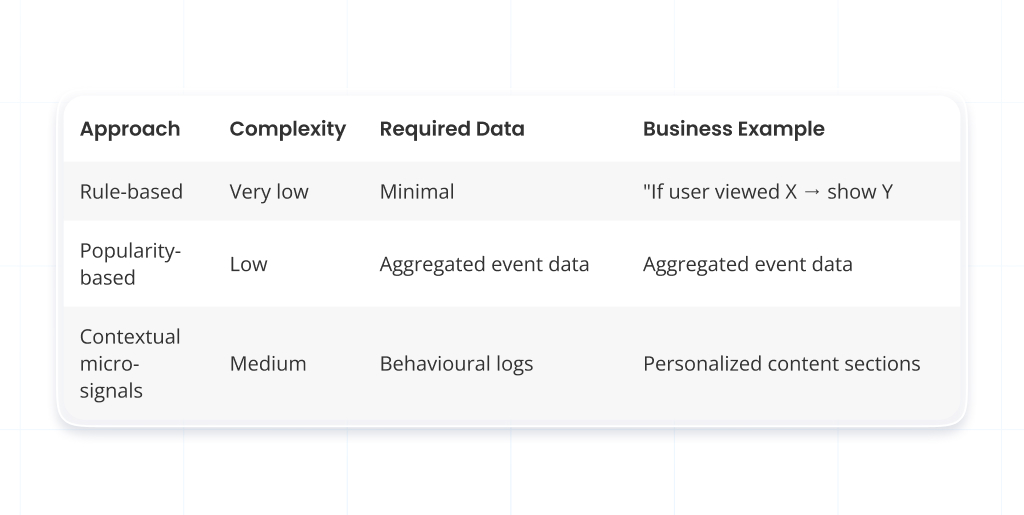
The table below presents typical recommendation system approaches, ordered by increasing complexity, data requirements and implementation cost.
How to measure value from the very first release
The effectiveness of an AI recommendation system should be measured through its contribution to business outcomes rather than the sophistication of its architecture. Typical indicators include browsing-to-action conversion, feature discovery, time spent inside the product and user return rate. A simple version can often produce noticeable improvement by reducing cognitive effort, shortening user journeys and increasing engagement.
This first stage is also the most cost-effective because each improvement is achieved with minimal development effort and provides real behavioural data, enabling informed decision-making.
Why each next iteration becomes more complex and expensive
The development trajectory of recommendation systems is not linear. At the beginning, value grows quickly at a relatively low cost. Over time, additional improvements still increase value, but require far greater investment in data engineering, infrastructure, experimentation and model maintenance. This is known as diminishing marginal returns.
The following diagram illustrates the concept, ending at the point of maximum practical value for an early-stage organisation:
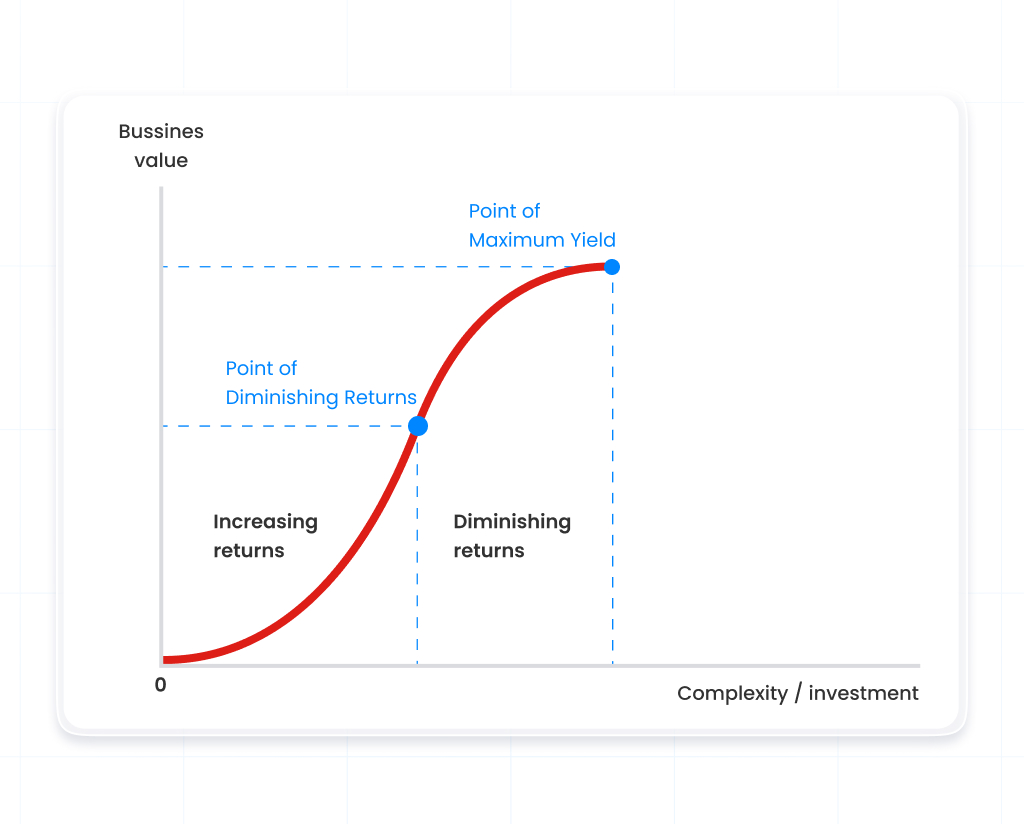
The point of maximum value represents the stage where further increases in model complexity still improve quality, but the growth becomes too small to justify the rising engineering and organisational cost. An experienced partner should be able to recognise that point and recommend stopping or redirecting investment rather than escalating effort.
Why recommendation system projects fail most often
Across the industry, unsuccessful implementations rarely stem from insufficient technology or talent. They are far more frequently the result of incorrect sequencing, lack of measurable hypotheses, unclear data strategy or the assumption that advanced modelling alone creates value. This often leads to over-engineering and solutions that outperform expectations technically, but not commercially.
Why choosing the right technology partner is the most decisive factor
Founders building their first technology product often concentrate on how the algorithm should work and underestimate the importance of when and why it should be built. A recommendation system must reflect product maturity, user activity, data volume and behavioural clarity. In this context, the most valuable asset is a partner who can advise on when to start, how to build and when to stop.
Stermedia works according to a model that combines advisory work, analytics and solution delivery aligned with business reality. The objective is not to build the most complex system possible, but to deliver business value appropriate for the stage, traction and constraints of the organisation.
Conclusion
AI recommendation systems can become one of the strongest accelerators of digital product growth. Their real value emerges when the development path is sequential, based on real data and aligned with the actual needs of users. In such conditions, the most critical success factor is collaboration with a partner capable of recommending a strategy proportional to product maturity, protecting the organisation from unnecessary cost and technical risk.
Want More?
If you are considering introducing an AI recommendation system to your product, the first step should not be the choice of technology but a conversation with a partner capable of recommending a rational scope, investment timeline and method of value verification. Stermedia can support you in designing and implementing a system that delivers measurable value early while maintaining a clear path for future development.
For further reading and context, consider the following:
1. How Recommendation Systems Transform Modern Business
This article explains how different types of recommendation engines shape user experience and business revenue across multiple industries, from e-commerce to streaming and healthcare. It highlights how tailored personalization strategies directly increase engagement, loyalty and sales by matching the right content or product to the right user at the right time.
2. How to Use Simple Math Models for Major Business Challenges
The article shows how even relatively simple mathematical and statistical models can solve important business problems effectively, without the need for advanced AI or data-heavy architectures. It emphasizes that many companies overestimate technological complexity while underestimating the impact of well-designed, lightweight analytical solutions.
3. Food Delivery Efficiency Increased by 10% Thanks to Machine Learning
The case study illustrates how targeted ML-driven optimization improved delivery logistics by 10% without rebuilding the entire product ecosystem or investing in advanced model engineering. It shows that even focused, narrow-scope initiatives can positively convert into measurable operational and financial outcomes when aligned with business priorities.