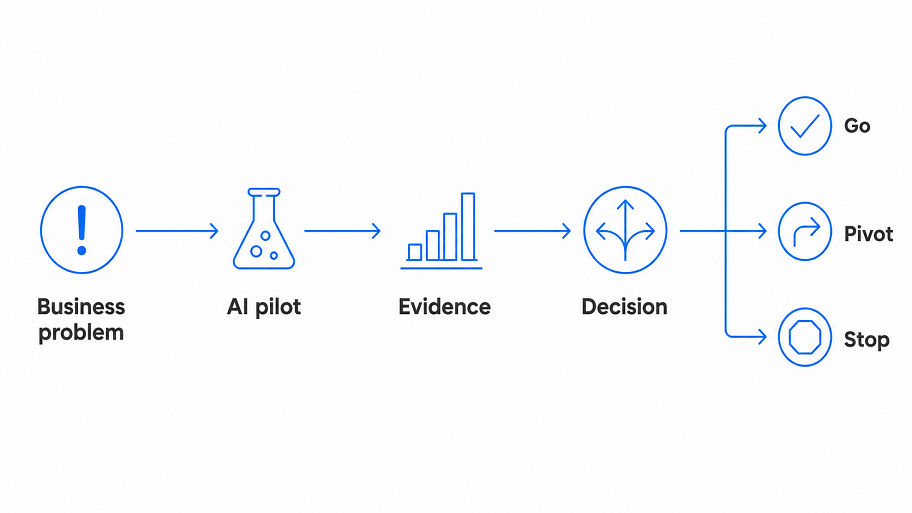
An AI proof of concept should not exist merely to demonstrate that a model can generate an impressive output. It should produce enough reliable evidence to support a real business decision: proceed, pivot or stop.
This distinction changes how an AI pilot should be designed.
A technical demonstration asks, “Can the technology do something interesting?”
A decision-ready pilot asks, “Can this solution improve a specific business outcome under realistic operational, financial and risk constraints?”
The second question is harder, but it is also the one that can justify further investment.
Terminology varies across organizations. In this article, we use “AI proof of concept” broadly for a small, controlled validation initiative; in stricter delivery models, some real-workflow testing described below may be classified as a pilot.
Why an AI Proof of Concept Must End With a Decision
Many AI initiatives finish with a polished demonstration and no clear next step.
The model summarizes a document, generates a recommendation or answers questions over internal data. Stakeholders agree that the result looks promising. However, nobody can confidently say whether the company should invest in building the production system
The pilot has demonstrated capability, but it has not reduced business uncertainty.
One common reason is that the scope was defined as a list of features:
- Build an internal AI assistant.
- Create a document analysis tool.
- Test an AI agent for customer service.
- Connect a large language model to company data.
These statements describe what the team intends to build. However, they do not define what the organization needs to learn.
A stronger scope converts the idea into a decision question:
Can an AI assistant reduce the time required to handle selected customer requests by at least 20% while meeting agreed quality, security and cost thresholds?
Now the pilot has a measurable purpose. At the end, the organization can compare the evidence against predefined criteria and decide what to do next.
Start With One Business Decision
Before selecting a model, preparing prompts or designing an interface, define the decision the pilot must support.
A useful decision statement includes four elements:
- the person who will make the decision,
- the investment or change being considered,
- the evidence required,
- the date on which the decision will be made.
A simple template is:
By [date], [decision owner] will decide whether to [proceed, expand, redesign or stop] based on evidence that the proposed AI solution can [business outcome] within [quality, cost, risk and operational constraints].
For example:
By Sept. 30, the COO will decide whether to fund production development of an AI document processing system based on its ability to reduce manual review time by 30% without increasing critical errors or exceeding the target cost per document.
This statement prevents the pilot from turning into an open-ended research project. It also gives business and technical teams a shared definition of success.
Scope the Smallest Workflow That Still Matters
A useful AI pilot is narrow, but it cannot be trivial.
Testing an entire customer service department, claims process or sales workflow usually introduces too many variables. Testing only a handful of clean examples in a notebook produces evidence that is too weak to support a serious investment.
Therefore, the right scope sits between these extremes.
Instead of testing “AI for customer service,” select:
- one group of users,
- one category of requests,
- one defined step in the workflow,
- one representative data source,
- one measurable outcome.
For example, a support pilot could focus only on drafting responses to Tier 1 refund requests in English. Complex complaints, legal disputes, account cancellations and multilingual cases could remain out of scope.
This boundary makes it possible to isolate the effect of the AI system and understand why it succeeds or fails.
A decision-ready scope should define:
- Users: Who will work with the solution?
- Task: What exact work will AI perform or support?
- Inputs: Which documents, records or requests will be processed?
- Outputs: What must the system produce?
- Systems: Which integrations are essential for the test?
- Duration: How long will the pilot run?
- Exclusions: Which cases will not be tested?
A smaller scope also makes failure easier to diagnose. When several workflows, data sources and user groups are combined, the team may know that the pilot failed without knowing what caused the failure.
Test the Riskiest Assumption, Not the Easiest Feature
Every AI initiative contains several assumptions:
- users have a problem worth solving,
- the proposed solution creates enough value,
- the necessary data is available,
- the model can perform the task reliably,
- the system can fit into the existing workflow,
- users will adopt it,
- security and compliance requirements can be met,
- the economics will remain attractive at scale.
For this reason, the pilot should focus on the assumption most likely to invalidate the investment.
If the main risk is data quality, a sophisticated user interface will not answer the important question. If user adoption is uncertain, testing only model accuracy in a notebook will produce incomplete evidence. If the task involves regulated decisions, the pilot must test review, traceability and escalation rather than only output quality.
The principle is simple:
Pilot the hardest part of the value proposition, not the easiest part of the demonstration.
A technically impressive pilot can still be commercially irrelevant. Strong evidence comes from testing the part of the idea that could cause the business case to fail.
Establish the Baseline Before Building
An AI pilot cannot prove improvement unless the current process has been measured.
Statements such as “the process is slow” or “employees spend too much time on this” are not baselines. The team needs enough information to compare the AI-supported process with the existing way of working.
Depending on the use case, the baseline may include:
- task volume,
- median processing time,
- longest processing times,
- labor hours,
- cost per case,
- error and rework rates,
- escalation frequency,
- throughput,
- customer satisfaction,
- employee satisfaction.
Do not rely only on averages. A process may have an acceptable average handling time but a large number of difficult cases that take several times longer. Those exceptions may represent the strongest opportunity for AI — or the greatest implementation risk.
For a new product without an existing internal process, the baseline may be a manual service, competitor solution, current user behavior or willingness to pay.
As a result, the baseline turns a general ambition into a measurable hypothesis.
AI Proof of Concept Metrics Should Cover Three Layers
Technical performance matters, but technical metrics alone cannot establish business value.
A decision-ready AI proof of concept should measure three connected layers.
Business Outcome
These metrics answer whether the solution creates economic or strategic value.
Examples include:
- cost per completed task,
- processing time,
- revenue generated,
- capacity released,
- errors avoided,
- cases resolved,
- customer retention.
User and Workflow Performance
These metrics show whether the system fits the way people work.
Examples include:
- adoption rate,
- task completion rate,
- percentage of outputs accepted,
- number of manual corrections,
- escalation rate,
- time spent reviewing AI output,
- user satisfaction.
AI and System Performance
These metrics assess whether the technology works reliably enough.
Examples include:
- factual accuracy,
- groundedness,
- critical omission rate,
- retrieval relevance,
- latency,
- availability,
- cost per request,
- safety violations.
Therefore, the metrics should form a logical chain.
For example, higher answer accuracy should reduce the number of manual corrections. Fewer corrections should shorten handling time. Shorter handling time should reduce cost or increase team capacity.
If a metric cannot be connected to a business outcome, it should not be the main reason for approving the next investment.
In addition, for quantitative metrics, report the sample size and uncertainty where appropriate so decision-makers can distinguish a real signal from noise.
Build the Evaluation Set Early
Generative AI outputs can vary even when the input appears similar. Traditional testing based on a few expected outputs is therefore insufficient.
Before development begins, prepare a representative evaluation set. It should reflect the work the system will encounter rather than the examples that make the model look good.
Include:
- common cases,
- difficult cases,
- incomplete inputs,
- ambiguous requests,
- unusual formats,
- high-risk scenarios,
- cases that should be escalated,
- inputs that the AI should refuse to process.
For this reason, domain experts should define what a successful output must contain. In some use cases, this may be a reference answer. In others, it may be a list of required facts, prohibited statements or scoring criteria.
Automated evaluation can accelerate iteration, but human judgment remains essential. Subject matter experts should review whether the output is useful, safe and appropriate for the actual workflow.
The evaluation process should begin early and continue as the team discovers new edge cases. “It looked good during the demonstration” is not a repeatable quality standard. Evaluation guidance similarly emphasizes task-specific datasets, explicit objectives, human calibration and continuous testing rather than generic or intuition-based scores.
For a broader view of the stages from experimentation to production, see the AWS Generative AI Lifecycle Operational Excellence framework.
Run the AI Pilot Inside a Controlled Real Workflow
A useful pilot must encounter real operational conditions, but that does not mean exposing the organization to uncontrolled risk.
Several deployment patterns can help:
- Shadow mode: The AI produces recommendations without affecting the live process.
- Human-in-the-loop mode: A user reviews and approves every output.
- Limited-user rollout: A small group of trained users tests the system.
- Restricted-case rollout: Only predefined low-risk cases are processed.
- Parallel processing: The existing and AI-supported processes run simultaneously for comparison.
As a result, this approach provides stronger evidence than an isolated laboratory test while maintaining oversight.
The architecture can remain lightweight. The purpose of an AI PoC is not to build the final production platform. However, the pilot should expose potential production blockers such as data access, permissions, latency, integration complexity, security, cost and auditability.
Minimal does not mean fake.
The solution should be simple enough to change quickly but realistic enough to reveal whether a viable path to production exists.
Set Go, Pivot and Stop Criteria in Advance
Decision criteria should be agreed upon before the results are known.
Otherwise, teams may shift the thresholds to protect an idea in which they have already invested time, money and reputation.
A basic decision framework can include three outcomes.
Go
Proceed when:
- the business target is met,
- quality remains above the required threshold,
- users can integrate the solution into their work,
- no unacceptable security or compliance risk has emerged,
- expected operating costs support a positive business case,
- the path to production is technically credible.
Pivot
Redesign the use case when value appears achievable, but a specific and solvable constraint remains.
Examples include:
- the model works, but the selected workflow creates too much user friction,
- output quality is strong for one document type but weak for another,
- the solution is valuable, but the proposed model is too expensive,
- users want recommendations rather than automatic execution.
Stop
Stop when:
- users do not consider the problem important,
- the required data cannot be accessed or trusted,
- performance remains below a nonnegotiable threshold,
- the economics do not support further investment,
- legal, security or operational risks cannot be controlled.
However, a stopped pilot is not necessarily a failed project. Discovering that an idea should not receive further funding may be the most valuable result the pilot produces.
Formal go/no-go decisions should combine business value, risk, technical viability, cost and strategic alignment rather than relying on optimism or a successful demo.
Assign Clear Ownership
An AI pilot requires more than a development team.
A typical core team includes:
- a business sponsor,
- a process owner,
- a domain expert,
- a technical lead,
- a representative responsible for security, legal or compliance,
- a named decision owner.
In smaller pilots, one person may cover more than one role, but the responsibilities should still be explicit.
The sponsor protects the business objective. The process owner explains how the work is performed. Domain experts define acceptable quality. The technical team designs and evaluates the solution. Governance stakeholders identify nonnegotiable constraints.
One person must remain accountable for the final decision.
The decision review should be placed on the calendar before development starts. This creates a real deadline for collecting evidence and prevents the pilot from continuing indefinitely.
Use a One-Page AI Pilot Scope
A practical scope document does not need to be long. It needs to be unambiguous.
A one-page AI pilot scope should contain:
- Business problem: What is happening today and why does it matter?
- Decision: What will be decided when the pilot ends?
- Decision owner: Who has authority to proceed, pivot or stop?
- Target users: Who will test or use the solution?
- Workflow: Which task or process step is included?
- Hypothesis: What improvement is expected?
- Riskiest assumption: What uncertainty must be reduced?
- Baseline: How does the process perform today?
- Data: What information will be used and who approves access?
- Metrics: Which business, workflow and technical measures will be tracked?
- Decision thresholds: What results lead to go, pivot or stop?
- Exclusions: What will deliberately not be built or tested?
- Timeline: When will testing and the decision review occur?
- Pilot outputs: What evidence, prototype and recommendations will be delivered?
This document becomes the reference point for the entire initiative. It also makes it easier to compare the original hypothesis with the final results.
What Happens After the AI Pilot?
When the evidence supports continued investment, the next stage is not simply “add more features.”
The organization should prepare for preproduction by:
- strengthening the architecture,
- expanding the evaluation dataset,
- addressing newly discovered failure modes,
- implementing monitoring and logging,
- improving security controls,
- defining human review and escalation,
- integrating the solution with real systems,
- preparing users and updating the workflow,
- validating the complete cost model.
The purpose changes from proving that the core idea can work to demonstrating that the solution can operate safely, reliably and economically.
If the decision is to pivot, the evidence should identify which assumption, workflow or technical component needs to change.
If the decision is to stop, the organization should retain the evaluation data, findings and rejected assumptions. That knowledge can prevent another team from repeating the same experiment.
Final Thoughts
A well-scoped AI pilot is a decision instrument, not a miniature production project.
It starts with one business question, tests the most important uncertainty and uses measurable criteria to determine the next step. Its value does not depend on whether the result is positive. Its value comes from replacing assumptions with evidence.
The best AI proof of concept does not leave executives asking, “Was the demo impressive?”
It allows them to answer a much more important question:
Do we have enough evidence to make the next investment?
Next Steps & Further Reading
If you want to test whether AI can improve a specific workflow or business outcome, the best starting point is a focused, controlled pilot with a measurable baseline and clear decision criteria.
At Stermedia, we help CEOs, innovation leaders and established organizations move from AI opportunity to evidence-based implementation — from needs analysis and data-readiness assessment to proof of concept, integration and production deployment.
Want to discuss your AI pilot? Contact our AI team
Continue reading:
- Working With Stermedia — AI Software Development Guide — an overview of how an AI initiative moves from data audit and discovery to a go/no-go recommendation and iterative development.
- How Companies Use Generative AI — Eight Use Cases — practical examples that can help teams identify workflows worth testing.
- Why Quality Assurance Is Essential in AI Projects — a closer look at validation, reliability and quality control throughout the AI lifecycle.