A software product takeover creates delivery risk before the incoming team changes a single line of code.
The team may receive repositories without production access, outdated documentation, a backlog without business context and immediate pressure to keep the roadmap moving. Meanwhile, the product must continue serving users and supporting daily operations.
Taking over existing software is therefore not a standard onboarding exercise. You are transferring the ability to understand, operate, change and recover the system safely. A successful takeover starts with control, verified knowledge and a reliable release process.
Why a Software Product Takeover Creates Delivery Risk
Most takeover failures do not begin with one obvious defect. Risk builds across several areas at once.
The code may be available, but deployment credentials belong to one person. The architecture diagram may look complete, while production depends on undocumented scripts. Tests may exist, but nobody knows whether they protect the workflows that matter most to customers.
The transition also creates uncertainty. Key employees may be leaving, the previous vendor may have limited availability and stakeholders may disagree about what the new team should own.
The main risk categories are:
- Operational risk: The team cannot reliably deploy, monitor or recover the product.
- Knowledge risk: Critical rules and workarounds exist only in the heads of individual employees.
- Delivery risk: Estimates depend on hidden dependencies and incomplete information.
- Ownership risk: Responsibilities for infrastructure, incidents and third-party services remain unclear.
- Transition risk: Each team assumes that the other owns a critical task.
A responsibility assigned to “both teams” often belongs to neither in practice.
Define What the Takeover Must Achieve
Before creating a transition plan, align stakeholders on the business outcome.
A CEO may want lower costs. A product owner may need faster feature delivery. Internal IT may want to remove dependence on the previous vendor, while operations prioritizes uptime.
A practical takeover should aim to:
- Maintain uninterrupted support for critical workflows
- Establish ownership of code, infrastructure and external services
- Create a repeatable deployment and rollback process
- Reduce dependence on individual employees
- Restore predictable roadmap delivery
- Identify the most urgent product and technical risks
Success does not mean understanding every line of code. It means the incoming team can operate the product, explain its critical behavior and deliver changes without hidden dependence on the previous provider.
Start the Software Product Takeover With Control
The first priority is not refactoring. It is gaining control over everything required to keep the product running.
Create an inventory covering:
- Source code repositories and cloud accounts
- Development, testing and production environments
- CI/CD pipelines
- Domains, certificates, secrets and credentials
- Monitoring, logging and alerting
- Databases, backups and recovery procedures
- Third-party APIs, SaaS accounts and licenses
- Support, analytics and administration systems
For each asset, record the current owner, future owner, access status and transfer deadline.
Do not accept “the team has access” as confirmation. Verify that the right people can perform the required operation. Viewing a dashboard is not the same as restoring a backup or changing a production configuration.
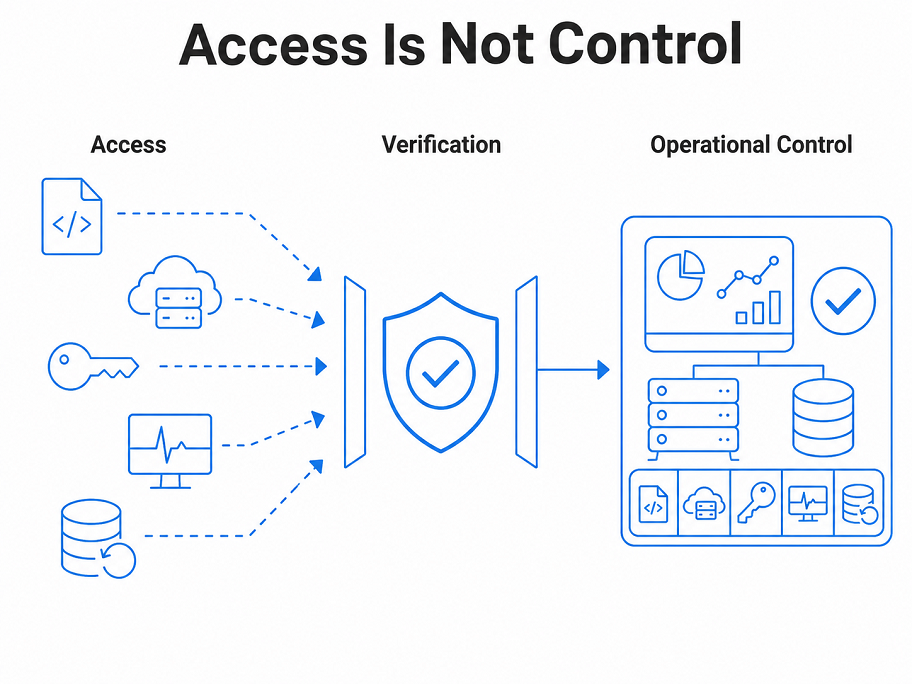
An asset should not be considered transferred until access has been verified.
The inventory should also cover resources outside the core stack. A product may depend on a domain registered through a founder’s account or a spreadsheet used in a critical business process. The repository rarely represents the complete product.
Transfer Knowledge Through Real Work
A software product handover often relies too heavily on presentations and documentation.
Recorded sessions and diagrams help, but they do not prove that the incoming team can operate the product. Start by mapping the flows that are critical to revenue, customer trust and regulatory compliance, such as authentication, billing, order processing, reporting and data exchange.
For every critical flow, identify:
- The users and the business owner
- The systems and integrations involved
- Common failure scenarios
- Monitoring and recovery procedures
The team should also capture why important decisions were made. A custom integration may support a key customer. A manual step may be required to satisfy a compliance requirement. Without this context, the new team can remove behavior that still has business value.
Knowledge transfer is often most effective during real work. Pair incoming and outgoing specialists while they resolve a support ticket, review an incident, execute a deployment or trace a transaction through the system.
Finish with a reverse handover. The incoming team performs the process while the outgoing team observes. This exposes missing knowledge before the transition ends.
Stabilize the Release Process
The incoming team should not promise faster delivery until it understands how software reaches production.
Can the team reproduce a build? Do tests run against the artifact that will be released? Can it identify which code and configuration are included in the release? How is a failed deployment detected and rolled back?
The release process should be:
- Repeatable: The same inputs produce the same artifact.
- Automated: Builds, tests and deployments do not depend on hidden manual steps.
- Observable: The team can see the deployment state and production impact.
- Auditable: Each release connects to its code, configuration and approvals.
- Reversible: The team has a tested response when a change causes problems.
The first takeover release should be intentionally small. A low-risk bug fix or configuration change can create more value than an ambitious feature because it validates access, environments, automation, approvals, monitoring and rollback.
In this context, the first release is also a diagnostic tool.
Replace Assumptions With Evidence
Existing products contain hidden behavior in code, integrations, operational procedures and customer-specific configurations.
Do not assume that documentation reflects production, tests cover the most valuable workflows or an apparently unused feature has no users.
Turn each critical assumption into a question that can be answered with evidence.
The team can add smoke tests for key user journeys and characterization tests that protect current behavior. Production logs, analytics, support tickets and interviews with business users provide additional evidence.
The goal is not complete test coverage before delivery. Protect the areas where failure would create the greatest business impact, then expand coverage as the team changes adjacent functionality.
Make Early Changes Small and Reversible
Large changes combine many assumptions. When something fails, the team must determine which assumption was wrong and whether the release can be reversed.
An early change should have:
- A narrow scope
- Limited dependencies
- Clear success and failure signals
- Monitoring before release
- A named decision owner
- A rollback or disablement path
Feature flags can separate deployment from release. Canary releases limit a new version to a small part of production traffic. Shadow execution and parallel runs let teams compare behavior before moving users to a new path.
These practices do not remove uncertainty. They limit how much damage uncertainty can cause.
Reversibility is not only an architectural feature. It is a delivery control.
Create Clear Ownership Across Both Teams
Technical preparation will not reduce risk if the transition lacks clear governance.
The client, outgoing team and incoming team need one operating model. Define decision owners, incident responsibilities, production approval rules, escalation paths, transfer acceptance criteria and the date when each responsibility moves.
Use one prioritized backlog, one risk register and one decision log. Separate documents maintained by different parties can create competing versions of reality.
The contract should support this model. It should specify required assets, access, knowledge transfer duties and acceptance criteria — not only roles and working hours.
Operational responsibility should not transfer until the incoming provider has the required access and has successfully executed the process.
Measure Whether Delivery Risk Is Falling
A takeover plan should produce evidence that the product is becoming safer to operate and change.
Do not measure progress only through meetings completed, documents written or tickets closed. These show activity, not delivery capability.
Track a focused set of indicators:
- Unresolved access gaps
- Critical workflows covered by monitoring and tests
- Remaining key-person dependencies
- Deployment frequency
- Change fail rate
- Failed deployment recovery time
- Delivery predictability against the roadmap
Create the baseline early. Use the metrics to identify friction and validate progress, not to rank individual developers.
What the First 30 Days Should Produce
The first month of a software product takeover should not be judged only by the number of new features delivered.
A strong first 30 days should produce:
An Operational Control Matrix
The team knows which assets exist, who owns them and whether access has been tested.
A Critical Flow Map
Business and technology stakeholders understand the workflows that must remain protected.
A Prioritized Risk Register
Each major risk has an owner, mitigation action and review date.
A Proven Release Path
The incoming team has built, tested, deployed and monitored a controlled change.
A Knowledge Retention Plan
The team has identified key-person dependencies and captured the information most likely to disappear.
A 30-60-90 Day Roadmap
The roadmap separates urgent stabilization, ongoing delivery and longer-term improvements. It also states the assumptions that may affect scope or estimates.
These outcomes show executives which risks have been removed, which responsibilities have been transferred and what the team can now deliver safely.
Final Thoughts
A successful software product takeover transfers more than code. It transfers operational control, product understanding, delivery discipline and accountability.
The incoming team should first establish access and ownership. It should then map critical behavior, validate assumptions and prove the release process. Early changes should remain small, observable and reversible.
This sequence may appear slower during the first weeks. In practice, it prevents larger delays caused by failed releases, missing access, lost knowledge and false confidence.
The goal is not to make the new team look productive immediately. The goal is to make future delivery predictable.
Next Steps & Further Reading
If you are preparing a software product takeover, start with a focused discovery and transition phase. Establish operational control, map business-critical flows and prove a safe release path before committing to an accelerated roadmap.
At Stermedia, we help CEOs, product companies and established organizations take over existing software products — from technical discovery and knowledge transfer to delivery stabilization, continued development and long-term ownership.
Want to discuss your product transition? Contact our software development team.
Continue Reading
Software Development Partner: First 30 Days — what a structured opening phase should reveal about communication, ownership and delivery capability.
AI Software Development: Platform Takeover & Optimization — a real-world case study involving incomplete documentation, departing specialists, team silos and continuous product operation.
Software Project Rescue: 5 Signs You Need External Help — when delivery problems indicate that a project needs an external assessment or takeover.
External Reading
Canarying Releases by Google SRE — practical guidance on limiting the production impact of new releases.