Conversational AI for Startups is becoming one of the most transformative tools for founders who want to validate ideas faster, reduce early-stage risks, and build products grounded in real user needs. Traditional methods — mockups, interviews, surveys, or clickable prototypes — provide only fragmented insights. Conversational interfaces, on the other hand, enable teams to explore product logic, test assumptions, and simulate real usage scenarios through natural dialogue with an intelligent agent.
This introduces a new paradigm: MVP 2.0. In this model, the first version of a product emerges not from code, but from knowledge gained through conversation. Instead of guessing what users want, founders discover it dynamically. They interact with systems that reflect user intentions and behaviors in real time.
Beyond Clicking: Why Conversational Interfaces Are Becoming the New UX
For years, digital product design relied on screens filled with buttons and forms. With advancements in AI, a more natural mode of interaction is emerging: conversation. A conversational interface does more than respond — it interprets intent, clarifies needs, and performs actions.
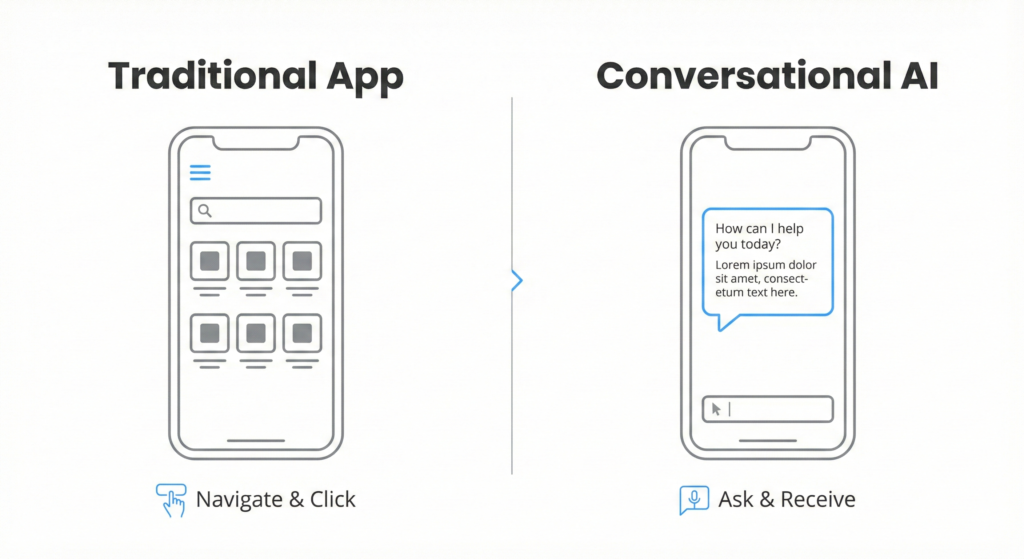
This shift makes product discovery more authentic and effective. Conversations uncover motivations, frustrations, and expectations that traditional prototypes often fail to reveal. And because functionalities can be simulated before they are built, teams gain clarity much earlier in the process, spotting logical gaps long before development begins.
Conversational AI for Startups as the Foundation of MVP 2.0
The traditional MVP model assumes that teams must first build a minimal product before testing it. This is costly, time-consuming, and risky — with many assumptions turning out to be wrong only after implementation.
In the MVP 2.0 approach, powered by Conversational AI, the first prototype becomes a dialogue: dynamic, iterative, and instantly verifiable. Each interaction with a user-like agent generates new insights. The AI can simulate different functions and behaviors, helping teams determine which directions make sense and which should be abandoned.
This reduces early development costs and enables teams to explore multiple product paths without writing a line of production code. Usage scenarios emerge through conversation, and iteration happens at the speed of dialogue, not engineering. Only after the concept is validated does it move into development — in a far less risky form.
Why Conversational AI Reduces Early-Stage Product Risk
Early-stage product development is filled with uncertainty — limited budget, unclear scope, and a lack of reliable data. Conversational AI helps mitigate these challenges.
First, it enables immediate hypothesis validation. A founder can walk through a process step by step with an AI agent that exposes logical gaps and proposes alternatives — much like a real user would. Instead of crafting extensive documentation, teams quickly discover how users might actually interact with the product
Second, iteration becomes significantly faster and cheaper. Adjusting a conversation flow takes minutes, whereas redesigning architecture or interfaces requires days or weeks of engineering effort.
Third, teams gain a clearer functional scope before development begins. Unnecessary features are eliminated early, roadmaps become more realistic, and technology partners receive more precise requirements — reducing the risk of misunderstandings and additional costs.
Finally, conversational prototypes improve communication with investors and stakeholders. Instead of abstract slides, founders can demonstrate an interactive, real-time simulation of the product, making the vision more tangible and compelling.
From Interfaces to Intelligent Partners: The Future of Conversation-Driven Products
Conversational systems are quickly evolving from simple chatbots into advanced AI agents capable of planning actions, integrating with tools, making context-aware decisions, and monitoring workflows. They are becoming not just interfaces, but active components of the product — able to simulate user behavior, map processes, or even operate certain features autonomously.
For readers who want a deeper understanding of how modern agents function and why they are becoming essential to next-generation software, IBM offers an excellent overview in its article on AI agents:
In the near future, product development will become increasingly dialogue-driven. A founder will describe a goal, an agent will propose solutions, generate usage scenarios, and produce the underlying logic. Iteration will occur through conversation, and the product will evolve alongside it.
This suggests that Conversational AI for Startups may become a foundational approach in how digital products are designed and scaled in the coming years.
Next Steps & Further Reading
Turn innovation into action with conversation-driven product development.
At Stermedia, we help organizations build intelligent MVPs, validate ideas faster, and integrate AI solutions that increase efficiency and reduce risk.
If you want to explore how conversational AI can accelerate your product development, get in touch with our AI specialists.
Continue your journey into the world of artificial intelligence by exploring related articles:
- How to Use Simple Math Models for Major Business Challenges – This article shows how even simple mathematical models can solve significant business problems without heavy AI. A real case study demonstrates how a lightweight algorithm improved efficiency and reduced costs in the insurance sector.
- Navigating the Future of AI Software Development Outsourcing: Trends, Benefits, and Best Practices – A practical overview of how companies can leverage global AI talent, reduce risk, and accelerate innovation. The article outlines key outsourcing trends and best practices for selecting the right technology partner.
- AI Software Development: Platform Takeover & Optimization – This case study explores how taking over and optimizing an existing platform with AI led to better performance, scalability, and product quality. It highlights the steps and strategic improvements that delivered measurable value.