Conversational AI in Software Development is increasingly becoming a core capability of modern digital products, driven by rapid technological advances in artificial intelligence and natural language processing (NLP). What was once limited to simple chatbots has evolved into AI-powered systems that can understand and respond to user queries in real time, across multiple communication channels.
Today, intelligent assistants play a growing role in how software products are designed, built, and scaled — particularly where speed, availability, and operational efficiency are critical.
The Role of Conversational AI in Software Development and Modern Systems
At its foundation, this technology combines natural language understanding and natural language generation to enable software systems to interpret human language and produce relevant responses. These capabilities allow virtual assistants to function as more than static interfaces.
In modern software architectures, conversational interfaces act as an intelligent interaction layer. Powered by architectures like Retrieval-Augmented Generation (RAG), AI assistants and virtual components can access backend systems and query internal knowledge bases in real time. Rather than relying solely on pre-trained knowledge, this capability allows models to use up-to-date, domain-specific company data to trigger actions and enable users to interact with applications through natural conversation rather than complex forms or rigid workflows.
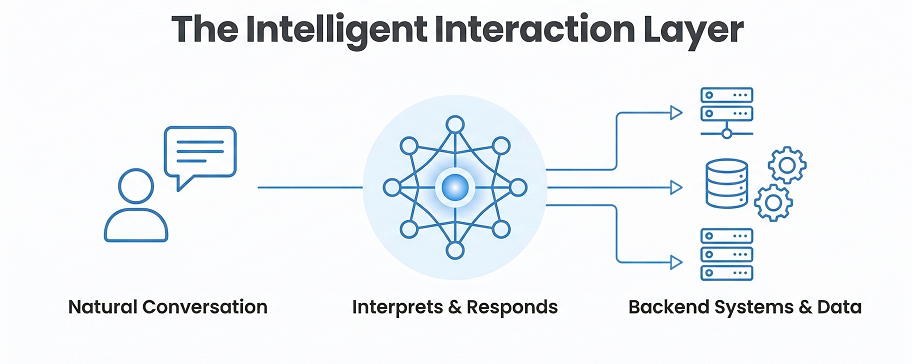
This shift is especially visible in customer-facing systems, where generative AI tools support customer service and improve customer experience by reducing friction and response times.
Designing Intelligent Conversation Flows in Real Time
One of the defining features of AI-driven communication is its ability to manage structured conversational flows while remaining flexible enough to handle unstructured input. Through advances in NLP, modern AI has shifted from rigid, intent-based classification to dynamic, generative responses based on deep semantic understanding. Today, these systems analyze broad context and sentiment to guide interactions dynamically.
In real-time environments, this means the assistant can:
- interpret user queries as they arrive,
- provide context-aware answers,
- adapt responses based on conversation history.
These capabilities enable AI-powered assistants to maintain coherent dialogues that feel natural, even when conversations span multiple steps or channels.
Business and Operational Benefits of AI-Powered Conversations
The benefits of these solutions extend well beyond automation. When implementing Conversational AI in Software Development, intelligent chat supports both external users and internal teams by improving consistency and scalability.
From a product perspective, virtual agents enhance customer experience by delivering faster, more accurate, and more relevant responses. Users no longer need to navigate complex interfaces to find information or complete tasks — they can simply ask.
From an operational standpoint, conversational AI improves operational efficiency by reducing the manual effort required to handle repetitive interactions. AI assistants can prepare responses, classify requests, and surface relevant data, allowing teams to focus on higher-value work rather than routine communication.
Building AI-Driven Assistants Within the Development Process
Implementing conversational interfaces is not just a technical exercise — it is a design and engineering challenge that affects the entire development process. Successful implementations begin with clearly defined use cases, structured data, and well-designed conversational flows.
These systems perform best when integrated into existing software systems rather than treated as standalone features. This approach allows AI-powered solutions to leverage established business logic, security models, and workflows, reducing implementation risk.
Equally important is ensuring that such tools operate within clearly defined boundaries. While AI assistants can understand and respond with impressive accuracy, human oversight remains essential in scenarios involving sensitive data or critical decisions.
Model Context Protocol and Intelligence Control in Conversational AI
As Conversational Systems become more advanced, controlling how much context and capability an AI model receives is essential. Model Context Protocol (MCP) introduces a structured way to manage what an AI-powered conversational system can see, access, and execute within a software environment.
Rather than exposing full datasets or unrestricted system access, MCP limits the model’s context to clearly defined data sources, tools, and actions. This makes these applications more predictable and safer to use, particularly in customer service and operational workflows where accuracy and trust are critical.
It is also important to understand why some AI solutions differ in quality. Many models are intentionally constrained to balance cost, scalability, and performance. This form of intelligence throttling — such as reduced context windows or simplified reasoning — directly affects how well AI assistants understand and respond to complex user queries in real time.
From a software development perspective, these limitations are not flaws but conscious design decisions. High-quality conversational technology depends on aligning model capability, contextual control through MCP, and real business requirements. When these elements are properly balanced, conversational systems can deliver relevant responses while maintaining operational efficiency and control.
AI-Driven Customer Service and Trust at Scale
Customer service is one of the most common entry points for automated communication, but long-term success depends on trust. Poorly implemented systems that provide generic or incorrect responses quickly erode confidence.
High-quality implementations prioritize relevance, clarity, and accountability. By combining generative technology with human review mechanisms, organizations can ensure that AI-powered interactions remain reliable and aligned with business goals.
Over time, this balance between automation and control allows the system to scale without compromising service quality or brand credibility.
Intelligent Interfaces as an Enabler of Better Software
AI-driven communication does not replace sound software engineering practices. Instead, it amplifies them. When aligned with a well-structured process, integrating Conversational AI in Software Development becomes a powerful enabler of more accessible, responsive, and resilient digital products.
As this technology continues to mature, its role in software development will expand — not as a shortcut, but as a strategic component of modern, AI-powered systems designed to support users more effectively.
Next Steps & Further Reading
Turn conversational AI into a practical capability within your software ecosystem.
At Stermedia, we help organizations design and implement solutions that combine AI-powered automation with reliability, security, and long-term scalability.
Continue exploring applied AI and software engineering:
- How Integrating A Chatbot To Your Website Will Turnaround Your Business – A practical look at how chatbots and conversational AI support customer service, service availability, and operational efficiency. The article explains where conversational automation delivers real business value — and where it requires deliberate design decisions.
- How To Make a Machine Understand Words – A technical introduction to natural language processing (NLP) and the mechanisms that enable AI systems to understand human language. The article explains how words are processed by models and why NLP is the foundation of conversational AI.
- AI Expert advises: chatbots and low-code without marketing myths– An expert analysis of the limitations of chatbots and low-code tools, free from marketing hype. The article helps clarify the real capabilities of conversational AI, technological trade-offs, and the risks of over-automation.