An external development team can stabilize software delivery faster than hiring more people when the real problem is flow, ownership and coordination, not simply headcount.
This is a common situation for CEOs, product owners and project managers. The roadmap is clear enough to create pressure, but not clear enough to support smooth execution. Deadlines move. Releases become harder to predict. The internal team works late, yet progress still feels slow. Everyone agrees that “we need more people,” but nobody is fully sure whether more people will actually help.
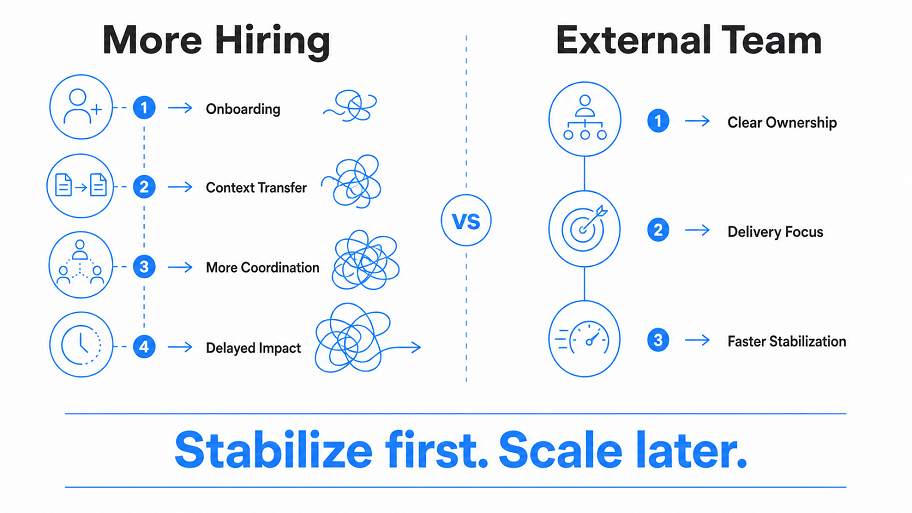
In many cases, the answer is not another recruitment round. Hiring can be the right long-term move, but it rarely solves a delivery crisis immediately. New developers need onboarding, context, access, mentoring and time to understand how the product really works. While they ramp up, the existing team must explain decisions, review more work and coordinate more dependencies.
That is why a well-structured external development team can be more effective than simply adding headcount. This is not because external people are ‘more productive’ by default, but because the right team enters with a stabilization mindset: reduce chaos, clarify ownership, improve delivery flow and protect the core product.
Why an External Development Team Can Stabilize Delivery
A delivery problem is often a system problem.
The team may have talented developers, but unclear boundaries. Product decisions may move faster than technical capacity. Architecture may force too many people to coordinate on every change. Testing may happen too late. Deployments may feel risky. Responsibilities may sit between teams instead of inside one accountable unit.
In that situation, adding more developers can increase the coordination burden instead of reducing it.
An external development team helps when it brings more than coding capacity. It should bring a delivery system: senior engineering judgment, project governance, QA discipline, DevOps support, architecture review and clear communication routines.
The goal is not to flood the project with people. The goal is to create a stable delivery unit that can take responsibility for a defined part of the system or a defined recovery objective.
That may include:
- stabilizing a critical module
- reducing deployment risk
- taking over a delayed workstream
- improving test coverage around key flows
- removing bottlenecks in the release process
- clarifying technical ownership
- supporting the internal team without overwhelming it
The difference is important. More hiring increases capacity later. The right external software team can reduce delivery risk now.
When More Hiring Makes Delivery Slower
Hiring feels logical when the backlog grows. More work should mean more people.
Software delivery does not scale that cleanly.
Every new person creates new communication paths. Every newcomer needs product context. Every new developer must understand code conventions, business rules, technical debt, deployment processes and team habits. If the product is already under pressure, the people best able to onboard newcomers are usually the same people who are already overloaded.
This creates a dangerous loop:
- the project is late
- management adds people
- senior developers spend more time explaining than delivering
- coordination increases
- review queues grow
- new bugs appear
- the project becomes even harder to predict
This does not mean hiring is wrong. It means hiring is rarely an emergency brake.
Hiring works best when the organization has time to onboard people gradually, clear ownership boundaries and enough internal capacity to mentor them properly. If those conditions are missing, recruitment may be part of the long-term plan, but it should not be the only response to delivery instability.
What an Outside Engineering Team Changes First
A strong outside engineering team should not start by asking, “How many developers do you need?”
It should start by asking, “Where is delivery breaking down?”
That diagnosis usually covers three areas.
Delivery Flow
The first question is whether work moves through the system smoothly.
If tasks sit in review for days, releases happen irregularly or every deployment creates anxiety, the project has a flow problem. In this case, the external team should look at change lead time, deployment frequency, change fail rate, failed deployment recovery time and deployment rework rate.
A measurement framework such as DORA’s software delivery metrics can help teams discuss delivery performance with more precision. The point is not to turn engineering into a dashboard exercise. The point is to replace vague pressure with visible bottlenecks.
Ownership Boundaries
Many delivery problems start when nobody knows who owns what.
One team builds a feature, another owns the API, a third owns deployment, while product decisions move across all of them. Every change requires negotiation. Every issue becomes a meeting. Every meeting creates more context switching.
An external development team can help by taking ownership of a bounded area. That may be a module, integration layer, application workflow, modernization stream or QA automation track.
Clear ownership reduces noise. It also gives managers a simple question to ask: “Who is accountable for this outcome?”
Technical Stability
Delivery speed depends on technical confidence.
If developers are afraid to change the system, progress slows. If tests do not protect critical paths, releases become risky. If architecture forces broad changes for small features, the team loses momentum.
External specialists can help stabilize the product by improving observability, test coverage, deployment discipline and rollback readiness. They can also identify where architecture is too complex for the current team size.
Sometimes the best technical move is not a rewrite. It is simplifying the path to safe change.
External Development Team vs. Staff Augmentation
Many companies compare external development teams with staff augmentation. They look similar because both involve external specialists. In practice, they solve different problems.
Staff augmentation works well when you already have strong internal leadership, clear tasks and enough management capacity. You bring in individual developers to support your team. Your organization still owns planning, onboarding, architecture decisions, task breakdown, QA and delivery risk.
An external development team works better when you need a partner to take responsibility for a larger delivery outcome. You are not only buying hours. You are buying a managed capability.
The difference becomes visible in a crisis.
If the project needs “more hands,” staff augmentation may be enough. If the project needs better ownership, better process and more predictable delivery, an external development team may be a better fit.
Signs You Need an External Development Team
You may need external support when the project shows repeated delivery friction, not just temporary overload.
Common signs include:
- deadlines slip even though the team is busy
- each release creates new defects
- the internal team cannot explain when work will be done
- senior developers become permanent bottlenecks
- hiring takes too long to protect the roadmap
- product scope changes faster than engineering can absorb
- architecture decisions depend on one or two people
- the team spends more time coordinating than shipping
These signals matter because they show that the issue is not only capacity. The issue is delivery design.
A good external partner should help you redesign how work moves through the product. That includes scope clarity, team boundaries, delivery metrics, release practices and risk management.
How to Use an External Software Team Without Creating More Chaos
External support helps only when the engagement is structured.
The worst approach is to add an outside team into the same unclear system and expect different results. If ownership, scope and communication remain vague, the external team becomes another dependency.
A better approach starts with a narrow stabilization brief.
Define:
- the business outcome that must improve
- the product area the external team owns
- the interfaces with the internal team
- the release and reporting cadence
- the quality standard
- the escalation path
- the first measurable milestone
The first milestone should be small enough to prove collaboration quickly. For example, stabilize one critical workflow, reduce release risk for one module or take over one delayed integration. Early proof matters because trust grows through visible delivery, not through promises.
What Business Leaders Should Expect
An external development team should not disappear into Jira and return weeks later with code.
For business leaders, the value of the model is visibility. You should understand what the team is stabilizing, why it matters and how progress will be measured.
The right partner should give you:
- clear ownership
- realistic delivery commitments
- transparent risks
- senior technical guidance
- structured communication
- measurable progress
- practical recommendations, not generic advice
This is especially important for organizations under pressure from investors, clients, internal stakeholders or regulatory requirements. When software delivery affects revenue, operations or customer trust, you need more than CVs. You need a team that can protect continuity and move the product forward.
When Hiring Still Makes Sense
This article is not an argument against internal hiring.
Hiring makes sense when you are building long-term product ownership, strengthening core engineering knowledge or expanding a stable team. Internal engineering capability becomes especially valuable when the product is a strategic capability that needs to stay close to the company.
Timing is key.
If the delivery system is already unstable, stabilize first. Then hire into a healthier environment. Otherwise, you risk bringing new people into a situation where nobody has enough time to help them succeed.
A practical sequence often looks like this:
- Use an external development team to stabilize delivery.
- Clarify architecture, ownership and release practices.
- Measure flow and quality improvements.
- Hire internally once the operating model is clearer.
- Keep the external team as a focused partner where it still creates leverage.
This way, hiring becomes a growth move, not a rescue tactic.
The Real Question Is Not “Internal or External?”
The better question is: “What kind of delivery problem are we solving?”
If you lack long-term product ownership, hire.
If you lack temporary specialist capacity, use staff augmentation.
If you lack delivery stability, consider an external development team.
Many software projects do not fail for lack of effort. They fail when that effort does not translate into predictable outcomes. Work gets stuck between teams. Requirements stay unclear. Architecture slows change. Releases become risky. Managers receive activity reports instead of confidence in delivery.
An external development team helps when it reduces that uncertainty.
The strongest partners do not just add developers. They help create the conditions in which software can move safely, quickly and predictably again.
Next Steps & Further Reading
If you want to explore how an external development team can stabilize your software delivery, the best starting point is a focused delivery assessment.
At Stermedia, we help leaders at startups and established organizations regain control over software delivery — from technical audits and project rescue to team extension, platform takeover and long-term product development.
Want to discuss your project? Contact our software development team.
Continue reading:
- Software Project Rescue: 5 Signs You Need External Help — how to recognize when a struggling development initiative needs structured outside intervention.
- Team extension or in-house? 7 arguments for startups — a practical comparison for founders and product leaders deciding how to scale engineering capacity.
- Extending the Java Team for the Enterprise Project. Striped Giraffe Case Study — a real-world example of external team support in an enterprise development context.