A legacy system takeover is not primarily a rewrite project. It is a business continuity project. The product still has to serve customers, process transactions and support internal teams while ownership, architecture and delivery responsibilities are changing. Teams that treat the takeover as a pure engineering cleanup usually create more risk than value. The safer path is incremental: stabilize, understand, isolate and replace only what must change first.
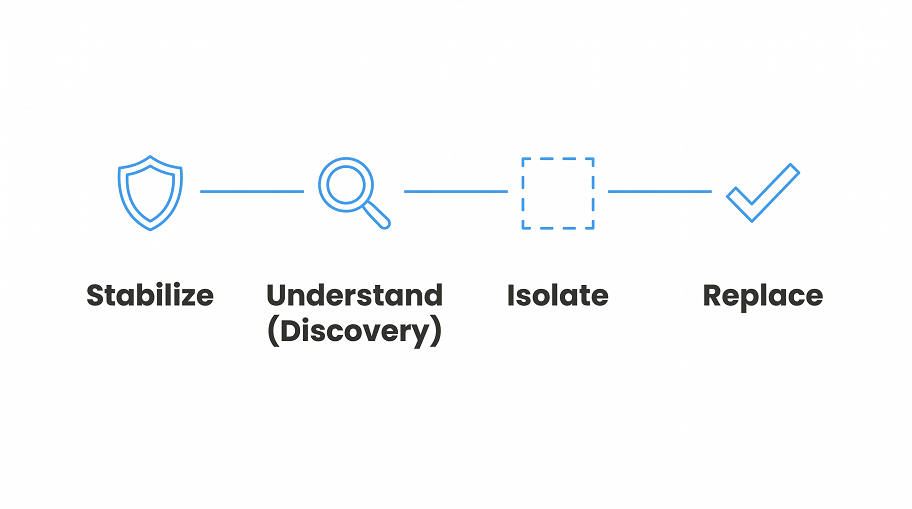
For organizations that rely on software to run revenue-critical operations, that distinction matters. A legacy product often sits at the center of revenue operations, customer service, logistics, compliance-heavy workflows or internal decision-making. In that context, the goal is not simply to modernize the stack. The goal is to reduce delivery risk, regain control and improve the product without disrupting the business. Long replacement programs built around feature parity alone often fail for one simple reason: the market keeps moving while the organization is still trying to rebuild what it already had.
Why Legacy System Takeover Projects Fail
One of the most common failure modes is the belief that there are only two options: either keep shipping and postpone modernization or stop shipping and rebuild. In practice, there is a wide middle ground. Modernization can happen progressively, while the legacy platform continues to operate and selected capabilities are moved, replaced or redesigned in stages.
Another common failure mode is the temptation to start with a clean rewrite. Teams inherit a chaotic platform, conclude that the current system is beyond rescue and decide to start over. That approach usually underestimates hidden use cases, undocumented rules, accumulated edge cases and the fact that the business does not stop evolving while engineering is rebuilding the system.
A third problem appears during vendor change. The incoming team often receives incomplete documentation, limited access and immediate pressure to solve security, stability or operational issues. By the time a new technology partner is brought in, the product is often already under strain. That makes the first phase of the takeover especially sensitive.
A Legacy Product Takeover Should Start With Continuity, Not Code
The first stage of a legacy product takeover should focus on continuity controls, not deep refactoring. Before making broad architectural changes, the new team needs to answer a few practical questions:
- What must stay online no matter what?
- Which workflows generate revenue or protect compliance?
- Where are the single points of failure?
- Which incidents would damage customer trust fastest?
- What can safely wait?
In many takeover scenarios, the new team has to fix serious problems before it fully understands the system. In that situation, confidence to deploy matters more than modernization ambition.
In practical terms, that usually means the incoming team should first establish:
- Production visibility
- Deployment discipline
- Rollback options
- Regression coverage for the most valuable flows
- A map of dependencies outside the codebase
That last point is especially important. In inherited systems, the code rarely tells the whole story. The biggest risks are often hidden in external integrations, infrastructure dependencies, deployment logic, access gaps and historical architectural decisions that were never properly documented.
Legacy System Takeover Needs Discovery Before Redesign
A sound legacy system takeover begins with structured discovery. Not discovery as a slide-deck exercise, but discovery as a way to reduce operational and delivery risk.
In many mature products, the architecture reflects how the business worked years ago, not how it operates today. Over time, the product evolves, but the code structure, the system boundaries and even the language used in the code often lag behind. When that happens, delivery slows down, innovation becomes harder and every change grows more expensive than it should be.
That is why discovery should answer three questions.
1. What does the business actually need now?
Do not modernize because the stack is old, the UI looks dated or the team dislikes the technology. Modernize where the current platform blocks revenue, customer experience, compliance or delivery speed.
2. Which parts of the platform are truly critical?
Not every ugly area is urgent. Some parts are merely frustrating; others are dangerous. A strong takeover team knows the difference between visible technical debt and business-critical fragility.
3. Which assumptions are false?
Inherited products are full of hidden use cases, partial refactors and fragile dependencies. The worst move is to assume that tests cover everything, documentation is accurate or migration will be easier than it looks. In large legacy systems, false assumptions tend to produce disproportionately expensive mistakes.
Platform Takeover Without Downtime: Use Seams, Not Big-Bang Rewrites
If the goal is a platform takeover without losing business continuity, the team needs controlled seams in the system rather than a single cutover event.
That usually means identifying a technical seam or product seam where a subset of users, workflows or traffic can take a new path while the old path remains available as fallback. Instead of switching the entire platform at once, the organization starts by moving one bounded area, validates the outcome in production and expands from there.
When seams are not obvious, parallel paths are often the safer option. The old and new implementations can run side by side, with outputs compared before final cutover. That makes it possible to prove correctness, reduce uncertainty and avoid exposing the entire business to one irreversible release.
This is the operational value of incremental modernization. It allows change to happen while the business continues to function.
What the Strangler Fig Pattern Changes in a Vendor Transition
In many takeover scenarios, the safest approach is to use the Strangler Fig pattern, replacing selected capabilities incrementally instead of attempting a single cutover.
Instead of promising to replace the whole system, the new team creates a controlled layer around the legacy platform and begins rerouting selected capabilities to new services one piece at a time. Traffic, features or processes can then move gradually from the old implementation to the new one.
This approach creates two major advantages. First, it reduces the amount of change introduced in any single release. Second, it gives the organization a practical rollback path if something goes wrong.
Feature flags, controlled routing and phased rollout all support this model. They allow old and new behavior to coexist until the replacement is stable enough to take over fully. In takeover projects, that is often the difference between a manageable transition and a high-risk migration.
So in practice, Strangler Fig is not just an architecture pattern. It is a continuity pattern.
What to Modernize First in a Legacy System Transition
A smart legacy system transition does not start where the code is ugliest. It starts where business risk and business value intersect.
Usually, those candidates fall into five groups.
Revenue-Critical Workflows
Checkout, quoting, account changes, invoicing, booking, subscriptions, dispatch, claims processing and similar business flows directly tied to revenue.
Stability Bottlenecks
Areas responsible for repeated incidents, performance degradation, fragile releases or unexplained downtime.
Security and Compliance Hotspots
Places where delaying remediation could create regulatory, contractual or reputational damage.
Cost-Heavy Legacy Dependencies
Unsupported middleware, expensive runtime environments or infrastructure that continues to drain budget without enabling growth.
Low-Risk Entry Points
Smaller features or bounded flows that let the team validate the modernization model before moving into more critical areas.
That final category matters more than many organizations expect. The first extraction is not just a technical milestone. It teaches the team how to collaborate, test, release, observe and govern the transition in a lower-risk setting.
A Practical Lesson From Takeover Projects: Start With Scope Clarity and Reverse Engineering
One of the most important realities of takeover work is that scope is rarely as clear as it looks at the commercial stage. Access, ownership boundaries, undocumented integrations and missing dependencies often appear only after the transition has started.
That is why reverse engineering is not a side activity in a takeover project. It is one of the core capabilities that makes a safe handover possible.
This is especially true in carve-outs, post-acquisition restructuring, vendor changes and other environments where the incoming team has to establish operational control before the target operating model is fully defined. In such cases, the first success is not shipping something new. The first success is understanding what exists, stabilizing what matters and taking responsibility without interrupting the business.
What Business Continuity Looks Like in Practice
Business continuity during takeover is not a slogan. It is a set of controls.
A mature takeover plan should include:
- Protected critical paths
- Explicit fallback routes
- Phased releases
- Production observability
- Output comparison between old and new paths
- Regression coverage for the most valuable flows
- Clear cutover criteria
- Rollback readiness
Just as importantly, continuity also requires alignment between product and engineering. Product owners and technology leaders need shared success metrics. The transition should be managed through hypotheses, measurable outcomes and clear operational checkpoints, not through vague promises of future modernization.
That is how trust is rebuilt during a takeover: not with declarations, but with controlled releases and visible results.
The Real Goal of Legacy Platform Modernization
The goal of legacy platform modernization is not to recreate the past on a newer stack. It is to build a platform that is easier to change, safer to operate and better aligned with how the business works now.
That is why a successful takeover team does not migrate everything by default. It questions inherited assumptions, removes obsolete behavior and avoids carrying forward historical complexity that no longer creates value.
For product and technology leaders, the implication is straightforward: the best takeover partner is not the one promising the fastest rewrite. It is the one that can stabilize the product, reduce dependency risk and modernize it incrementally without disrupting operations.
Conclusion
A successful legacy system takeover protects continuity first and transforms architecture second. The order matters. Start with control, visibility and the most business-critical flows. Build understanding before redesign. Replace incrementally through seams, parallel paths, feature-controlled rollout and fallback mechanisms. And if the project involves a vendor transition, assume from the start that documentation will be incomplete and part of the system will need to be rediscovered before it can be safely changed.
That is how organizations take over a legacy product without losing business continuity.
Next Steps and Further Reading
If you are planning a legacy system takeover, the safest first step is not a full rebuild. It is a focused discovery and stabilization phase that maps critical flows, identifies hidden dependencies and defines the smallest modernization moves that reduce risk without interrupting the business.
At Stermedia, we help software-driven companies take over existing platforms, stabilize legacy products and modernize them incrementally — from technical discovery and reverse engineering to phased delivery and long-term platform ownership.
Want to discuss your project? Contact our team
Continue reading:
- How do you take over IT architecture painlessly? Company Split — a practical Stermedia perspective on takeover scope, reverse engineering and operational ownership during transition.
- AI Software Development: Platform Takeover & Optimization — a related perspective on platform takeover and optimization services.
- Updating a Complex Broker System — a strong supporting case for readers interested in modernization of high-complexity business software.