Prescriptive analytics in business helps organizations move beyond forecasting future outcomes and start making concrete, data-driven decisions that directly impact profit, risk, and growth. Instead of stopping at predictions based on historical data, companies can analyze data from multiple data sets and evaluate alternative courses of action in real time. The goal is not only to anticipate future outcomes, but to recommend actions that lead to the best result under real-world constraints.
In an environment shaped by big data, artificial intelligence, and rapidly changing markets, prescriptive analytics answers the question executives care about most: what should we do next to make informed decisions?
From Data to Decisions: How Analytics Evolves
Most organizations mature analytically in a predictable way. They begin by collecting raw data and transforming it into reports that describe past performance. Over time, this evolves into broader business analytics, where teams seek to understand why certain outcomes occurred and how to respond.
Predictive analytics adds the ability to forecast what is likely to happen next, often using machine learning models trained on historical patterns and customer behavior. However, prescriptive analytics in business is the stage where analytics becomes a true decision-making tool — one that goes beyond prediction and actively supports cost effectiveness and operational optimization.
In practice, this type of data analytics evolves as follows:
- Descriptive analytics explains what happened based on historical data
- Diagnostic analytics clarifies why it happened
- Predictive analytics estimates what is likely to happen next
- Prescriptive analytics recommends what should be done
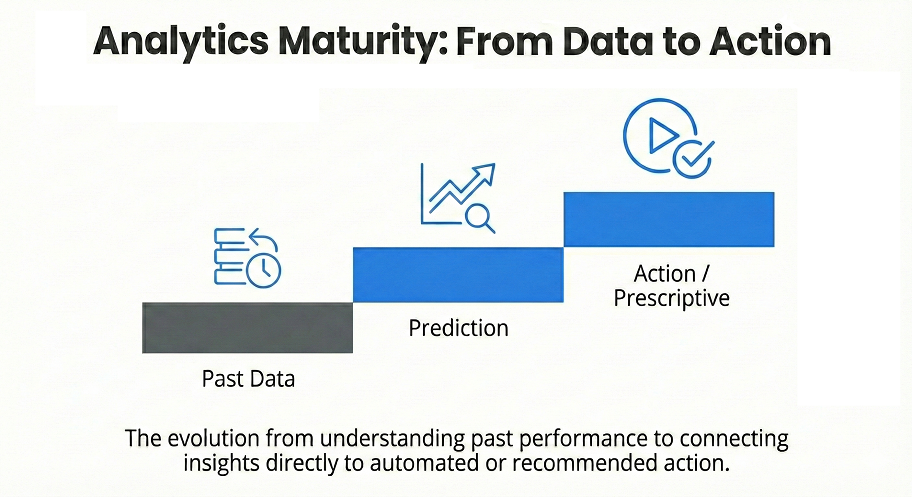
What distinguishes the final stage is not better forecasting accuracy, but the ability to connect data directly to action and enable truly informed decisions.
Why Predictive Analytics Alone Is Not Enough
Predictive analytics plays a critical role in modern business. By combining statistics, machine learning, and artificial intelligence, it enables organizations to forecast customer demand, estimate risk, and anticipate operational issues. These insights are valuable — but for executives, they often raise more questions than answers.
When a model predicts declining sales or rising costs, leadership must still decide how to respond. Should the organization adjust pricing, reallocate marketing spend, optimize operations, or delay investment? Each option represents a different course of action, with distinct cost and risk implications. Without structured decision support, choices tend to rely on intuition rather than data.
This is exactly the gap that predictive and prescriptive analytics are designed to close.
What Prescriptive Analytics Actually Delivers
Prescriptive analytics builds on predictive insights but explicitly models decisions, objectives, and constraints. Instead of presenting a single forecast, it evaluates multiple scenarios and identifies the option that best aligns with business goals.
At its core, every prescriptive analytics use case includes three elements:
- Decision variables – what the business can influence
- Objective function – what is being optimized (profit, cost, time, risk, cost effectiveness)
- Constraints – real-world limits such as budget, resources, capacity, or time
By combining these elements with predictive models and prescriptive analytical tools, organizations move from “this might happen” to “this is the decision that produces the best result.”
In practice, prescriptive analytics answers the key question decision-makers care about most: what should we do next, moving from forecasts to concrete action recommendations. This approach aligns with the widely accepted understanding of prescriptive analytics within the broader field of business analytics.
Operational Optimization in Practice
One of the most common applications of prescriptive analytics is operational optimization. Consider a manufacturing company producing multiple products with different margins. A purely intuitive approach would focus on the highest-margin product, but real-world constraints quickly make this strategy ineffective.
By combining demand forecasts, real-time operational data, and constraints related to labor, capacity, and materials, prescriptive analytics calculates the optimal production mix. The outcome is often counterintuitive yet objectively superior, maximizing total profit rather than individual margins. This approach enables organizations to improve cost effectiveness while responding dynamically to changes in customer demand.
Such optimization is difficult to achieve with spreadsheets, but it becomes feasible when predictive models and prescriptive analytics work together on unified data sets.
Strategic Decisions Under Uncertainty
Prescriptive analytics is equally valuable for high-level strategic decisions, especially in capital-intensive or fast-growing environments. Whether a company is deciding how to allocate budget, prioritize product features, or scale infrastructure, the same logic applies.
Prescriptive models allow leadership teams to:
- compare multiple investment scenarios
- quantify trade-offs between short-term gains and long-term strategy
- understand how constraints shape optimal decisions.
Instead of debating opinions, teams align around quantified outcomes and shared data-driven reasoning.
Why This Matters for Startup CEOs
For startup founders, decision quality often outweighs decision speed. Limited resources, investor scrutiny, and previous negative experiences with technology partners increase the cost of wrong choices. Prescriptive analytics in business reduces this risk by making the consequences of decisions visible before they are executed.
It supports founders in prioritizing initiatives, justifying strategic moves with data, and building MVPs that respond to real market signals rather than assumptions derived from incomplete or fragmented data.
Prescriptive Analytics Is About Execution, Not Complexity
A common misconception is that prescriptive analytics requires complex mathematics or massive volumes of data. In reality, the primary challenge lies in execution — translating business questions into decision models and integrating them into operational systems that work in real time.
Successful implementations focus on:
- clearly defined objectives,
- realistic constraints,
- production-ready solutions that decision-makers trust.
This is where experienced AI and data partners create the most value.
Next Steps & Further Reading
If you want to explore how prescriptive analytics in business can support better product, operational, or investment decisions, the best starting point is a small, controlled pilot.
At Stermedia, we help CEOs, startups, and established organizations deliver end-to-end AI and data solutions — from business analysis and proof of concept to production deployment.
Want to discuss your project or MVP? Contact our AI team.
Continue reading:
- How Companies Use Generative AI – 8 Use Cases – This article explores real-world examples of how organizations apply generative AI to automate decision-making, improve operational efficiency, and accelerate business processes. It shows how data-driven systems move from experimentation to measurable business value.
- Prediction of Potential Errors in the Early Production Process – A case study focused on predictive analytics in manufacturing, where early detection of potential issues reduces operational risk and cost. It demonstrates how predictive models support proactive decisions long before problems affect production or customers.
- Machine Learning Helps Cars Factory at Materials Consumption Prediction – This case study shows how machine learning models forecast material consumption in an automotive production environment, highlighting how predictive analytics becomes the foundation for optimization and prescriptive decision-making in constraint-driven industrial processes.