Software house evaluation should never start and end with an hourly rate, a portfolio page or a stack of impressive CVs.
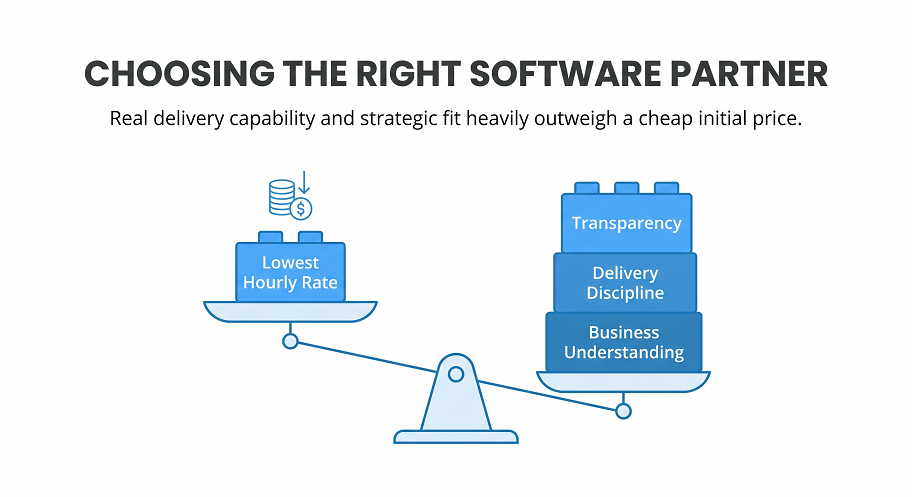
When you choose a software development partner, you do not simply buy coding capacity. You buy judgment, communication, delivery discipline, technical ownership and the ability to turn business context into working software. That is why the cheapest offer can become the most expensive option, and the most expensive vendor can still be the wrong fit.
A rate card tells you how much one hour costs. It does not tell you how many hours your team may lose because of unclear requirements, weak communication, poor testing, hidden technical debt or a vendor that does not understand your business model.
CVs are useful, but they are also marketing documents. They show experience, not necessarily how that experience will apply to your product, users and constraints.
So how should CEOs, founders, CTOs and product leaders evaluate a software house before signing the contract?
Below is a practical framework.
Why Software House Evaluation Needs More Than Price
Price matters. Budget matters. But price without context can mislead you.
A lower hourly rate may look attractive during procurement, especially when several vendors submit similar proposals. But the real cost of software development includes much more than development hours:
- Time your internal team spends explaining the same things repeatedly
- Missed deadlines caused by unclear scope
- Rework caused by weak business analysis
- Bugs that block adoption
- Technical debt that slows future development
- Vendor lock-in that makes switching providers expensive
- Lost revenue when the product does not support sales, operations or customer experience
The better question is not: “Which software house has the lowest rate?”
The better question is: “Which partner gives us the highest probability of reaching the business outcome with controlled risk?”
That shift changes the whole evaluation process.
Instead of comparing vendors only by price and team size, you start looking at business understanding, technical transparency, delivery model, communication standards, security practices and long-term maintainability.
Start With the Business Problem, Not the Feature List
A strong software development partner should understand why the project matters before discussing what needs to be built.
Many RFPs fail before vendors even respond because they focus too much on features and not enough on the business problem, constraints and success outcomes. If a vendor receives only a list of functions, they may estimate the list, but they will not necessarily understand the product.
Before asking for a quote, prepare answers to questions such as:
- What business problem are we solving?
- Who is affected by this problem?
- How does the current process work today?
- What does the problem cost in time, money, errors or missed opportunities?
- What does success look like after launch?
- Which systems, APIs, databases or workflows must the new software connect with?
- Which constraints are nonnegotiable: security, compliance, scalability, performance or data handling?
This is especially important in AI software development, intelligent automation and complex custom software projects. A vendor cannot propose a realistic solution if they do not understand the business context, data environment and operational constraints.
A good software house will ask questions before giving confident answers. A vendor that offers a fixed price, short timeline and no serious questions may optimize for sales speed, not project success.
Software House Evaluation Should Test the Delivery Process
A polished sales process does not guarantee a mature delivery process.
During evaluation, many companies spend too much time assessing sales materials and too little time assessing how the project will actually run. The person who sells the project may not be the person who builds it. The senior architect presented during the pitch may not stay involved after kickoff. The team shown in the offer may not be the team assigned to your product.
That is why software house evaluation should include delivery-specific questions:
- Who will work on the project after kickoff?
- What are their roles and responsibilities?
- How much time will senior technical leadership actually spend on the project?
- Who owns product decisions, technical decisions and delivery decisions?
- What does a typical sprint or delivery cycle look like?
- How often will we see working software?
- How will the team prioritize and resolve bugs?
- How will the team communicate risks?
- How will the team handle unclear requirements?
- What happens when scope changes?
You are not looking for a vendor that promises no problems. That is unrealistic. You are looking for a partner that can identify risks early, communicate them clearly and manage them before they become expensive.
In software projects, transparency is not a soft skill. It is a risk-control mechanism.
Evaluate Strategic Fit, Not Just Company Size
Large software houses are not always better. Small software houses are not always more flexible. The right choice depends on your project, industry, maturity and expected collaboration model.
A large vendor may offer scale, formal processes and broad expertise. But if your project is too small for them, you may become a low-priority client. In that situation, your project may not receive the best people, fastest response times or strategic attention.
A smaller vendor may offer stronger involvement, faster communication and more flexibility. But if your project is too large or technically complex, the team may struggle to deliver at the required scale.
The key question is: “Will our project be strategic for this partner?”
A good fit means your success matters to the vendor. You are not too small to be ignored, and you are not too large for the vendor’s delivery capacity. You should be important enough to receive senior attention, but not so complex that the vendor has to learn critical capabilities at your expense.
Look for evidence of fit:
- Similar project complexity
- Relevant domain experience
- Experience with your integration landscape
- Ability to challenge assumptions
- Clear ownership structure
- Stable senior involvement
- References from clients with comparable needs
A partner that has already solved a similar integration, workflow or business challenge may create more value than a larger company with a more impressive logo wall.
Check Whether the Vendor Understands Your Business Model
A software house should not blindly execute tickets. It should understand how your product creates value.
For a digital product, technical decisions influence marketing, sales, operations, compliance, customer experience and future scalability. For example, an e-commerce platform built without SEO, content management, loading speed and conversion paths in mind may require expensive rework after launch. An AI solution built without data governance and workflow adoption may never move beyond a proof of concept.
During evaluation, check whether the vendor asks about:
- Your users and their jobs to be done
- Sales and marketing channels
- Operational workflows
- Conversion goals
- Customer support processes
- Data quality and ownership
- Regulatory requirements
- Internal team adoption
- Long-term product roadmap
A strong custom software development company connects technology choices with business outcomes. It should not only ask what to build. It should ask why the feature matters, who will use it and how it will affect the product after launch.
Treat Technology Recommendations With Healthy Skepticism
Every software house has preferred technologies. That is normal. Specialization can be a strength.
But the technology stack should match your product, team, budget and long-term ownership model. A vendor should not push a technology only because it is convenient for them, fashionable on the market or useful for building internal team experience.
Before accepting a technology recommendation, ask:
- Why is this technology suitable for our business goal?
- What are its limitations?
- How many developers are available on the market?
- Can another vendor take over the project later?
- How mature is the ecosystem?
- What are the maintenance costs?
- What does the hosting and infrastructure model look like?
- How will this choice affect scalability, security and future development?
This is one of the most important areas of technology partner assessment. A poor stack decision may not hurt during the first few sprints, but it can become expensive when you scale, hire internally or switch vendors.
Avoid CV-driven development, where consultants recommend a technology because it looks good on resumes or helps the team experiment with something new. Innovation is valuable, but your product should not become a training ground unless you knowingly accept that risk.
Look for Anti-Lock-In Practices
Vendor lock-in is one of the most expensive hidden risks in software outsourcing.
It happens when your company becomes dependent on one provider because no one else can easily understand, maintain or extend the system. Lock-in can come from poor documentation, proprietary tools, unusual technologies, unclear ownership of repositories or limited access to delivery systems.
A trustworthy software development partner makes it easy for you to retain ownership. The same logic appears in mature vendor management in software development practices: you need access, visibility and clear ownership before problems emerge.
Before signing, confirm that you will have:
- Full access to source code repositories
- Clear intellectual property arrangements
- Access to documentation
- Access to task management systems
- Access to environments, deployment processes and build pipelines
- Transparent architecture decisions
- Clear code quality standards
- Transferable knowledge inside your organization
You should also know what happens if cooperation ends. Can another team continue the work? Can your internal developers maintain the product? Are the tools and technologies standard enough to avoid dependency on one vendor?
A reliable partner does not keep you by making leaving impossible. It keeps you by delivering value.
Ask About AI-Assisted Development and Code Review
AI has changed software delivery. It can accelerate development, testing, documentation and analysis, but only when teams use it responsibly.
Today, software house evaluation should include questions about AI-assisted development:
- Are developers allowed to use AI coding tools?
- Which tools are allowed?
- What data can and cannot be processed through AI tools?
- How will the team review AI-generated code?
- How does the team prevent security, licensing or quality issues?
- Do AI tools support testing, documentation or refactoring?
- Who is accountable for code quality when AI tools are used?
AI does not remove the need for engineering discipline. In fact, it increases the importance of review, governance and senior technical oversight.
A modern AI software development partner should be able to explain how AI improves productivity without exposing your data, weakening security or creating unreviewed code.
Red Flags in Vendor Evaluation
A vendor does not need to be perfect. But some warning signs should make you slow down.
Be careful when a software house:
- Gives a confident quote without understanding the business problem
- Asks very few questions
- Promises unrealistic timelines
- Skips testing, security or documentation details
- Avoids discussing risks
- Cannot explain who will work on the project
- Shows senior CVs but does not guarantee senior involvement
- Requests a large upfront payment without clear milestones
Rarely releases working software- Communicates only when you chase them
- Treats every scope change as an opportunity to increase cost
- Pushes a technology without explaining trade-offs
- Avoids IP, repository access or ownership discussions
One of the strongest signals is communication frequency. If you do not receive regular updates, see working software increments and understand what is happening, your risk increases quickly.
Software development is complex. Bugs and changes are normal. Silence is not.
Compare Vendors With a Scoring Framework
To avoid choosing based on charisma, brand recognition or price alone, create a simple scoring model before you collect proposals.
You can score each software house across criteria such as:
| Evaluation Area | What to Check |
|---|---|
| Business understanding | Does the vendor understand the problem, users and success metrics? |
| Relevant experience | Has the team solved similar technical or industry challenges? |
| Delivery process | How often will you see progress? How are risks managed? |
| Technical approach | Is the architecture maintainable, scalable and secure? |
| Team structure | Who will work on the project and how senior are they? |
| Communication | What cadence, tools and reporting standards are used? |
| Transparency | Will you have access to repositories, boards and documentation? |
| AI governance | Does the team use AI tools responsibly and securely? |
| Contract clarity | Are scope, IP, SLA, support and acceptance criteria defined? |
| Strategic fit | Will your project be important to this vendor? |
This kind of structured vendor evaluation makes proposals easier to compare. It also helps your internal team align on what matters most: deadline, cost, quality, scalability, innovation or long-term ownership.
Contract Terms Are Part of Software House Evaluation
The contract should not be treated as a legal formality after the “real” decision is made. It is part of the evaluation.
A professional software development agreement should define:
- Scope of work
- Deliverables
- Acceptance criteria
- Project schedule
- Budget and payment model
- Change request process
- Communication channels
- Documentation requirements
- Testing responsibilities
- Warranty and support
- SLA expectations
- Data protection
- Security responsibilities
- Intellectual property rights
- Project roles and escalation paths
The more complex the project, the more important these details become. Ambiguity may look convenient at the start, but it often becomes expensive during delivery.
A good partner will not avoid these topics. They will help clarify them.
The Best Software House Evaluation Question
One question often reveals more than a rate card or portfolio:
“What could make this project fail?”
A mature partner will answer honestly. They may mention unclear ownership, weak user validation, unstable requirements, poor data quality, integration complexity, internal decision delays, underfunded maintenance or unrealistic deadlines.
That answer is valuable. It shows whether the vendor thinks like a delivery partner or only like a sales organization.
The right software house does not promise a risk-free project. It helps you see the risks early, reduce them and make better decisions before money, time and momentum are lost.
Final Thoughts
Choosing a software house is not about finding the cheapest developers or the most impressive CVs. It is about selecting a partner that can understand your business, challenge your assumptions, build the right solution and keep you in control.
A strong software house evaluation process should help you answer three questions:
- Can this partner understand our business problem?
- Can this team deliver working software with transparency and discipline?
- Will we still own our product, knowledge and future options after launch?
When the answer is yes, you are not just buying development capacity. You are building a technology partnership that can support growth, innovation and long-term product success.
Next Steps & Further Reading
If you want to explore how a software development partner can help you build, scale or rescue a digital product, the best starting point is a structured discovery process.
At Stermedia, we help CEOs, startups and established organizations move from business needs to production-ready software — from needs analysis and proof of concept to custom software development, AI integration and long-term support.
Want to discuss your project? Contact our AI team
Continue reading:
- Working with Stermedia – AI Software Development Guide – a practical overview of how cooperation with Stermedia starts, from needs assessment to project scope and delivery planning.
- Navigating the Future of AI Software Development Outsourcing: Trends, Benefits and Best Practices – a broader guide to outsourcing as a strategic model for accessing expertise, scaling delivery and reducing operational complexity.
- Team Extension or In-House? 7 Arguments for Startups – useful for teams deciding whether to hire internally, extend their team or work with an external software development partner.