Software project rescue becomes necessary when a development initiative starts drifting away from its goals — deadlines slip, budgets grow and the team loses clarity about what should happen next.
Many software projects don’t fail suddenly. Instead, they gradually become harder to manage. Releases slow down, features introduce new bugs and every Sprint introduces more uncertainty instead of progress.
For CEOs, product owners and innovation leaders, this situation is especially stressful. The business still depends on the product, investors expect results and the development team is working hard — but the outcomes don’t match expectations.
The key question becomes: Is this a temporary slowdown or does the project need external intervention?
In this article, we’ll explore the most common signals that a project is in trouble and explain when bringing in an external development team is the smartest move.
Why Projects Derail in the First Place
Contrary to popular belief, failing projects are rarely caused by technology alone.
In many cases, the real issue lies in governance — how the project is organized, scoped and managed. Technology stacks, frameworks, and programming languages rarely determine success or failure by themselves, although poor technical choices can amplify existing governance and delivery problems.
Instead, problems usually appear in three critical areas:
- unclear project scope
- weak project governance
- lack of alignment between business and development teams
Many projects begin with a clear product vision in the founder’s or product owner’s mind. But unless that vision is translated into structured requirements and processes, developers may lack a clear target to work toward.
When the team doesn’t fully understand what problem the product solves, development becomes guesswork. Features are built, but they don’t necessarily move the product closer to business goals.
Early Warning Signs You May Need Software Project Rescue
Recognizing warning signals early makes software project rescue significantly easier and cheaper.
Here are some common symptoms that indicate the project may require intervention.
1 Scope Exists Only in Someone’s Head
One of the most common issues in troubled projects is uncaptured requirements.
Startups and small teams often rely on a founder’s or product owner’s vision instead of structured documentation. Developers receive fragments of the concept, but the full product logic remains undocumented.
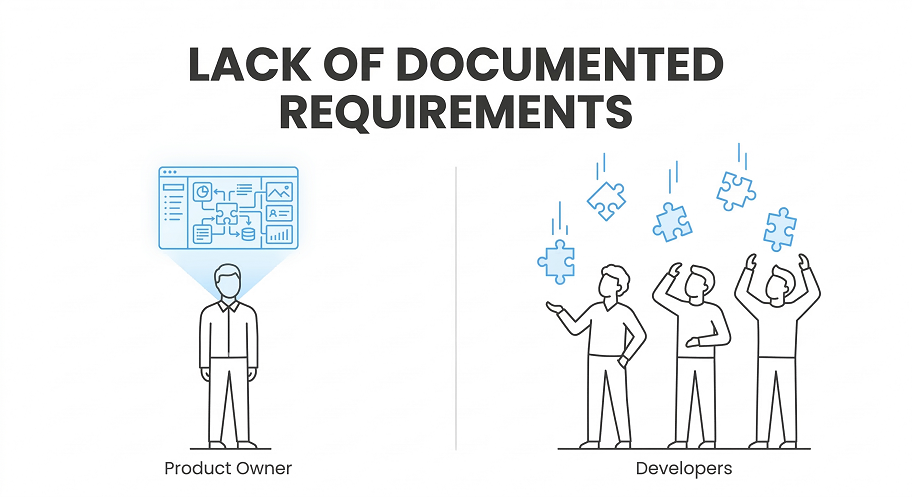
This creates several problems:
- inconsistent feature implementation
- repeated redesign of components
- unpredictable development timelines
Without a shared understanding of scope, even the best developers struggle to deliver consistent results.
2 Budget and Timeline Keep Expanding
When projects lack clearly defined scope, budget problems inevitably follow.
Unexpected work appears mid-development. Features take longer than expected. Teams spend time solving problems that should have been clarified earlier in the design phase.
In many cases, budget issues are simply scope problems in disguise.
If the project scope is properly defined, estimating effort and cost becomes significantly more reliable.
3 Developers Work Hard, But Progress Feels Slow
Another classic symptom is the feeling that the team is busy, but product delivery is inconsistent.
You may observe situations such as:
- every release introduces new bugs
- fixes take longer than expected
- developers disappear into technical rabbit holes
This usually happens when developers don’t fully understand the business problem they are solving.
Without clear requirements and architecture direction, technical teams often spend time exploring solutions rather than delivering outcomes.
4 Communication Between Teams Breaks Down
Software projects rely heavily on communication.
When collaboration weakens, problems multiply quickly. Teams may stop sharing information, dependencies remain unresolved and different parts of the system evolve in isolation.
Typical signs include:
- developers discovering integration issues late
- misunderstandings between product and engineering
- lack of ownership over features
In small teams especially, clear ownership and strong communication networks are critical.
5 Architecture Becomes Too Complex for the Team
Another risk appears when the technical architecture outgrows the organization’s capabilities.
This often happens when teams adopt advanced architectural patterns—such as complex microservices systems—without having the scale to support them.
Large technology companies may be able to manage complex microservice environments because they have dedicated platform, DevOps, and architecture teams. Smaller organizations often cannot justify that level of operational overhead.
The result?
- complicated infrastructure
- difficult debugging
- slower development cycles
In such cases, software project recovery often involves simplifying the architecture, not expanding it.
The Role of External Experts in Software Project Rescue
When these warning signs appear, an external team can help regain control of the project.
External specialists bring several advantages:
Objective Project Assessment
Internal teams may struggle to diagnose problems because they are too close to the project.
External experts can perform an independent audit covering:
- architecture
- development processes
- code quality
- delivery workflows
This creates a clear picture of where the project stands.
Structured Software Project Recovery Strategy
After diagnosing the issues, experienced teams implement a software project recovery plan.
Typical steps include:
- Stabilizing unstable systems
- Simplifying architecture where necessary
- Fixing development bottlenecks
- Restoring predictable delivery cycles
The goal isn’t to rebuild everything from scratch. The goal is to restore momentum and protect the investment already made.
Restoring Governance and Visibility
Many failing projects lack proper governance structures.
External partners often help introduce:
- clear ownership of components
- better requirement documentation
- milestone-based planning
- realistic risk management
Once governance improves, teams regain clarity and delivery becomes predictable again.
When to Bring in External Support for Software Project Rescue
Organizations often wait too long before asking for help.
In reality, the earlier a project is evaluated, the easier it is to recover.
Consider external support when:
- delivery timelines become unpredictable
- product quality declines after each release
- the team struggles to explain technical decisions
- architecture complexity slows development
In many cases, a short technical audit is enough to reveal the root causes and define the next steps.
Final Thoughts
Software development is inherently complex, but failing projects are rarely caused by a single mistake.
More often, they result from a combination of unclear scope, weak governance, communication gaps and architectural decisions that no longer fit the organization.
Recognizing these signals early and engaging experienced external specialists can transform a struggling project into a successful product.
In many situations, software project rescue is not about starting over—it’s about regaining control.
Next Steps & Further Reading
If your development initiative is experiencing delays, architectural complexity or unclear delivery progress, a structured software project rescue approach may help you stabilize and accelerate the product.
At Stermedia, we help CEOs, startups and established organizations recover struggling software initiatives — from technical audits and architecture reviews to full project takeover and development acceleration.
Want to rescue a struggling software project? Contact the Stermedia team
Continue reading:
AI Software Development: Platform Takeover & Optimization — A real-world case study showing how Stermedia took over an existing platform, stabilized its architecture and transformed it into a scalable product ready for further growth and AI-driven capabilities.
Team Extension or In-House: 7 Arguments for Startups — An overview of the key factors startups should consider when choosing between building an internal development team and working with an external technology partner.
Updating a Complex Broker System — A case study describing how Stermedia modernized and upgraded a critical insurance platform while maintaining operational continuity and system reliability.