Saudi Arabia is becoming one of the most attractive markets in the Middle East for custom digital products, advanced automation and enterprise AI, making it a strong market for an AI development company. That creates a major opportunity for companies looking for an AI development company in Saudi Arabia, but it also raises the bar. This is not a market where generic tooling or one-size-fits-all delivery is enough. Saudi organizations are investing in AI at a moment when infrastructure, public policy, and sector demand are all moving quickly, which means they increasingly need custom products built around real business workflows.
Why Saudi Arabia Is a Strong Market for an AI Development Company
The macro picture is already strong. In 2024, Saudi Arabia’s digital economy reached approximately SAR 495 billion, contributing 15% to GDP, while the ICT market surpassed SAR 180 billion. The Kingdom also reported nearly 99% internet penetration, more than 381,000 quality jobs in the technology sector, and 77% nationwide 5G coverage. For product builders and any AI development company, that is a powerful combination: market size, connectivity, digital maturity and policy support.
There is also clear momentum behind AI itself. Saudi AI spending has been projected at more than $720 million in 2024 and $1.9 billion by 2027, while cloud spending is expected to reach $4.7 billion by 2027. That matters because custom AI products do not scale without underlying cloud and data infrastructure, and Saudi Arabia has been building both aggressively through its Cloud First policy and broader digital investment programs.
Capital-market signals reinforce the same direction. On the first day of LEAP 2025, Saudi Arabia announced more than $14.9 billion in new AI and technology investments. In parallel, PIF launched HUMAIN as a national AI company spanning infrastructure, cloud, data centers, and advanced models, including multimodal Arabic large language models. Taken together, these moves show that Saudi Arabia wants to be not only a buyer of AI products, but also a builder of long-term AI capability.
The Strongest Demand Is in Complex and High-Value Sectors
The most promising AI opportunities in Saudi Arabia are not the most superficial ones. They are concentrated in sectors where operational complexity, scale, and decision quality matter. Healthcare is one of the clearest examples. Saudi Arabia is positioning digital health as a major growth area, with strong telehealth adoption, major spending on healthcare IT and digital transformation, and ongoing efforts to improve access and service quality through technology. That creates room for custom solutions such as triage tools, diagnostic support, patient platforms, workflow automation, and clinical decision support.
Finance is another clear growth area. The number of fintech companies in Saudi Arabia continues to rise rapidly, and the long-term target remains 525 fintech companies by 2030. Growth at that pace creates demand for custom platforms, secure integrations, onboarding flows, analytics, fraud controls, and AI-supported decision systems.
More broadly, Saudi Arabia’s AI and digital economy agenda continues to create opportunities across industries where integration, process design and regulatory fit matter more than generic tooling. That is exactly where custom AI development becomes more valuable than off-the-shelf software for companies building products for the Saudi market.
Why Off-the-Shelf AI Is Often Not Enough for Saudi Projects
This is where many companies make the wrong assumption. They see Saudi Arabia as a high-growth AI market and assume that a global SaaS stack or a generic GenAI wrapper will be enough. In practice, the Saudi market often demands deeper localization, stronger systems integration, and tighter control over data handling than off-the-shelf tools were originally designed for.
That challenge is not just technical. In practice, factors such as data localization, cross-border data restrictions, compliance requirements, public-sector procurement complexity, and growing local content expectations all matter. In other words, building for Saudi Arabia is not just a software challenge. It is also an architecture, compliance, and delivery challenge.
That is why choosing an AI development company in Saudi Arabia should be about fit, not just rate card or headcount. The right partner needs to understand where product design, system architecture, governance and market realities intersect.
What Companies Should Look For in an AI Partner
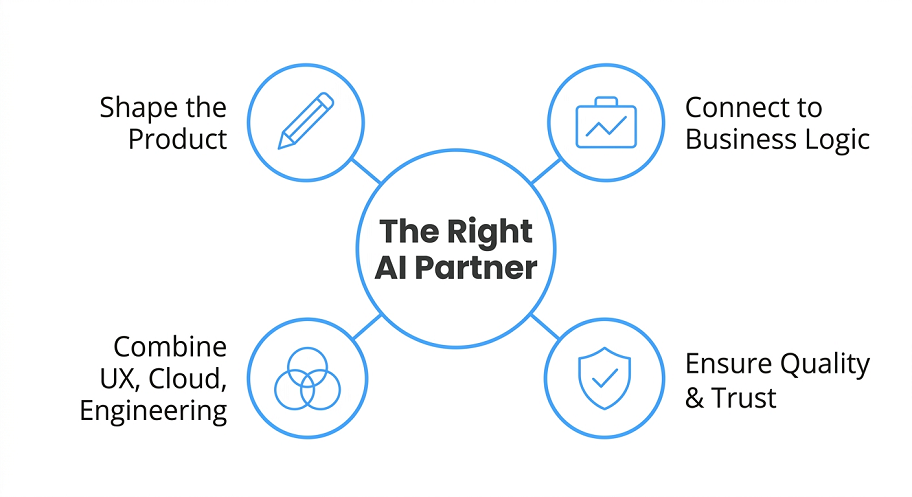
The right partner for Saudi projects should be able to do four things well. First, it should help shape the product, not just implement tickets. Second, it should connect AI to real business logic rather than ship a demo. Third, it should combine UX, engineering, and cloud thinking in one team. Fourth, it should be comfortable working in environments where process quality, trust, and scalability matter.
That is where our positioning is strong. At Stermedia, we combine AI, automation, software development, and product design in one delivery model. That mix matters in Saudi Arabia, where companies often need more than development capacity alone. They need structured discovery, realistic scoping, technical architecture, and a product team that can move from idea to implementation without losing sight of business value.
Our Saudi-Relevant Experience
Our most direct public reference point for the Kingdom is our Saudi healthcare case study. In that project, we worked on an AI-supported primary care concept designed to improve access to care in Saudi Arabia. The solution concept allowed patients to submit symptoms, receive an AI-generated report with a possible diagnosis, and share that output with a doctor. Our role was to help shape the product through workshops, translate the concept into a structured MVP backlog, and align scope with realistic time and budget expectations.
That kind of work is highly relevant in Saudi Arabia because many projects do not start with full-scale implementation. They start with discovery, prioritization, workflow design, validation, and a credible MVP path. For healthcare providers, startups, investors, and enterprise innovation teams, that early-stage product discipline is often what determines whether an AI initiative turns into a scalable product or stalls after the concept phase.
Our broader positioning supports that story as well. Across our AI-related work, we consistently treat successful AI delivery not as isolated model work, but as a combination of business alignment, governance, workflow fit, scalable engineering, and iterative rollout. That is a good match for the Saudi market, where AI buyers are increasingly focused on usable products and measurable outcomes rather than emerging-tech branding alone.
Why This Positioning Works in Saudi Arabia
Saudi buyers are increasingly looking for tangible business outcomes, not just innovation branding. They want products that reduce friction, improve decisions, speed up service delivery, and integrate into real operations. The Kingdom’s market conditions support that: strong infrastructure, rising AI budgets, growing cloud adoption, and expanding sector demand. But those same conditions also reward partners who understand delivery discipline, compliance boundaries, and product-market fit.
That is why the phrase AI development company in Saudi Arabia should signal more than outsourced engineering. It should signal product strategy, technical architecture, UX, AI enablement, and long-term iteration. Framed that way, our angle is strong: we bring AI and software depth, visible Saudi healthcare experience, and a delivery model that can support multiple Saudi sectors with a practical, sector-aware delivery approach..
Final Thoughts
Saudi Arabia is becoming a serious market for custom AI products, and the best opportunities are likely to go to teams that can connect technology with local execution realities. Companies entering the Kingdom need more than code. They need a partner that can shape the product, navigate complexity, and build something useful, scalable, and commercially relevant. That is how Stermedia can support companies building AI products for the Saudi market.
Next Steps & Further Reading
If you are exploring how to launch or scale a custom AI product in Saudi Arabia, the best next step is usually a focused discovery phase or a small, controlled pilot. This approach helps validate business value, technical feasibility, product scope, and market fit before moving into full-scale delivery.
At Stermedia, we support companies across the full AI delivery journey — from discovery and solution design to proof of concept, MVP development, and production rollout.
Want to discuss your project? Contact our AI team
Continue reading:
- Artificial Intelligence in Saudi Arabia: Why the Kingdom Is Becoming a Regional Innovation Hub: A broader view of Saudi Arabia’s AI ecosystem — from Vision 2030 and digital infrastructure to investment momentum, sector demand, and the conditions making the Kingdom a strong market for AI products.
- AI Consulting for NLP Solutions: from MVP to Production: A practical look at how to move from an AI idea to a production-ready NLP solution through the right discovery process, scope definition, and implementation path.
- Why Quality Assurance Is Essential in AI Projects: An overview of why testing, validation, and quality control are critical in AI products — especially when reliability, trust, and long-term scalability matter.
Sources
This article is based on publicly available market data, official government communications, and industry guidance, including materials from the Ministry of Communications and Information Technology (MCIT), the Saudi Data & AI Authority (SDAIA), the Public Investment Fund (PIF), the Financial Sector Development Program (FSDP), and U.S. Commercial Service market guidance on Saudi Arabia’s digital economy.
Key references include:
- Ministry of Communications and Information Technology (MCIT): official updates on Saudi Arabia’s digital economy, including market size, ICT growth, internet penetration, and LEAP 2025 investment announcements
- Saudi Data & AI Authority (SDAIA): official information on Saudi Arabia’s national AI strategy and institutional AI framework
- Public Investment Fund (PIF): official announcement of HUMAIN and Saudi Arabia’s AI infrastructure and model-development ambitions
- Financial Sector Development Program (FSDP) / Vision 2030 reporting: official reporting on fintech growth, sector progress, and long-term targets in the Kingdom
- U.S. Commercial Service (trade.gov): market guidance on Saudi Arabia’s digital economy, including AI spending, cloud spending, Cloud First policy, and digital infrastructure trends