Artificial Intelligence in Warsaw is becoming a serious business topic because Poland’s capital combines startup density, fintech strength, engineering talent and growing AI-sector visibility in one of Central and Eastern Europe’s most important markets.
Warsaw is not just Poland’s political and economic center. It is also one of the country’s strongest technology environments, where startups, enterprise buyers, financial institutions, universities, investors and global technology companies operate close to one another. For companies planning AI products, automation programs or data-driven platforms, that proximity matters.
AI does not scale through models alone. It needs business problems, data, technical talent, infrastructure, capital and implementation partners. Warsaw has more of these ingredients than most cities in the region.
Dealroom tracks 701 startups in Warsaw and estimates the city’s combined startup enterprise value at $9.9 billion, with $280.7 million in venture capital invested over the last 12 months. That makes Warsaw a visible startup ecosystem, not only a large administrative capital.
Artificial Intelligence in Warsaw Is Built on a Strong Technology Base
A serious AI market needs more than enthusiasm. It needs a mature technology base, and Warsaw benefits from Poland’s broader IT and ICT sector.
According to PARP’s 2025 report, Poland has more than 100,000 ICT entities and nearly 3,000 medium-sized firms in the sector. The report also describes Polish companies as providers of advanced solutions in AI, cloud computing, IoT and cybersecurity, while Poland’s technology sector continues to move from outsourcing and service delivery toward global innovation.
Warsaw plays a central role in that shift. It is the largest business city in Poland, a strong academic center and a natural entry point for companies expanding into Central and Eastern Europe. It is also becoming more visible as an AI-specific location.
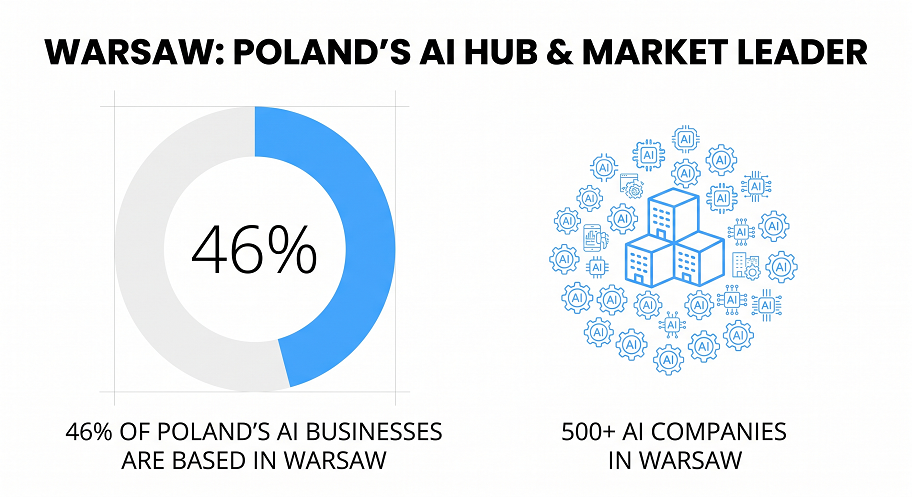
The State of Warsaw AI report describes the Warsaw-based artificial intelligence sector as a significant part of the Polish technology market. According to Digital Poland, the capital brings together around 500 AI companies, representing 46% of Poland’s AI businesses.
For buyers, that creates a practical advantage. Warsaw offers access not only to software developers, but also to data scientists, machine learning engineers, AI consultants, UX specialists, cloud experts and product teams that can support the full path from concept to production.
Why Artificial Intelligence in Warsaw Matters for Business
The most valuable AI ecosystems are usually close to real business demand. Warsaw has that demand.
One of the clearest examples is fintech. Antal’s report on the fintech industry in Warsaw states that 45% of Polish fintech companies are headquartered in Warsaw, confirming the city’s dominant role in the sector.
That matters because fintech creates natural demand for AI and automation. Financial companies need faster onboarding, better fraud detection, more efficient compliance workflows, customer service automation, risk scoring, document analysis and secure data processing. These are not abstract AI ideas. They are operational problems where machine learning, NLP, decision-support systems and workflow automation can create measurable value.
The same logic applies beyond finance. Warsaw is relevant for healthcare, logistics, public services, professional services, cybersecurity, education and enterprise software. Each of these sectors has processes that can benefit from AI when the solution is built around real workflows instead of generic functionality.
Artificial Intelligence in Warsaw Has Strategic Momentum
AI in Warsaw is also connected to Poland’s broader strategic technology agenda.
In February 2025, Google and Poland signed a memorandum to develop the use of AI in energy, cybersecurity and other sectors. Google CEO Sundar Pichai also said that Poland is Google’s biggest engineering hub, with more than 2,000 employees.
This matters because AI is moving from experimentation into national competitiveness, security and infrastructure. Energy, cybersecurity, healthcare and public-sector modernization are not lightweight use cases. They require strong engineering, safe architecture, reliable systems and clear governance.
Warsaw is well positioned in that context because it concentrates business decision-makers, technical talent, investors and public-sector institutions in one place. That makes the city an important environment for AI initiatives that need both market access and execution capability.
Where AI Demand in Warsaw Is Likely to Grow
The strongest opportunities for artificial intelligence in Warsaw are likely to appear in sectors where complexity, data and decision quality matter most.
That includes:
- Fintech and banking: fraud detection, onboarding, regulatory workflows, document intelligence and customer service automation.
- Healthcare: triage support, patient platforms, medical data processing and operational workflow optimization.
- Cybersecurity: anomaly detection, threat analysis, risk scoring and AI-supported monitoring.
- Enterprise operations: internal copilots, knowledge management, reporting automation and process optimization.
- Logistics and mobility: forecasting, routing, resource allocation and operational planning.
- Public services: correspondence automation, case classification, citizen-facing digital services and decision-support systems.
These opportunities are valuable because they connect AI with measurable business outcomes. The point is not to add AI for branding. The point is to reduce manual work, improve decisions, accelerate service delivery and make complex operations easier to manage.
Why Generic AI Tools Are Not Enough
Many companies begin with public AI tools, low-code platforms or lightweight prototypes. That is often a useful starting point. But it rarely solves production-level business problems.
The challenge is not access to a model. The challenge is fit.
A generic AI tool usually does not understand a company’s data structure, user permissions, compliance obligations, existing systems, security rules or operational workflow. It may help a team explore an idea, but it will not automatically become a reliable product.
This is especially important in finance, healthcare, cybersecurity, public administration and enterprise software. In these sectors, AI systems need to be tested, monitored, integrated and governed. Outputs must be useful, secure and explainable enough for real users to trust them.
That is why AI adoption in Warsaw will increasingly depend on custom software development, not only model access.
Why Stermedia Fits the Warsaw AI Opportunity
At Stermedia, we combine AI, automation, software development and product design in one delivery model. That matters in a market like Warsaw, where buyers often need more than experimental AI features. They need product discovery, data readiness assessment, UX design, software architecture, quality assurance, integration and production deployment.
We also have a real local connection. Stermedia operates in Poland and lists a Warsaw office alongside its other locations. That makes Warsaw more than a geographic SEO label for us. It is a business environment where we can support companies with AI, software and product expertise.
Our value is strongest when a company wants to move from AI interest to implementation. We help teams define the use case, validate technical feasibility, build proof of concept, develop an MVP and move toward scalable production systems.
That fits the Warsaw market well. The city has talent, business demand and AI visibility. What many companies still need is a partner who can connect those conditions with practical delivery.
Final Thoughts
Artificial intelligence in Warsaw matters because the city brings together the core conditions needed for AI growth: technology talent, startup activity, fintech strength, enterprise demand, academic depth and access to the wider European market.
For companies planning to launch or scale AI-enabled products, Warsaw is more than a location. It is a practical environment for building technology that solves real operational problems.
The opportunity is real, but success depends on execution. AI projects need more than models and ambition. They need clear product thinking, software architecture, testing, integration and long-term improvement.
That is where Stermedia can make a meaningful difference.
Next Steps & Further Reading
If you want to explore how Artificial Intelligence in Warsaw can support your product, operations or market-entry strategy, the best starting point is usually a focused discovery phase or a small, controlled pilot.
At Stermedia, we help CEOs, startups and established organizations move from AI opportunity to working product – from needs analysis and proof of concept to MVP development, integration and production deployment.
Want to discuss your project? Contact our AI team
Continue reading:
- AI Consulting and Integration as a Business Strategy – A practical look at how companies can move from AI experimentation to measurable business outcomes by aligning technology with workflows, governance and long-term business priorities.
- AI Development – Your Strategic Partner in Building Modern Digital Products – An overview of how AI can accelerate MVP delivery, support scalable product development and create long-term business value when combined with the right product and engineering approach.
- Why Quality Assurance Is Essential in AI Projects – An overview of why testing, validation and quality control are critical in AI products, especially when reliability, trust and long-term scalability matter.
Sources
This article is based on publicly available market data, official ecosystem materials and industry reporting, including:
- Dealroom – Warsaw startup ecosystem profile, including startup count, enterprise value and VC investment.
- PARP – The IT/ICT Sector in Poland report 2025, including data on ICT entities, medium-sized technology firms and Poland’s technology-market direction.
- Antal – Fintech Industry in Warsaw report, including data on the share of Polish fintech companies headquartered in Warsaw.
- AP News – Google and Poland AI memorandum, including AI cooperation in energy, cybersecurity and other sectors.
- City of Warsaw – State of Warsaw AI – official city page presenting the State of Warsaw AI report.