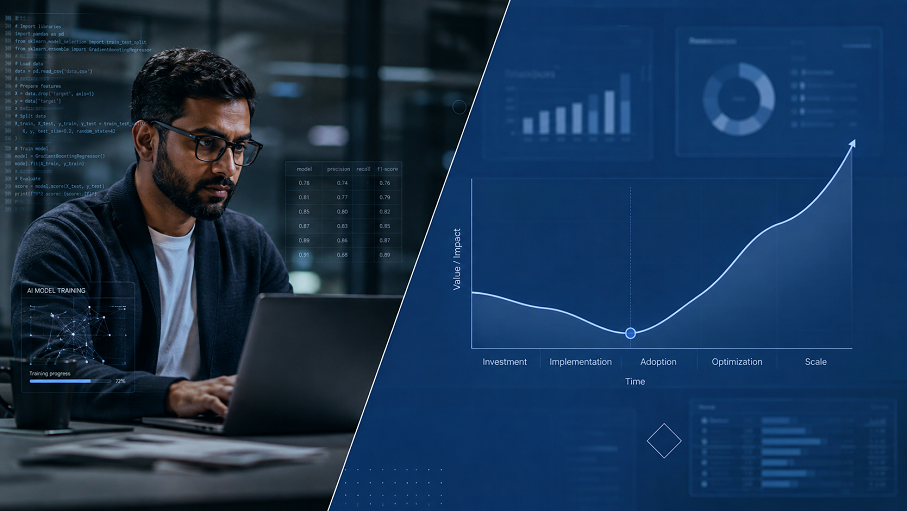
Enterprise AI is entering a new phase.
For the last two years, companies have tested generative AI, copilots, chatbots and automation tools. Many have launched proofs of concept. Many have built demos. Many have given teams access to AI assistants.
But access is no longer the main challenge.
The harder question is now much more practical:
How do you turn AI into a production system that works inside a real organization?
This is why the role of the Forward Deployed Engineer is gaining attention across the AI market. OpenAI describes FDEs as engineers who lead complex end-to-end deployments of frontier models in production, working directly with customer engineering and domain teams. Anthropic describes a similar role: engineers who embed with strategic customers to drive AI adoption and build production applications with Claude.
The signal is clear: enterprise AI is not only a model capability challenge.
It is a deployment challenge.
And deployment is where business value either appears or disappears.
The Gap Between AI Potential and AI Value
Most companies do not lack access to AI anymore.
They can buy APIs. They can use enterprise AI platforms. They can run internal workshops. They can test copilots. They can build prototypes quickly.
Yet many organizations still struggle to move from experimentation to measurable impact.
McKinsey’s 2025 global AI survey describes a market where AI use is expanding, including agentic AI, but the move from pilots to scaled impact remains a work in progress for most organizations. The same research highlights that high performers manage AI across strategy, talent, operating model, technology, data, adoption and scaling.
This is the real enterprise AI gap.
It is not the gap between an old model and a new model. It is the gap between a promising technology and a working business capability.
That gap usually includes:
- messy and fragmented data,
- undocumented workflows,
- legacy systems,
- unclear ownership,
- compliance and security constraints,
- user resistance,
- weak evaluation processes,
- lack of integration with CRM, ERP, document management or internal tools.
A demo can ignore most of these constraints.
A production AI system cannot.
What Is a Forward Deployed Engineer?
A Forward Deployed Engineer, or FDE, is a technical specialist who works close to the customer’s real environment.
The role is not limited to writing code. It is also not traditional consulting. An FDE combines engineering, product thinking, domain discovery and deployment ownership.
In practice, an FDE helps answer questions such as:
- What business process should AI actually improve?
- What data is available, reliable and safe to use?
- Which parts of the workflow should be AI driven?
- Which parts should stay deterministic?
- Where does human review still matter?
- How should the solution integrate with existing systems?
- How do we measure whether it works?
Palantir helped popularize this model years before the current generative AI wave. Its Forward Deployed Software Engineer role shows a different delivery logic than traditional software development: instead of building generic features for abstract users, FDEs work close to specific customers and their operational problems.
That distinction matters.
A traditional software delivery model often starts with a specification.
Forward Deployed Engineering starts with the customer’s reality.
Why This Role Matters More in the AI Era
AI changes what companies can automate.
Modern models can analyze documents, summarize knowledge, generate code, classify information, support decisions and operate through agents. This creates new possibilities, but it also creates a new implementation problem.
The number of possible AI use cases inside an enterprise is enormous.
Every department has workflows. Every workflow has exceptions. Every exception has business context.
That is why AI deployment cannot rely only on generic products. Many enterprise problems are too specific, too regulated or too deeply embedded in existing systems.
The strongest FDE teams do not simply ask, “Where can we add AI?”
They ask, “Where can AI change the operating model?”
This is a different level of ambition. It means redesigning how work happens, not just adding a model to an existing process.
OpenAI’s launch of the OpenAI Deployment Company is a strong market signal in this direction. OpenAI says the company is designed to help organizations build and deploy AI systems they can rely on every day across their most important work. It also announced an agreement to acquire Tomoro, a company specializing in AI adoption and enterprise deployment, bringing experienced Forward Deployed Engineers and Deployment Specialists into the new company from day one.
In other words, the frontier is no longer only model performance.
The frontier is implementation.
AI Systems Need Business Context
One of the biggest mistakes in enterprise AI is assuming that the model is the process.
It is not.
A model may extract information, classify a document, generate a recommendation or support a user decision. But the surrounding workflow still needs structure.
Someone must define:
- where the input comes from,
- how the system validates it,
- what the model is allowed to decide,
- where deterministic logic is safer,
- when a human must approve the result,
- how outputs move into downstream systems,
- and how quality is measured over time.
This distinction is especially important in agentic AI. Agents can perform more complex tasks than simple prompts, but they also need boundaries, tools, evaluations and operational controls.
In enterprise environments, the best architecture is often hybrid.
AI handles ambiguity, language, context and judgment-heavy tasks. Deterministic systems handle orchestration, permissions, schemas, validation, auditability and repeatable transactions.
That is where Forward Deployed Engineering becomes valuable.
An FDE does not treat AI as magic.
An FDE treats AI as one part of a production system.
From Proof of Concept to Production
A proof of concept can be impressive and still fail.
It may work on a small sample. It may perform well in a controlled demo. It may show that a model can solve part of the problem.
But production requires a different standard.
A production AI system must work with real data, real users, real exceptions, real latency requirements, real security policies and real business consequences.
That is why many AI projects stall after the pilot stage. The problem is not always the model. Often, the problem is that nobody owns the difficult middle layer between model capability and operational reality.
Forward Deployed Engineering fills that layer.
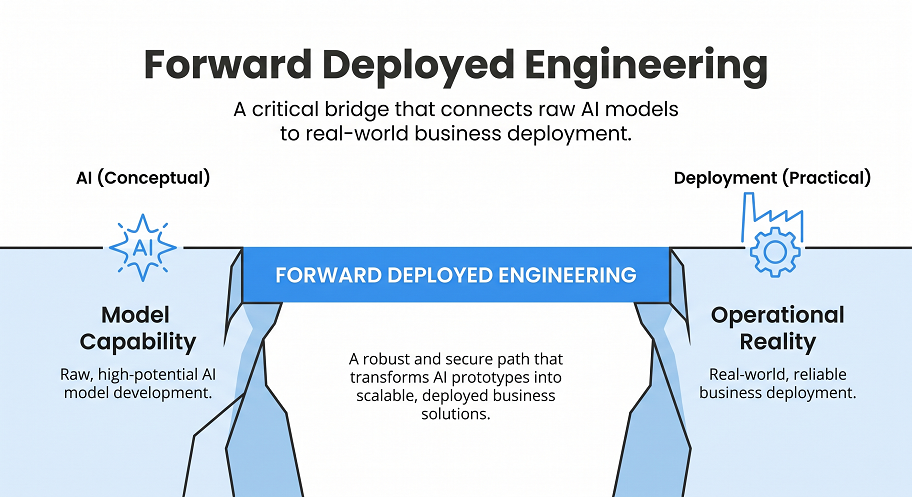
It connects discovery, architecture, data readiness, user workflow analysis, rapid prototyping, production implementation, integration, evaluation and iteration.
This is not an optional add-on.
For many enterprise AI initiatives, it is the difference between a demo and a business capability.
We Have Worked This Way for Years
Forward Deployed Engineering may sound like a new category created by the largest AI companies.
For Stermedia, it describes an approach we have practiced for years.
We do not start by asking, “Which model should we use?”
We start by asking:
What business process needs to change, what data can support it and what has to be true for this solution to work in production?
You can see this pattern across our work in healthcare, manufacturing and public administration.
In clinical trial planning, the challenge was not simply to apply AI to medical documents. The client needed to turn thousands of complex, inconsistent PDFs into structured and trustworthy data. Stermedia designed a hybrid workflow that combined OCR, agentic AI, structured outputs, deterministic orchestration, validation layers and human review. One medical document that previously required roughly half a day to a full day of expert work can now be processed automatically in about 5 minutes, with overall extraction quality around 65% to 70% and selected fields approaching 90%.
In industrial energy management, the challenge was to connect AI with the physical reality of manufacturing. Stermedia developed an AI-driven Energy Management System for industrial compressors to optimize energy losses, prevent unplanned downtime and extend equipment lifetime. The project showed that successful AI in industrial systems depends on more than algorithms. It requires process alignment, data reliability and organizational readiness to act on insights.
In public administration, the Warsaw RPA project required more than automation scripts. Stermedia built a secure and scalable robotic process automation environment for processing thousands of waste declarations each month. The solution combined Blue Prism, Decipher IDP, dedicated infrastructure, role-based access, VPN-based entry points, GDPR alignment, validation rules and human verification where needed.
These projects differ by industry and technology.
But the delivery pattern is consistent:
We enter the client’s operational context, understand the real constraints, design the right technical architecture and help move the solution toward practical use.
That is the core of Forward Deployed Engineering.
Why This Is Not Just Consulting
There is an important distinction between Forward Deployed Engineering and traditional consulting.
Consulting often ends with recommendations.
Forward deployed engineering must end with working systems.
An FDE team can analyze, advise and design, but it also has to build, integrate, test and iterate. The responsibility does not stop at the slide deck.
There is also an important distinction between Forward Deployed Engineering and custom development.
Custom development can solve one client’s problem once. Forward Deployed Engineering should generate reusable knowledge.
The best teams ask:
- What did we learn from this deployment?
- Which patterns can we reuse?
- Which components should become part of our delivery toolkit?
- Which problems are specific to this client?
- Which problems will appear again in the next enterprise deployment?
This is what makes the model scalable.
It respects the uniqueness of each client, but it does not treat every engagement as a blank page.
AI Value Comes From Deployment
The next stage of enterprise AI will not be won by companies that collect the most pilots.
It will be won by companies that turn AI into measurable operating change.
That means fewer isolated demos and more production systems, fewer generic tools and more workflow-aware solutions, and less model hype with more business accountability.
Forward Deployed Engineering gives this shift a name.
But the name is less important than the principle behind it:
AI creates value only when it reaches the real workflow.
At Stermedia, this is how we approach AI delivery. We connect models with data, software, automation, users and business processes. We design systems that can be tested, validated, integrated and improved.
Because enterprise AI does not end when the model responds.
It starts when the organization can use that response to do real work better.
Ready to Move AI From Pilot to Production?
At Stermedia, we help companies identify valuable AI use cases, design production-ready architectures and deploy solutions that work in real business environments.