A software development partner should not be tested with a random small task, but with a controlled first scope that shows how the team thinks, communicates, delivers and handles uncertainty.
For product companies, this is often the safest way to make a high-stakes decision.
You may have a product roadmap to deliver, investors waiting for progress, internal users asking for improvements or a legacy system that needs attention. You may also receive many similar-looking proposals from software vendors. Everyone promises senior developers, clear communication, an understanding of the business and fast delivery.
The real question is simple: How do you determine whether those promises are true before you give an external team your product, budget and trust?
A small first scope can answer that question. When designed well, it gives you more than a piece of code. It shows whether a potential software development partner can understand your business goal, challenge assumptions, manage risk and work as part of your product organization.
Why Test a Software Development Partner First?
Choosing a software development partner based only on sales calls, case studies and proposals is risky.
For example, a good presentation can explain the process. It can list technologies, industries and team roles. But it cannot fully show how the partner behaves once the real work begins.
This is why some product teams use a pilot project as part of their partner selection process, allowing them to gather evidence before committing to a larger engagement. Instead of relying only on portfolios, proposals or sales conversations, they validate how a potential software development partner works in practice: how they communicate, manage scope, deliver working software and respond to feedback.
Therefore, that first controlled engagement is where the difference becomes visible.
You see how the team asks questions. Their priorities also become clear: do they care about business outcomes or only about features? It soon becomes apparent whether they identify risks early or avoid difficult conversations. Their reaction to incomplete documentation, scope changes or incorrect technical assumptions reveals even more.
For product companies, the cost of choosing the wrong external software team is rarely limited to the invoice. It can lead to delayed roadmap items, frustrated internal teams, technical debt, missed stakeholder expectations and rework that could have been avoided.
That is why a small first scope should work as a practical test.
It should not be a symbolic task, a cheap trial or a throwaway prototype.
It should be a focused, representative engagement that helps both sides decide whether a larger partnership makes sense.
A Small First Scope Is Not Just a Small Task
One common mistake is to test a software partner with something too small, too isolated or too artificial.
For example, asking a new team to build one simple screen or one backend endpoint may show whether they can complete a task. But it will not show whether they can support product success.
A better first scope should reflect the real conditions in which your product operates.
It may be small, but it should still test collaboration, technical thinking and delivery discipline. In practice, this often means choosing a narrow but complete product slice.
Examples include:
- One user workflow from input to result
- One integration with an internal or third-party system
- One AI proof of concept using a limited dataset
- One automation that removes a manual business step
- One technical discovery phase for an existing platform
- One MVP feature that can generate real user feedback
Therefore, the scope should be small enough to control cost and risk, but meaningful enough to answer one critical question: Would we trust this team with a larger part of our product?
What a Software Development Partner Should Prove
A small first scope should test more than coding speed.
Product companies need a partner who can support business outcomes, not just close tickets. This is especially important when you are building an MVP, modernizing an existing platform, adding AI capabilities or extending an internal product team.
During the first engagement, a software development partner should prove four things.
1. They Understand the Business Goal
A strong partner starts with why.
What should the product achieve for the business? Should it increase revenue, reduce costs, improve user experience, speed up operations or remove manual work?
If a team jumps straight into features without understanding the outcome, it may build exactly what you asked for and still miss what you need.
A reliable technology partner connects product decisions with measurable business value. They help you decide what belongs in the first scope and what should wait. They may also challenge your initial idea if another approach can reach the goal faster or with less risk.
However, that is not a problem. In fact, it is a good sign.
2. They Can Reduce Uncertainty Through Discovery
The first scope should include enough discovery to reduce risk.
Importantly, discovery does not need to be heavy or slow. But some level of analysis is necessary before a team can make responsible decisions about architecture, timeline, budget, data, user flows and integrations.
A focused discovery phase helps answer practical questions:
- What problem should we solve first?
- Who will use the solution?
- What systems, data or APIs do we need?
- Which assumptions are still untested?
- What can affect delivery?
- What should be included now?
- What should wait?
This is also where you test whether the development partner can prioritize. Many product ideas start with a broad vision. The partner’s job is to help turn that vision into a first scope that can be built and tested while generating useful learning.
The best first scope is not the one with the most features. It is the one that generates the most learning without unnecessary complexity.
3. They Explain Technical Trade-Offs Clearly
A software development partner should explain technical decisions in a way your team can use.
You do not need every stakeholder to understand every architectural detail. But you should expect clear reasoning behind the main decisions.
For example:
- Why this architecture?
- Why this technology stack?
- What are the risks of this integration?
- What can be reused later?
- What may create technical debt?
- What should be tested before full implementation?
Therefore, during a small first scope, technical judgment matters more than polished language. You want to see how the team thinks under real constraints.
Do they overcomplicate the solution?
Do they oversimplify it?
Are they transparent about uncertainty and proactive in explaining risks?
Most importantly, do they build in a way that supports the next step?
These signals are critical before you scale the engagement.
4. They Communicate Before Problems Become Expensive
Communication is one of the clearest indicators of the quality of future collaboration.
In the first scope, look at how the software partner manages updates, decisions and difficult topics. Strong teams create a rhythm that makes progress visible and problems easy to raise and discuss.
That may include kickoff alignment, regular demos, sprint reviews, retrospectives, written decision logs, risk tracking and clear ownership.
However, the key point is not the ceremony itself. Instead, the key question is whether communication prevents surprises.
A weak partner stays quiet until something is late. A strong partner makes risk visible early enough to act on it.
For product leaders, this is a major difference. You do not need a partner who says everything is fine. You need a partner who helps you understand the situation early enough to make good decisions.
How to Design the Right First Scope
Start With One Business Outcome
A good first scope starts with one business outcome.
Not a list of features.
Not a full roadmap.
One outcome.
For example:
- Reduce manual document processing time
- Validate whether users will adopt a new workflow
- Determine whether an AI model can classify a specific type of data
- Replace one unstable part of a legacy system
- Automate one repetitive internal process
- Deliver one MVP feature for investor or customer feedback
Define the Smallest Useful Scope
Once the outcome is clear, define the smallest useful scope around it.
The scope should be narrow enough to complete without months of commitment, but complete enough to expose real product and delivery conditions. If the scope is too broad, it becomes a full project. If it is too narrow, it tells you nothing about the partner.
Include Five Essential Elements
In addition, a useful first scope should include five essential elements.
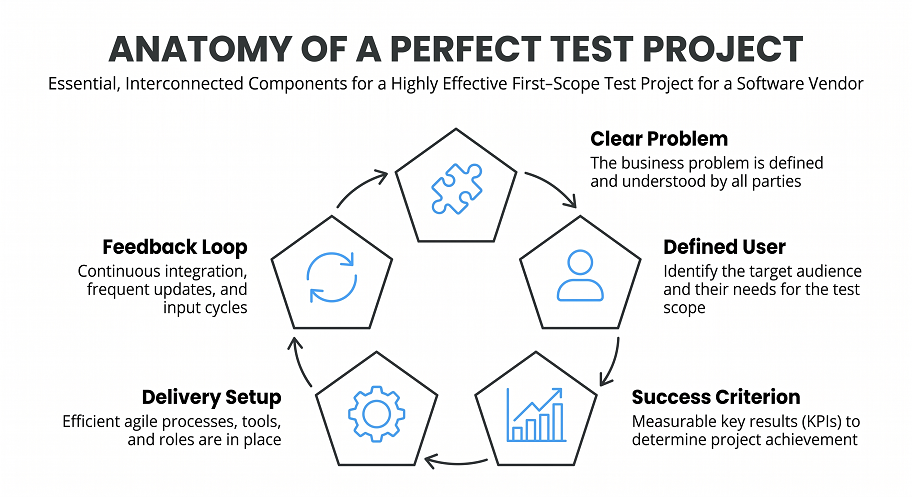
A clear problem.
Start with the problem, not the feature. A feature says what to build. A problem explains why it matters.
A defined user or stakeholder.
Every product decision should connect to someone’s work, experience or outcome. This may be an external customer, internal employee, analyst, operations manager, doctor, engineer or administrator.
A measurable success criterion.
Before the work starts, define how you will decide whether the first scope worked. This could be user feedback, reduced manual effort, successful data processing, a working demo or a go/no-go recommendation.
A realistic delivery setup.
The first scope should test the collaboration model you may later scale. Depending on the project, this may include a product manager, business analyst, designer, tech lead, developer, QA specialist or AI engineer.
A feedback loop.
The work should not disappear into a black box. Plan feedback points from the beginning. Share work in progress. Review assumptions. Demo early. Discuss blockers. Adjust when new information appears.
As a result, you learn not only about the product, but also about the partner.
Red Flags in a Software Partner
A small first scope can quickly reveal warning signs.
Some red flags appear early:
- The partner agrees to everything without asking questions
- They focus only on features, not outcomes
- They avoid discussing risks
- They give precise estimates with very little context
- They do not explain how communication will work
- They treat QA as optional
- They do not ask about users
- They push for a large commitment too early
- They resist transparency around process or code
- They cannot explain what should happen after the pilot
- They blame unclear requirements instead of helping clarify them
One red flag does not necessarily mean the partnership will fail. But repeated red flags during a small first scope are valuable information.
They give you a chance to stop, adjust or choose a different partner before the cost becomes much higher.
How to Measure the First Scope
A first scope should end with a decision.
Not just “the feature is done” or “the prototype looks good.” The real question is whether you have enough confidence to continue.
You can evaluate the engagement across four dimensions.
Product Value
Did the work move you closer to the business outcome?
For example, this may mean user feedback, internal adoption, technical validation, lower manual effort or a clearer roadmap. If the first scope created learning that changes your next decision, it delivered value.
Delivery Quality
Did the partner deliver usable work in a reliable way?
Specifically, this includes code quality, testing, documentation, demo quality, release discipline and technical reasoning.
Collaboration Quality
Did the relationship make your team stronger or more burdened?
A good software development partner reduces uncertainty. They do not create more confusion for your product owner, CTO, COO or internal team.
Scalability of the Relationship
Would you trust this partner with more responsibility?
Ultimately, after the first scope, you should know whether the team can handle a larger roadmap, more complex integrations, AI development, platform takeover or long-term product support.
How Stermedia Approaches First-Scope Projects
At Stermedia, we work with companies that need more than development capacity. They often need a partner who can understand the business problem, analyze technical constraints, build AI solutions or custom software and support the product beyond the first release.
A small first scope is often the right starting point.
It may take the form of a discovery phase, proof of concept, MVP feature, technical audit, AI validation, platform takeover assessment or controlled automation pilot. The format depends on the client’s situation.
For a startup, the first goal may be to validate an MVP before another funding round.
Similarly, a product company may use the first scope to remove a technical bottleneck that slows growth.
An innovation leader may need it to demonstrate ROI before asking the board for a larger budget.
For an enterprise team, the priority may be to reduce delivery risk before handing over responsibility for a business-critical system.
In each case, the principle is the same: start with a focused scope, prove value, learn fast and make the next decision based on evidence.
Conclusion
Product companies do not need to choose a software development partner based only on trust, references or a polished proposal.
They can test the partnership through a small first scope.
The key is to make that scope meaningful. It should reflect a real business goal, include enough technical and product complexity, create a feedback loop and produce a decision-ready outcome.
In this way, a small first scope helps you see how a partner works before you commit to a larger roadmap. It shows whether they understand outcomes, communicate clearly, manage risk, deliver quality and think beyond the first ticket.
Ultimately, this is how you turn vendor selection into evidence-based product decision-making.
Next Steps and Further Reading
If you want to evaluate a software development partner without committing your full roadmap too early, the best starting point is a small, controlled first scope.
At Stermedia, we help product companies, startups and established organizations move from discovery and proof-of-concept work to production-ready software, AI integration and long-term product development.
Want to discuss your project? Contact our team
Continue reading:
- Working with Stermedia – AI Software Development Guide – how we approach discovery, proof of concept, implementation and long-term support.
- AI Software Development: Platform Takeover & Optimization – how Stermedia took over an existing AI platform, stabilized delivery and supported further product growth.
- Legacy System Takeover Without Downtime – how to reduce delivery risk, regain control and modernize software incrementally.