Intelligent automation services are no longer about “doing the same work faster.” The real competitive edge now comes from turning messy, everyday business signals into reliable decisions—earlier, with less friction, and without forcing teams into new habits.
Most companies already automate something: a workflow rule here, a bot there, a dashboard somewhere. But the winners are the ones where automation becomes almost invisible—embedded so tightly into operations that it feels like the organization simply got sharper: fewer delays, fewer escalations, cleaner handoffs, and clearer priorities. That’s not magic. It’s a shift from basic automation to intelligent process automation (IPA): automation that can interpret context, learn patterns, handle unstructured inputs, and support decision-making—not just task execution across a single business process.
Why intelligent automation services feel “invisible” when they work
The best AI in business rarely announces itself. It doesn’t show up as a standalone tool that people must remember to use. Instead, it quietly improves outcomes inside the workflows that already exist: requests get routed to the right place, exceptions surface earlier, anomalies trigger checks before they become incidents, and leaders receive “nudges” based on live signals—not weekly slide decks.
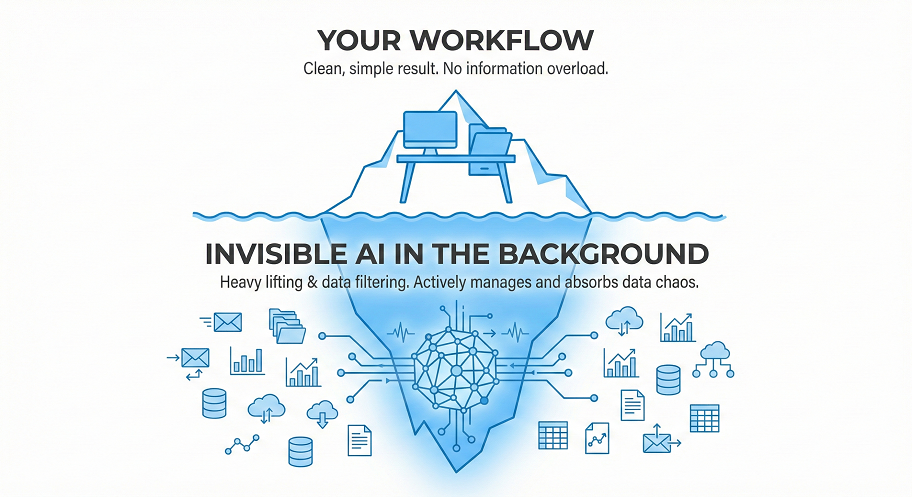
This “invisible advantage” happens when AI is designed to reduce cognitive load rather than add it. Even small frictions—another tab, another login, another dashboard—can kill adoption. When intelligent automation is embedded inside the systems teams already live in (collaboration tools, CRMs, service desks, internal portals), the behavior change required is minimal, and the ROI becomes visible quickly.
Intelligent automation services vs traditional automation
Traditional automation is rule-based and works best when inputs are structured and predictable: “if X, then Y.” In many organizations, that’s where Robotic Process Automation (RPA) shines—handling repetitive tasks with consistency and speed.
Intelligent automation services go further by combining automation with artificial intelligence—machine learning, natural language processing, and analytics—so systems can work with unstructured data (emails, PDFs, chats, documents), recognize patterns, and recommend the next best step. In practical terms, this is the difference between a workflow that stops when something is missing and a workflow that continues by extracting missing information, validating it, and escalating only the genuinely ambiguous cases.
That distinction matters because most operational bottlenecks don’t come from tasks that are perfectly structured. They come from the messy middle: incomplete requests, unclear priorities, conflicting data, and exceptions that force people into manual workarounds. IPA reduces that chaos by making automation adaptive—not just fast.
For a concise definition of intelligent automation, see IBM’s overview.
How intelligent automation services enable decision intelligence
One of the most underappreciated outcomes of intelligent automation is its role as a foundational enabler of Decision Intelligence (DI). While DI is a broader, cross-disciplinary field, intelligent automation acts as the trigger—giving teams and leaders timely, actionable insights that translate directly into “what should we do next?” rather than “here’s what happened.”
When decision intelligence is delivered daily (or continuously), it changes the rhythm of execution. People stop spending energy on hunting information, building status narratives, or re-creating the same analysis across teams. Instead, they spend energy on choosing, acting, and learning. That speed compounds—especially when market conditions shift quickly and the cost of hesitation is higher than the cost of an imperfect first move.
This is also why waiting for “perfect data” is often the wrong strategy, though caution is strictly required. In the era of modern Large Language Models (LLMs), the “Garbage In, Garbage Out” (GIGO) principle remains a major implementation challenge. Working with highly toxic or completely unvalidated data can lead to AI hallucinations with severe consequences. While you don’t need flawless data, real progress typically starts with a controlled pilot that avoids fundamentally flawed inputs and relies on strong validation layers (known as guardrails) to catch errors. By using the data that exists today, making outputs transparent, and improving data quality through feedback loops, organizations can move forward safely. Perfectionism delays value; visibility and robust guardrails improve quality.
Building intelligent automation services with human-in-the-loop control
A common worry is that more automation means less control. In mature implementations, the opposite is true—because intelligent automation is designed with human-in-the-loop automation as a core pattern.
Human-in-the-loop means AI handles volume, pattern recognition, and repeated decisions, while humans handle edge cases, judgment calls, and approvals. In practice, this includes confidence thresholds (low-confidence items escalate), audit trails (what data informed the outcome), exception queues (humans focus only on true ambiguity), and dashboards that provide oversight instead of black-box behavior.
This approach is particularly important when automation influences customer experience, operational risk, or business-critical reporting. It’s also the mechanism that builds trust internally: teams see that automation supports them and doesn’t surprise them. By leveraging mechanisms like Active Learning or Reinforcement Learning from Human Feedback (RLHF), the system continuously improves over time based on this real, practical human input.
What intelligent automation services unlock in day-to-day operations
The fastest wins usually appear where organizations have high volumes of requests, scattered information, and repeated decisions. Support operations are a classic example: when systems can automatically classify, prioritize, route, and enrich incoming work, teams resolve issues faster and customers feel the difference. But the same pattern applies to many other workflows—claims processing, compliance checks, onboarding, procurement, finance operations, or any environment where unstructured inputs need to become structured actions
A second class of wins comes from converting unstructured knowledge into usable operational data through Intelligent Document Processing (IDP). This includes extracting key fields from PDFs, summarizing large feedback streams into themes, or transforming documents and conversations into reliable signals that can trigger workflow steps.. This is where “invisible AI” becomes a real lever: it quietly turns information overload into operational clarity.
How to start: a controlled pilot that proves value
The most reliable path is not a big-bang transformation. It’s a small, controlled pilot with clear success metrics, tight scope, and an explicit route to production. This is where intelligent automation consulting makes the difference: selecting the right workflow, defining measurable outcomes, and designing guardrails so you can implement intelligent automation safely—without turning the organization into a test environment.
What matters is not a flashy demo, but an implementation plan that answers practical questions: what data is required now vs later, how exceptions are handled, how quality is monitored, and how the solution stays maintainable after launch. Done well, these pilots become repeatable patterns—your foundation for broader intelligent automation solutions across teams.
Next steps & further reading
If you want to explore how intelligent automation services can accelerate execution and reduce operational drag, the best starting point is a small, controlled pilot.
At Stermedia, we help CEOs, startups, and established organizations deliver end-to-end AI integration—from needs analysis and proof of concept to production deployment.
Want to discuss your project? Contact our AI team.
Continue reading:
- AI Consulting and Integration as a Business Strategy – A practical look at how to scope AI initiatives, reduce risk, and move from experimentation to production delivery. Especially useful if you need a clear governance-and-ROI narrative for leadership.
- Working with Stermedia – AI Software Development Guide – How we run discovery, pilots, and production rollouts, with clear checkpoints and measurable outcomes. A good reference if you want to understand our delivery process before committing.
- Tender Process Optimization with AI Solutions – A real-world example of automating a high-friction workflow, from document handling to decision support. Useful if your organization runs on approvals, formal requests, or repeatable compliance steps.