Machine learning in manufacturing helps car factory owners improve material consumption prediction. Daily production often depends on the type and number of parts sent to the production hall. Increasing efficiency by ensuring the lowest possible consumption of materials is a big challenge for car factory owners. Read how Stermedia used machine learning to help a leading brand in the global automotive market improve the prediction of materials consumption.
Machine Learning in Manufacturing Challenge
Our client, a German car manufacturer, wanted to predict daily materials consumption. The prediction used the type and number of parts sent to the production hall on a given day. The purpose of daily consumption prediction was to minimize waste and save unnecessary purchases.
The client asked Stermedia data scientists to verify the internal team’s idea. They also wanted our team to refine the business side of the project. Furthermore, they expected Stermedia to conduct data analysis using artificial intelligence and machine learning.
Machine Learning in Manufacturing Solution
Firstly, our machine learning data scientists conducted a full business interview to understand the client’s needs and choose the most adequate approach. They collected information about the factory’s inner workings. They also analyzed the data the customer could provide and the process of data gathering. Next, they tested several models for material consumption prediction. Then, they picked the best one.

Our team faced one main challenge: the client had only a small amount of data. The factory received many different types of car parts. In data terms, the number of columns, or features, was much higher than the number of rows, or observations. To overcome that, our team used regularized linear models with recursive feature elimination. Our team built each model in an iterative fashion. The team started with all available features. In every iteration step, they removed the least important feature. The steps were as follows:
- In every iteration step, the team used cross-validation to check model performance. Then, they removed the feature with the lowest relevance score.
- The team repeated this step until only one feature was left. Then, they chose the optimal number of features. They based this choice on cross-validation scores from all tested feature sets.
The feature that entered the model was chosen with the help of correlation analysis. By the end of the process described above, each of the modeled values was assigned the optimal set of features to consider when making a prediction.
Results: Better Manufacturing Prediction Models
The plot on the left shows predicted material consumption in relation to the actual one. The closer the dots are to the diagonal, the better. In the plot on the right, the blue line is actual material consumption, and the yellow line is predicted consumption. The values are sorted for clarity. This way, we can more easily focus on the days when a significant amount of material is consumed.
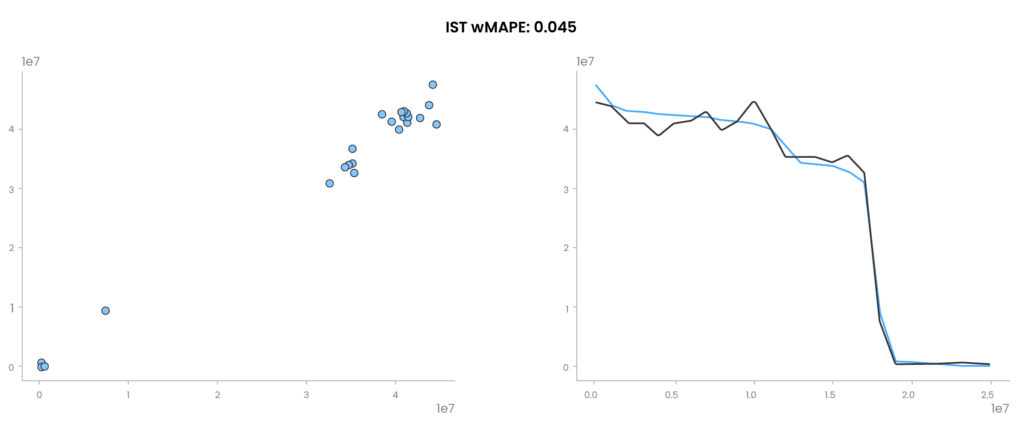
Pic. 1 Model predictions on a test dataset
It is worth mentioning that if more data were available, the team would most likely end up using random forests, neural networks, or gradient boosting methods like XGBoost or LightGBM. In this task, though, classic regression models worked best.
As a result of this machine learning in manufacturing project, we improved the quality of materials consumption prediction by 15%, according to the weighted mean absolute percentage error. In a longer perspective, this prediction leads to more accurate planning and waste reduction in the manufacturing process.
Technologies Used in the Machine Learning Project
The team prepared the models in the Jupyter Notebook environment for Python. They also used the scikit-learn and pandas libraries. These technologies supported data analysis and feature selection. They also helped the team test models and predict material consumption in a manufacturing environment.
Next steps & further reading
A small, controlled pilot is the best starting point for machine learning in manufacturing. It helps you test how AI can improve prediction, planning, and waste reduction based on real production data.
At Stermedia, we help CEOs, startups, and established organizations turn AI ideas into working products. We support every stage, from needs analysis and proof of concept to production deployment.
Want to discuss your project? Contact our AI team
Continue reading:
- Improving Production Lanes of An Automotive Giant — a related automotive case study focused on production improvement.
- Prediction of Potential Errors in the Early Production Process — a relevant AI/ML case study for early production-stage prediction.
- Gradient Boosting Decision Trees – Stermedia — useful further reading because the article mentions gradient boosting methods such as XGBoost and LightGBM.