Nearshore software development in Poland helps product companies access skilled engineering teams, accelerate delivery and reduce the pressure of building everything in-house.
For many CEOs, CTOs, COOs and product leaders, the situation is familiar.
The roadmap keeps growing. The internal team is too small. Local hiring takes too long. Investors, customers or internal stakeholders expect faster progress. At the same time, the company cannot afford to lose control over product quality, architecture or business knowledge.
This is where nearshoring to Poland becomes a serious option.
But nearshoring is not a shortcut that automatically solves delivery problems. It can accelerate product development, improve capacity and reduce operational pressure. It can also create new risks if you choose the wrong partner, leave the scope unclear or treat collaboration as simple developer outsourcing.
The real question is not whether Poland is a strong nearshoring destination. For many product companies, it is.
The better question is: What do you actually gain, and what do you still need to manage carefully?
Why Nearshore Software Development in Poland Appeals to Product Companies
Product companies rarely look for external engineering support because everything works perfectly.
Usually, there is pressure somewhere.
A startup needs to build an MVP before the next investor conversation. A scaleup has product-market fit, but its engineering team cannot keep up with customer requests. An established company wants to modernize a platform, integrate AI or launch a new product line without distracting its core team.
Nearshore software development in Poland fits these situations because it solves several practical problems at once.
First, you get proximity.
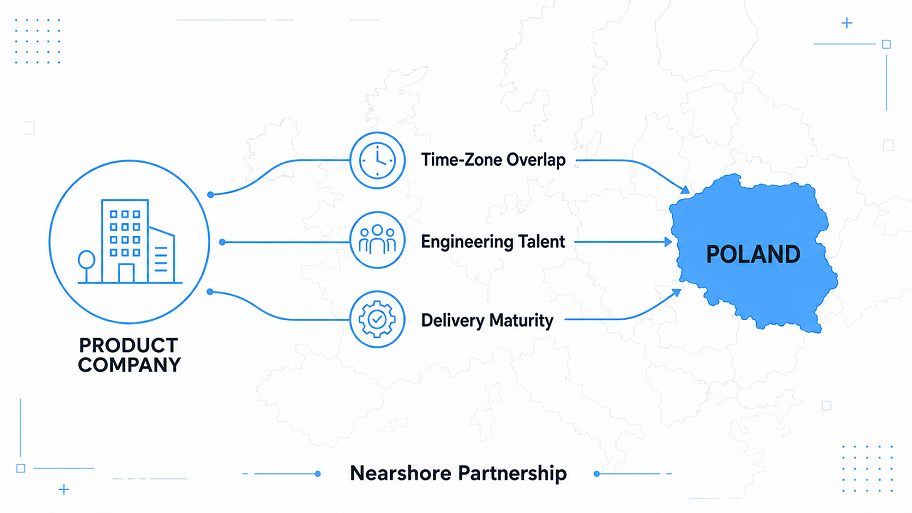
For companies in the U.K., Germany, Scandinavia, the Netherlands and other European markets, Poland offers strong overlap in working hours, easy communication and the option to meet in person when needed. This matters more than many companies expect.
Product development is not only coding. It involves workshops, trade-offs, fast feedback, backlog decisions, edge cases and constant alignment between business and technology.
When teams can discuss those issues during the same business day, delivery becomes easier to manage.
Research on global software development also suggests that nearshore development can reduce communication friction and support better project outcomes compared with farshore models.
Second, you get access to a mature engineering market.
Poland has built a strong position as a software development hub in Europe. According to the latest report on Poland’s IT/ICT sector, the country’s technology ecosystem continues to grow around areas such as AI, cloud computing, IoT and cybersecurity. For product companies, this means access to developers, QA engineers, DevOps specialists, product designers, business analysts and AI experts who know how to work with international clients.
Third, you get business compatibility.
Many Polish teams work in English, use Agile delivery models and are accustomed to international client expectations around transparency, ownership and deadlines. That does not remove every communication risk. But it lowers the friction compared with cooperation models built across larger time-zone and cultural gaps.
What Product Companies Actually Gain
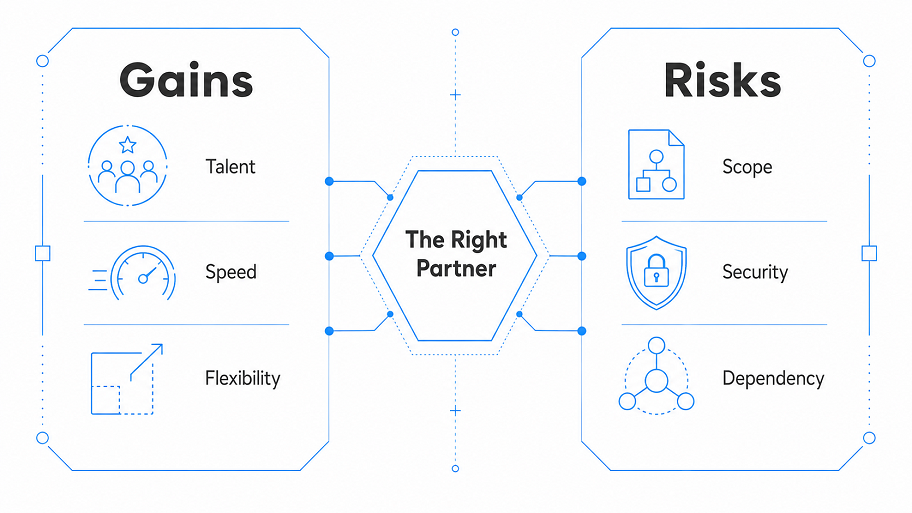
The most obvious gain is capacity.
Nearshoring gives you access to skills you may not be able to hire locally, or not quickly enough. But capacity alone is not the main value.
For product companies, the bigger gain is delivery flexibility.
You do not need to hire permanent employees for every new capability. You can bring in a focused team for a specific stage: discovery, MVP development, platform modernization, AI proof of concept, system integration, QA improvement or product scaling.
The team can grow when the roadmap expands. It can also become smaller when the product stabilizes.
That flexibility matters when you still need to validate direction.
A startup may not know which feature will matter most to users. A mature product company may not know whether a new AI module, integration or market feature will generate enough ROI. Nearshore development in Poland lets you build, test and learn faster without committing too early to a large internal hiring plan.
You also gain speed.
The right partner already has delivery processes, senior engineers and project experience. You can move from idea to technical scope, from scope to backlog and from backlog to working software faster than through local recruitment alone.
Finally, you gain operational focus.
Your internal team can focus on strategy, product ownership, customers and core architecture. The nearshore team can take responsibility for delivery within an agreed scope.
This is where nearshoring works best: not as a replacement for product ownership, but as an extension of it.
Nearshoring to Poland Is Not Just Cheaper Development
Cost matters. It always does.
Poland can offer an attractive balance between cost and quality compared with hiring in Western Europe, the U.K., Scandinavia or the U.S. But product companies should avoid one common mistake: choosing Poland only because it looks cheaper.
The value of nearshoring to Poland is not only a lower hourly rate.
The real value comes from the combination of:
- strong technical skills
- communication overlap
- cultural fit
- delivery discipline
- product thinking
- long-term accountability
A cheaper team that requires constant supervision is not truly cheaper.
A vendor that delivers code without understanding the product creates hidden costs in architecture, QA, maintenance and rework. A team that moves fast but ignores security, documentation or scalability can slow you down later.
So the better question is not:
“How much does one developer cost per hour?”
The better question is:
“What business result will this collaboration help us deliver?”
That shift changes the whole conversation. It moves nearshoring from cost reduction to product acceleration.
The Main Risks of Nearshore Software Development in Poland
Nearshore software development in Poland reduces some risks, especially around communication and working hours. It does not remove the risks of outsourcing itself.
The first risk is choosing the wrong partner.
A vendor may look strong in a sales meeting but lack the experience, seniority or delivery discipline your product needs. Many offers look similar on the surface: team size, rates, technologies and availability. The real difference appears later, when the project faces ambiguity, changing priorities or integration complexity.
The second risk is unclear scope.
If your company does not know what should be built, who owns decisions, what success looks like or which constraints matter most, an external team will not magically solve that problem. A good partner can help structure discovery and challenge assumptions. But product ownership cannot be fully outsourced.
The third risk is weak engineering management.
Outsourcing development does not mean outsourcing responsibility for project control. You still need clear milestones, technical leadership, code review, QA standards, security expectations and transparent reporting.
The fourth risk is intellectual property and data security.
Product companies need to protect code, customer data, algorithms, documentation and business knowledge. That requires clear contracts, access management, secure development practices and rules for handling sensitive information.
The fifth risk is vendor dependency.
If too much product knowledge stays only with the external team, the company may become dependent on one partner without enough internal visibility. Good nearshoring should prevent that through documentation, shared repositories, regular demos and structured knowledge transfer.
How to Reduce Risk in Nearshore Software Development in Poland
The safest way to start is usually not a large, long-term commitment.
A focused discovery phase or a small pilot gives both sides a practical way to test collaboration. You can validate communication, clarify product context, check technical assumptions and define a realistic roadmap before you scale the team.
A strong nearshore setup should include:
- clear business goals and success metrics
- product ownership on the client side
- a transparent backlog and delivery process
- regular demos and decision checkpoints
- code quality and QA standards
- security and IP protection rules
- documentation and knowledge-sharing routines
This may sound operational, but it is strategic.
Many outsourcing problems do not start with bad code. They start with vague expectations, weak ownership and lack of visibility.
The best nearshore partner does not simply say “yes” to every request. The best partner asks the right questions early, challenges risky assumptions, explains trade-offs and helps turn business goals into a delivery plan.
When Nearshore Software Development in Poland Works Best
Nearshoring works especially well when a product company has a clear business need but limited internal capacity.
It can support:
- MVP development
- product scaling
- AI proof-of-concept development
- platform modernization
- legacy system takeover
- third-party integrations
- QA and test automation
- DevOps support
- SaaS development
- product design and UX improvement
For startups, nearshoring can mean faster MVP validation and better investor readiness.
For scaleups, it can help accelerate roadmap delivery without overloading the internal team.
For established companies, it can support modernization, AI implementation and the development of new digital capabilities without disrupting day-to-day operations.
The model works best when you look for a technology partner, not only extra hands.
Staff augmentation can solve a short-term capacity gap. A product development partner helps you make better technical decisions, structure delivery, manage risk and connect software development with business outcomes.
When Nearshoring May Not Be the Right Answer
Nearshoring is not always the right solution.
If your company has no product owner, no decision-making structure and no willingness to clarify priorities, an external team will struggle.
If your main goal is only to find the lowest possible rate, Poland may not be the cheapest option.
If your product involves sensitive data and your organization has not defined access rules, security requirements or legal safeguards, the project should not move too quickly.
Nearshoring also works poorly when the client expects the vendor to compensate for every internal gap without giving the team context, authority or feedback.
A Polish software development partner can bring engineering capability, delivery experience and product thinking. But you still need to bring business context, priorities and decision ownership.
The strongest collaborations happen when both sides understand their role.
How to Choose a Polish Software Development Partner
A strong selection process should go beyond rates and CVs.
You need to understand how the partner thinks.
Ask questions such as:
- Do they ask about business goals before proposing technologies?
- Do they understand product risk, not only technical tasks?
- Can they work with incomplete requirements?
- Do they have experience in discovery, MVP delivery, integrations, QA and long-term maintenance?
- Can they show relevant case studies or delivery patterns?
- Do they explain how communication, reporting and knowledge transfer will work?
- Do they challenge assumptions when they see risk?
The right partner should be able to describe the first weeks of cooperation clearly.
You should know who will join discovery, how the backlog will be built, how risks will be reported, how quality will be measured and how the team will scale if the product grows.
This is where product companies should be selective.
You are not buying hours. You are reducing uncertainty and increasing delivery confidence.
Why Stermedia Fits This Nearshoring Model
Choosing Poland is only one part of the decision. The second part is choosing a partner that can turn the advantages of nearshoring into reliable execution.
At Stermedia, we help product companies move from idea to working software through a practical, business-focused delivery process.
We combine:
- AI development
- custom software development
- product design
- RPA and automation
- QA and testing
- system integration
- legacy system takeover
- long-term product development support
This matters because nearshoring is rarely only about writing code.
Your product may need discovery before development starts. It may need UX decisions before users can adopt it. It may need AI features that work in real workflows, not only in a demo. It may need integration with existing systems, security requirements, documentation and long-term monitoring.
Stermedia fits the nearshoring model because we work across these layers.
We help you clarify the business need, define the technical scope, build the right team and move toward production-ready software. That approach supports the main reasons product companies choose nearshoring to Poland in the first place: access to talent, faster delivery, strong communication, controlled risk and long-term technical partnership.
Final Thoughts
Nearshore software development in Poland can give product companies real advantages: skilled talent, faster delivery, flexible scaling, strong communication overlap and a healthy balance between quality and cost.
But the benefits are not automatic.
The companies that gain the most from nearshoring treat it as a strategic collaboration, not a quick procurement decision. They define goals, protect ownership, start with a focused scope and choose partners who can handle both technical complexity and business reality.
Poland can be the right place to build, extend or modernize a product.
A key success factor is choosing a partner who can turn that location advantage into reliable execution.
Next Steps and Further Reading
If you want to explore how nearshore software development in Poland could accelerate your product roadmap, the best starting point is a focused discovery phase or a small, controlled pilot.
At Stermedia, we help CEOs, startups and established organizations build, extend and modernize software products — from needs analysis and proof of concept to MVP development, integration, AI implementation and production deployment.
Want to discuss your project? Contact our team
Continue reading:
Working with Stermedia – AI Software Development Guide – A practical overview of how we approach AI and software projects, from discovery and validation to deployment and long-term improvement.
Team Extension or In-House? 7 Arguments for Startups – A useful perspective for founders and product leaders deciding whether to build internally, extend the team or work with an external technology partner.
Software Project Rescue: 5 Signs You Need External Help – A practical guide for companies facing delays, unclear delivery progress, technical debt or architectural complexity in an existing product.