An AI implementation roadmap turns boardroom interest in artificial intelligence into a sequence of decisions, pilots and production systems that teams can actually deliver.
That distinction matters.
Many leadership teams already see the potential. They discuss generative AI, automation, copilots, intelligent assistants, forecasting, document processing and new digital products. They run workshops. They collect ideas from departments. They test tools.
But after the initial excitement, a harder question appears:
Which AI ideas should we actually build first?
A strong AI implementation roadmap helps answer that question. It moves the conversation away from “Where can we use AI?” and toward “Where can AI create measurable value, with the data, systems and people we already have or can realistically prepare?”
For CEOs, CIOs, COOs and innovation leaders, this is where AI becomes a business discipline rather than just a technology trend.
Why an AI Implementation Roadmap Starts With Business Value
The first mistake many companies make is building an AI backlog around technology categories.
They create lists such as:
- chatbot,
- document summarization,
- predictive analytics,
- code generation,
- customer support automation,
- internal knowledge assistant.
These categories are useful, but they are not enough. A chatbot can be valuable or irrelevant. A forecasting model can improve margins or become another dashboard nobody trusts. A document processing system can reduce expert workload or create new review bottlenecks.
The value depends on the business problem.
An AI implementation roadmap should start with business areas where the organization already feels pressure:
- slow decision-making,
- repetitive manual work,
- high operational costs,
- poor data visibility,
- customer experience gaps,
- knowledge trapped in documents,
- overloaded expert teams,
- software delivery delays,
- quality or compliance risks.
This approach changes the quality of the discussion. Instead of asking which model to use, you ask what outcome should improve. Instead of collecting random AI ideas, you create a portfolio of opportunities linked to business goals.
That is the point where AI strategy becomes practical.
From Boardroom Ideas to an AI Implementation Roadmap
Boardroom conversations often produce broad statements:
“We should use AI in operations.”
“We need an internal assistant.”
“We should automate document workflows.”
“We need to use generative AI before competitors do.”
These ideas are too vague for delivery teams.
Before prioritization, each idea needs to become an AI opportunity card. This does not have to be a heavy document. It should capture the minimum information needed to compare opportunities fairly.
For each AI idea, define:
- the business problem,
- the current workflow,
- the users affected,
- the expected business outcome,
- the data sources required,
- the systems involved,
- the level of human review needed,
- the compliance or security constraints,
- the likely integration points,
- the owner on the business side,
- the first measurable success metric.
This simple step prevents one of the most common AI delivery problems: comparing ideas that are not equally defined.
One department may propose a small automation with clean data and clear ROI. Another may propose a large transformation initiative with unclear ownership, fragmented data and many dependencies. Without structure, the more exciting idea often wins the discussion. With an AI opportunity inventory, the idea with the strongest delivery case becomes clear.
How to Prioritize Your AI Implementation Roadmap
A prioritized AI delivery roadmap should balance ambition with feasibility.
Business leaders usually want impact. Delivery teams usually see constraints. Legal and compliance teams see risk. Data teams see quality issues. Product teams see user adoption challenges.
A good scoring model brings these perspectives together.
A practical AI prioritization matrix can include seven criteria:
1. Business Impact
How much value can this initiative create?
Value may mean cost reduction, faster service, improved accuracy, higher conversion, lower churn, shorter delivery time, better compliance or new revenue. The key is to define value in measurable business terms.
A use case with visible business impact should rank higher than one that only looks innovative.
2. Data Readiness
AI systems depend on the quality, accessibility and security of data.
Before you prioritize an idea, check whether the required data exists, whether it is structured enough to use, who owns it and whether the organization trusts it. Generative AI can help teams work with messy and unstructured data, but it does not remove the need for data governance.
In many projects, the first real milestone is not model development. It is data readiness.
3. Technical Feasibility
Can the solution work with the current architecture?
This includes integrations with CRM, ERP, document management platforms, internal databases, cloud services, permission systems and reporting tools. It also includes latency, scale, security and maintainability.
A proof of concept can ignore many of these factors. A production AI system cannot.
4. Risk and Governance
AI is probabilistic. It can generate wrong answers, expose weak data, reinforce bias or create compliance risks if nobody defines the boundaries.
That does not mean companies should avoid AI. It means every serious AI roadmap needs governance from the beginning.
Ask:
- What can the system decide on its own?
- Where is human approval required?
- What data can the model access?
- How will we test output quality?
- How will we monitor errors?
- Who is accountable for the result?
The more sensitive the process, the more explicit the controls should be.
5. Reusability
Some AI use cases solve one narrow problem. Others create capabilities that can be reused across the organization.
For example, a document extraction pipeline may start in one department but later support legal, finance, operations or healthcare workflows. An internal knowledge assistant may begin with HR policies and later expand into technical documentation or customer service.
Reusable capabilities deserve higher priority because they compound over time.
6. User Adoption
AI creates value only when people use it inside real workflows.
A technically impressive system can fail if users do not trust it, if it adds extra steps or if it does not fit how decisions are made. That is why AI roadmap planning should include user behavior, change management and training.
The best AI solutions do not replace every human decision. They help people make better decisions faster.
7. Time to First Measurable Result
Not every project should be small, but every roadmap needs momentum.
Early wins help leadership teams build confidence, secure budget and learn how AI behaves in the organization. The best first projects often combine visible value, manageable risk, available data and a clear path to production.
What to Put in the AI Roadmap Before Development Starts
Once you prioritize AI opportunities, the roadmap should not jump straight into development.
A delivery-ready AI roadmap should define the conditions for execution. This is where many companies underestimate the work.
Your roadmap should include:
- business objectives,
- success metrics,
- data requirements,
- architecture assumptions,
- integration points,
- security and privacy rules,
- model evaluation criteria,
- human-in-the-loop requirements,
- roles and decision rights,
- budget ranges,
- delivery phases,
- rollout plan,
- monitoring and improvement process.
This level of detail does not slow innovation. It protects it.
Without these elements, teams often build impressive prototypes that cannot survive production. They work on a narrow sample, but not on real data. They perform in a demo, but not under operational constraints. They answer questions, but do not integrate with the systems where work happens.
An AI implementation roadmap should close that gap before development accelerates.
Build Delivery Waves, Not a Random AI Backlog
A strong roadmap usually works better as a set of delivery waves than as one long backlog.
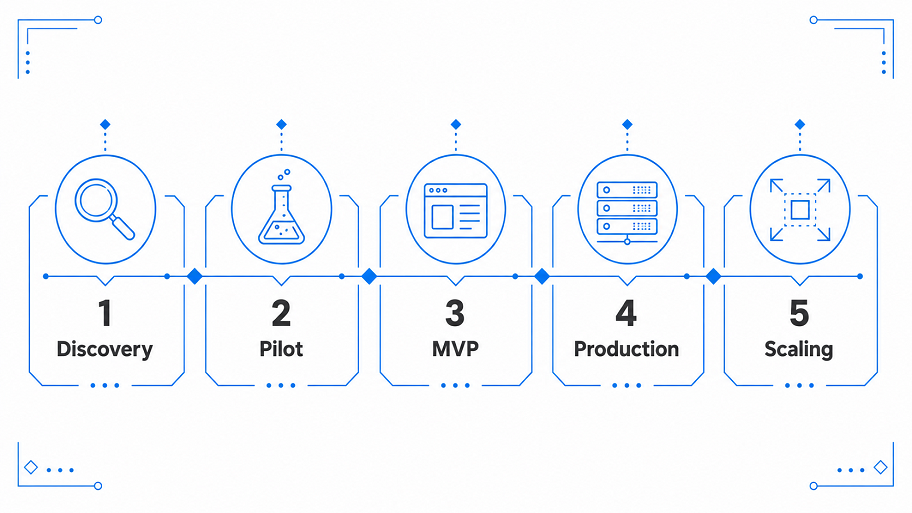
Wave 1: Discovery and Use Case Validation
This is where the team maps workflows, interviews users, checks data sources and defines the business case.
The goal is not to build yet. The goal is to decide what deserves to be built.
At this stage, companies often discover that some AI ideas are not ready, some are better addressed with traditional automation and some need data preparation before any model work starts.
That is a good outcome. It prevents wasted investment.
Wave 2: Controlled Pilot or Proof of Concept
A pilot should test the riskiest assumptions.
Can the model produce useful outputs?
Is the data good enough?
Do users trust the recommendation?
Can the workflow be redesigned around the output?
Does the system improve a measurable business metric?
A pilot should be small enough to control, but realistic enough to teach the team something about production.
Wave 3: MVP and Integration
At the MVP stage, the solution starts moving from an experiment to a working product.
This means adding a user interface, access controls, integrations, validation logic, logging, feedback loops and basic monitoring. It also means clear rules for what AI can and cannot do.
For example, AI may extract information from documents, but deterministic logic may validate formats, permissions and downstream transactions. AI may recommend an action, but a human may approve it in regulated workflows.
This hybrid approach is often more reliable than trying to make the model responsible for the entire process.
Wave 4: Production Deployment
Moving into production changes the requirements.
The system must work with real users, real exceptions, real data quality issues, real security policies and real business consequences. It must be monitored and improved after launch.
At this stage, the roadmap should include support, ownership, evaluation cycles and cost monitoring. AI is not a one-time release. It is a system that needs ongoing care.
Wave 5: Scaling and Capability Reuse
Once one AI capability works, the organization can expand it.
A document processing engine can support more document types. A forecasting model can move into new markets. A knowledge assistant can serve more teams. A workflow automation layer can connect more systems.
This is where the roadmap creates strategic value. The company stops running isolated AI experiments and starts building reusable AI capabilities.
AI Implementation Roadmap Governance: Who Owns the Decisions?
AI initiatives often fail because ownership is unclear.
The business wants outcomes. IT owns systems. Data teams own pipelines. Compliance owns risk. Vendors own parts of delivery. Users own adoption. Without a clear operating model, decision-making slows down.
An AI roadmap should define governance early.
That may include:
- a business owner for each use case,
- a technical owner for architecture,
- a data owner for data quality and access,
- a compliance owner for risk review,
- a product owner for user needs,
- a delivery owner for execution,
- a steering group for prioritization and budget decisions.
The purpose of governance is not to create bureaucracy. It is to make decisions faster and safer.
Companies also need a feedback loop. Once an AI solution goes live, teams should compare expected value with realized value. This helps improve future prioritization and prevents the roadmap from becoming a static presentation.
How to Know Which AI Ideas to Stop
A mature AI roadmap does not just decide what to start. It also decides what to stop.
Some ideas should be paused because the data is not ready. Some should be redesigned because the business value is too weak. Some should be replaced with simpler automation. Some should wait until the organization has stronger governance or better integration capabilities.
This discipline is difficult, especially when an idea has executive sponsorship. But it is necessary.
The goal is not to prove that every AI idea works. The goal is to direct investment toward the ideas that can become useful, scalable and measurable business capabilities.
A smaller number of high-value use cases is usually better than a wide portfolio of disconnected experiments.
Choosing the Right Partner to Deliver Your AI Implementation Roadmap
Many companies can define AI ambitions internally. Fewer can turn them into production systems without external support.
The right partner should help with more than model selection. They should understand business discovery, data readiness, product thinking, software architecture, security, integration, testing and deployment.
When evaluating an AI delivery partner, look for three things.
First, trust. The partner may work with sensitive business data, internal workflows and strategic initiatives. Security, transparency and governance matter.
Second, delivery maturity. AI projects require experimentation, but they also require engineering discipline. The partner should know how to move from discovery to proof of concept (PoC), MVP and production.
Third, business understanding. The best AI roadmap is not the one with the most advanced model. It is the one that improves how the organization works.
At Stermedia, we approach AI delivery as a combination of consulting, product design, data work, custom software development and integration. We help companies move from a business problem to a validated solution, then from a validated solution to a production system that users can rely on.
Final Thoughts
AI ideas are easy to generate. AI value is harder to deliver.
The difference is execution.
An AI implementation roadmap gives leaders a practical way to move from ambition to action. It helps teams define the right problems, compare opportunities, prioritize by value and feasibility, prepare data, manage risk and sequence delivery.
It also keeps AI grounded in real workflows.
That is where business value is created: not in the boardroom discussion, not in the demo and not in the model alone, but in the moment when AI helps people do real work better.
Next Steps & Further Reading
If you want to explore how an AI implementation roadmap can turn strategic ideas into production-ready AI systems, the best starting point is a small, controlled discovery phase or pilot.
At Stermedia, we help CEOs and teams in startups and established organizations implement AI end to end — from needs analysis and proof of concept to MVP development, system integration and production deployment.
Want to discuss your project? Contact our AI team
Continue reading:
- AI Consulting and Integration as a Business Strategy — a practical look at how to move from AI experimentation to measurable business outcomes through clear priorities, workflow alignment and responsible implementation.
- Forward Deployed Engineering: Why Enterprise AI Needs More Than a Model — why enterprise AI needs product thinking, technical ownership, data readiness and deployment discipline, not only model access.
- AI for Clinical Trial Planning at Scale — a real-world example of turning complex documents and expert knowledge into an AI-assisted workflow with structured outputs, validation and human review.