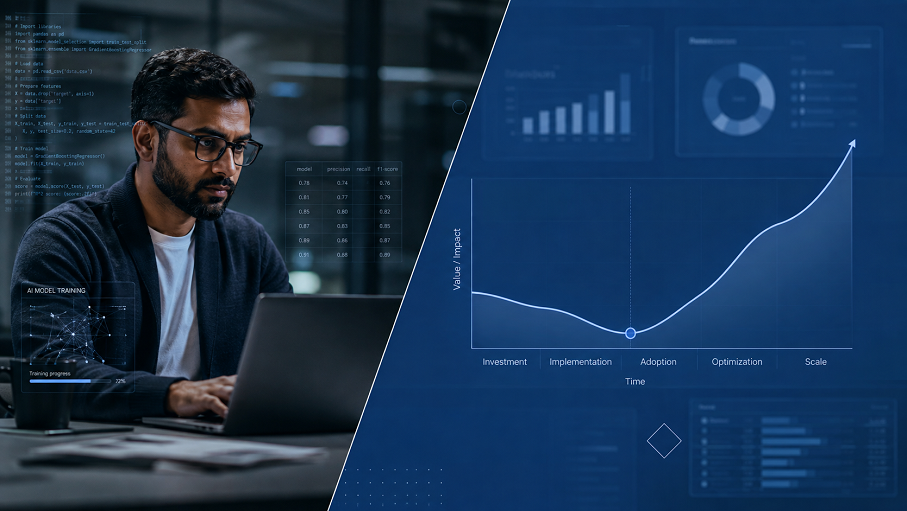
Industrial AI and other new technologies are more and more boldly entering the world of Polish industry and are more and more appreciated by factory managers. Stermedia participates in this transformation.
Thanks to appropriate cooperation in the above-mentioned areas, increasing competitiveness and saving losses on the production line or better-managing human talents. For managers working in factories, machine learning, IoT, augmented reality or big data constitute an inexhaustible potential to deliver value to customers at an unprecedented pace. It must not be forgotten that the most important aspect of an organization’s promotion to a higher generation is generation 4.0. They are self-development workers who are key to fully exploiting the breakthrough technology.
Industrial AI: support with expert knowledge
It is worth talking about these and other aspects of industrial AI and new technologies in the industry. Therefore, as a company with many years of experience in the field of artificial intelligence, Stermedia joins the ranks of speakers at the Generation 4.0 conference.
Together, we discuss, inter alia, how the company’s motivation and culture affect the increase of talent retention, and when pointing to new professions, we mention those that belong to the dying species. Together with other participants, we predict the creation of a whole generation of intelligent factories for the Polish economy. We also look at how Lean and other improvement methodologies fit into a broader development strategy and what the black swan of the pandemic has taught us about digital transformation and the advancement of several generations to the world of Generation Z.

Artificial intelligence in industry: how to avoid errors on the production line
It is worth remembering to look for examples of digital transformation in people who are close to the daily challenges of professional factory managers.
The work environment and development prospects can be seen completely differently through the eyes of an industrial AI provider. Therefore, one of the speakers at the Generation 4.0 conference is Marcin Wierzbicki – CTO Stermedia and CEO AndonCloud. Marcin shares the challenges from his own experience interweaving them with the stories he hears from his clients.
He talks about the five biggest mistakes you can make when implementing industrial AI in your factory at the conference. Thanks to problems taken from his own experience and clients’ fascinating stories, he can advise the best solutions. The cause-and-effect analysis carried out by him allows specifying whether, how, and when it is worth starting the implementation and successfully implementing machine learning in a selected factory.
Industrial AI: a wide range of possibilities
A speech on the top five mistakes you can make when implementing artificial intelligence in your factory is not the only topic discussed at the Generation 4.0 conference. It also discusses the aspects of overcoming barriers and human deficits on the way to the standard of the fourth industrial revolution, explains how a small manufacturing company accelerated customer service, optimized production, and revolutionized its own operations using Epicor ERP and European Union funding, or how to effectively prepare for the implementation of 5G in the manufacturing plant. A very wide spectrum of topics allows for a holistic look at the 21st-century production plant. Knowing all the above aspects, we can take our company to a higher level.
Next steps & further reading
If you want to explore how industrial AI can support production processes, the best starting point is a small, controlled pilot focused on a clearly defined factory challenge.
At Stermedia, we help CEOs, startups, and established organizations move AI in manufacturing projects from needs analysis and proof of concept to production deployment.
Want to discuss your project? Contact our AI team
Continue reading:
- Computer Vision in Manufacturing: A Practical Guide – how computer vision can support inspection, monitoring, and quality control in modern manufacturing.
- Predictive Quality Control in Manufacturing – a practical example of using AI to identify potential production errors earlier.
- Machine Learning in Manufacturing for Car Factories – how machine learning supported material consumption prediction and production efficiency.