Predictive analytics in business helps organizations move from understanding past performance to anticipating what is likely to happen next. By analyzing large volumes of big data and identifying patterns based on historical data, companies can predict future outcomes and gain a measurable competitive edge in areas such as demand planning, risk management, and operational efficiency.
Instead of reacting to change after it happens, organizations use predictive analytics to anticipate future trends, improve decision quality, and support more confident planning across marketing, operations, and finance.
From Reporting to Prediction: How Analytics Creates Business Value
Most organizations begin their analytics journey with reporting. Descriptive and diagnostic analytics explain what happened in the past and why it happened, transforming raw data into transparency but offering limited guidance on what comes next. Predictive analytics represents a turning point: analytics stops looking backward and starts looking forward.
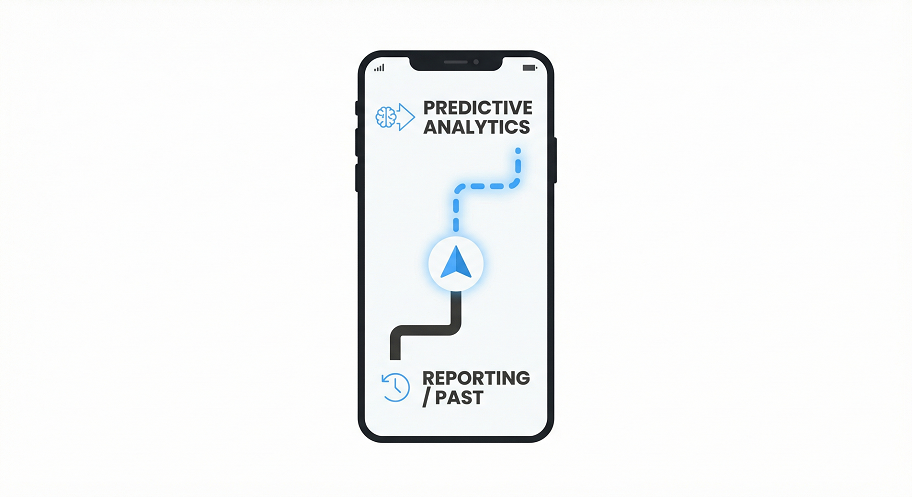
Using data science techniques and machine learning models, organizations analyze data sets to uncover hidden patterns, relationships, and seasonality trends. These insights support planning across multiple business areas — from marketing campaigns and sales forecasting to supply chain optimization and capacity planning.
What Predictive Analytics Answers — and What It Does Not
Predictive analytics answers a fundamental business question:
What is likely to happen next?
Models trained on historical data estimate probabilities related to customer demand, operational disruptions, financial risk, or fraud. Common applications include customer behavior predictions, churn analysis, and early warning systems for fraud detection or process failures.
At the same time, predictive analytics does not recommend actions. It explains what may happen, not what should be done. Understanding this limitation is essential for achieving improved decision quality and setting realistic expectations for analytics initiatives.
Techniques Used in Predictive Analytics
Predictive analytics relies on a broad set of analytical approaches. Techniques include classical statistical methods as well as advanced machine learning.
Depending on the use case, organizations may apply:
- regression and time-series models to capture trends and seasonality,
- classification algorithms for risk scoring and fraud detection,
- neural networks for complex, non-linear relationships in large and dynamic data sets.
The choice of technique depends on business context, data availability, and the type of outcome the organization wants to predict.
Common Business Use Cases for Predictive Analytics
Predictive analytics is widely adopted because it addresses recurring, high-impact challenges across industries. Typical use cases include:
- forecasting demand for sales and marketing campaigns,
- anticipating delays and disruptions in the supply chain,
- predicting equipment failures and maintenance needs,
- identifying risk patterns in finance and compliance.
These scenarios illustrate the benefits of predictive analytics: reduced uncertainty, earlier insights, and better preparation for change.
Why Predictive Analytics Is a Foundation, Not a Final Step
While predictive analytics delivers valuable foresight, forecasts alone rarely provide full decision support. Leaders often need to understand trade-offs, constraints, and the consequences of different options before committing resources.
For this reason, predictive analytics should be treated as a foundation — not the final stage of analytics maturity. Forecasts become most valuable when they are later connected to decision logic and optimization, enabling organizations to move from anticipation to action.
Data, Models, and Execution Matter More Than Accuracy
A common misconception is that success in predictive analytics depends solely on model accuracy. In practice, business value depends far more on execution.
Effective predictive analytics initiatives focus on:
- high-quality and relevant data sets,
- models aligned with real business questions,
- integration with operational systems in near real time,
- outputs that decision-makers trust and understand.
Without these elements, even sophisticated models fail to influence real-world outcomes.
Predictive Analytics as a Strategic Capability
Organizations that consistently apply predictive analytics across functions — from marketing and operations to finance and risk management — gain a sustainable competitive advantage. By anticipating customer needs, operational disruptions, and market shifts, they position themselves ahead of change rather than reacting under pressure.
Predictive analytics does not eliminate uncertainty, but it significantly reduces it — enabling organizations to act with clarity in complex environments.
Next Steps & Further Reading
If you want to explore how predictive analytics in business can support forecasting, risk reduction, and operational planning, the best starting point is a small, focused pilot built around a real business problem.
At Stermedia, we help organizations design and implement predictive analytics solutions — from data analysis and model development to production-ready systems that support real business decisions.
Want to discuss your analytics project? Contact our AI team.
Continue reading
- Finding Structure in Raw Data – Introduction to Clustering -This article explains how clustering techniques help identify hidden structures and patterns in raw data before predictive models are built. It shows why proper data exploration is a critical first step for reliable forecasting and customer behavior analysis.
- Prescriptive Analytics in Business: How to Make Better Decisions – This article explores the natural next step after predictive modeling: turning forecasts into concrete, data-driven actions. It explains how organizations can evaluate multiple scenarios, account for real-world constraints, and use decision models to determine the optimal course of action.
- How to Use Simple Math Models for Major Business Challenges – This case study demonstrates how relatively simple mathematical models can solve complex business problems when aligned with the right data and objectives. It shows that effective predictive analytics does not always require advanced AI, but well-designed models embedded in real business processes.