A good software development partner proves its value in the first 30 days not by writing code as fast as possible, but by reducing risk, building shared understanding and turning business goals into a clear action plan.
For many companies, the beginning of cooperation with an IT partner feels exciting and risky at the same time. You may have a product idea, a modernization challenge, an AI initiative or an existing platform that needs new energy. You also have pressure: budget, deadlines, stakeholders, internal expectations and technical unknowns.
That is why the first month matters so much.
A good IT partner does not treat the first 30 days as a formal onboarding period. It treats them as a structured discovery and alignment phase. The goal is simple: understand the business, clarify the product direction, identify risks early and build enough confidence to move into delivery.
The best partners do not ask, “What should we build?” and disappear for a few weeks. They ask better questions:
- What problem are we solving?
- Who needs this solution most?
- What will success look like?
- What do we already know?
- What still needs validation?
- What can we test before making an expensive decision?
This approach reflects one of the most important principles of effective product development: learn early, learn fast and avoid investing months in a direction that has not been tested.
A Software Development Partner Starts With Context, Not Code
The first responsibility of a good software development partner is to understand the project context.
This includes the business model, users, internal processes, existing systems, technical constraints, decision-making structure and the reason why the project matters now. Without this context, even a technically correct solution can solve the wrong problem.
That is why the right people should be involved from the start: product builders, designers, decision-makers and people who understand how customers use the solution. This mix of perspectives often leads to the most important discoveries.
A simple example: imagine a company selling coffee online. Internally, it may seem logical to organize products by the region where the beans come from. For many customers, that structure may not help at all. If users do not understand the difference between coffee from Guatemala and Colombia, the catalog itself can make buying harder. A better starting point may be a question such as: “How do you brew coffee at home?” This perspective is closer to the customer’s everyday experience and can lead to a simpler, more useful product.
This is an important lesson for any software project. The most valuable insight rarely comes from a requirements document alone. It usually appears during well-structured conversations with people who understand the business, users and technology from different angles.
In the first 30 days, a good IT partner should run sessions that help uncover:
- business goals and expected outcomes
- user groups and their real needs
- current workflows and pain points
- existing architecture and dependencies
- constraints related to security, compliance or scalability
- risks that may affect cost, timeline or adoption
- decision-making and communication rules
For the client, this is an early signal: the partner is not just collecting tasks. It is learning how the business works.
How a Software Development Partner Builds Shared Understanding
Many IT projects do not fail suddenly. Problems appear early, but teams often ignore them: unclear ownership, vague priorities, missing access, different expectations between business and engineering, or a roadmap built on assumptions.
A good IT partner uses the first month to make these issues visible.
This is where kickoff, discovery and knowledge transfer become practical tools. The partner should not only ask for documentation. It should build shared understanding with the client’s team and capture it in concrete artifacts, such as:
- product vision
- stakeholder map
- personas or user groups
- user journeys
- high-level architecture overview
- risk register
- assumptions list
- initial backlog
- delivery plan
- definition of success
- communication plan
The most important outcome of this process is not the document, canvas or board itself. The real value comes from alignment created when people work together. When developers, business stakeholders and product or UX experts define the MVP together, they understand not only what was selected, but also what was deliberately postponed.
This matters especially when a company brings in an external development team. A new IT partner needs to earn trust quickly. Shared understanding reduces friction because everyone sees the same picture: the goal, risks, order of work and reasons behind priorities.
A Good IT Partner Manages Knowledge Transfer Deliberately
Knowledge transfer is not a folder of documents sent before the project starts. It is a managed process.
In outsourcing, system takeovers, or vendor transitions, weak knowledge transfer can create dependency, slow down delivery and increase operational risk. That is why the first month should include a clear knowledge transfer plan.
This plan should answer:
- Who owns critical knowledge?
- Which systems, repositories and tools require access?
- Which processes are documented and which exist only in people’s heads?
- Which decisions shaped the current architecture?
- Where are the known problems, shortcuts and technical debt?
- What should the new team learn first to work safely?
In practice, good knowledge transfer includes workshops, architecture walkthroughs, access reviews, codebase analysis, documentation audits, business process mapping and recorded Q&A sessions with subject matter experts.
The goal is not to know everything immediately. The goal is to know enough to avoid dangerous assumptions.
Why a Software Development Partner Should Validate Before Scaling
The first 30 days should not turn into a long theoretical analysis. A good software development partner moves the project toward validation.
Instead of building a full version, launching it and hoping the data will be clear, it is better to shorten the learning cycle: understand the problem, sketch possible solutions, make a decision, build a prototype and test it with real users.
You can compare it to the rule: rent before you buy. In product development, this means testing a realistic version of the idea before making a large investment in production code.
For the client, this is valuable because early validation protects the budget. It helps answer questions such as:
- Do users understand the proposed workflow?
- Does the solution solve the right problem?
- Which feature should be built first?
- Which assumption is the riskiest?
- Is the MVP small enough to release quickly, but valuable enough to matter?
It is also worth remembering that an MVP should not be a random small version of the product. It should be the simplest valuable solution that validates a business hypothesis.
The “cupcake” metaphor works well here: you are not building the whole cake immediately, but the small version still needs to be attractive, useful and valuable. The user should not receive an unfinished piece of a technical puzzle. They should receive a smaller but meaningful version of the experience that shows the product direction.
This is exactly where a good technology partner should help in the first month: define the smallest meaningful step that delivers real learning.
A Project Kickoff Should Clarify the “Why”
A kickoff meeting is not enough on its own, but it sets the tone for the entire partnership.
A weak kickoff focuses on introductions and a slide deck. A strong kickoff clarifies the goal, roles, constraints, risks and way of working.
In the first 30 days of cooperation, this translates into a simple rule: do not start with a task list. Start with a goal.
A good partner should help define:
- product goal
- first measurable outcome
- first sprint goal
- definition of done
- decision-making process
- rhythm of demos, reviews and feedback
- first set of backlog items
This is where a good IT partner separates planning from wishful thinking. It does not promise everything. It helps choose what matters most at the beginning.
What Should Happen in the First 30 Days?
Every cooperation model is different. A new AI product, legacy system takeover, team extension and platform modernization will not follow the same path.
Still, a strong first month usually follows a similar logic.
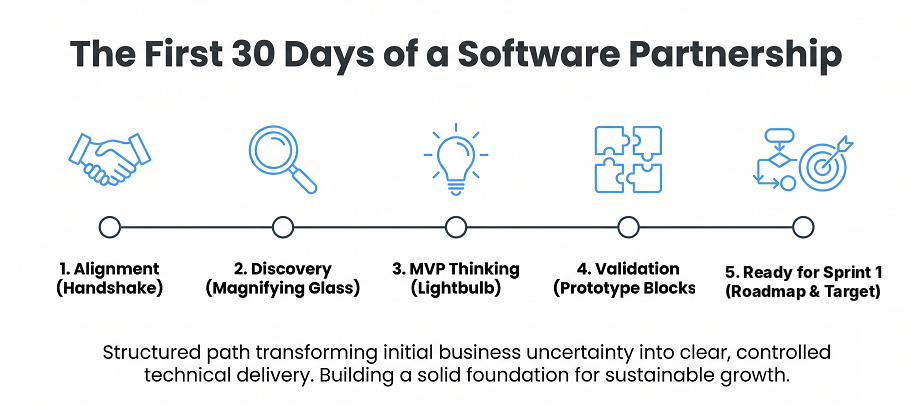
Days 1-5: Alignment and Access
The first week should build momentum. The partner meets stakeholders, confirms business goals, reviews documentation, collects access requirements and runs the first kickoff or discovery workshop.
This is when both sides should agree on communication rules, tools, roles and the most urgent risks. The partner should also quickly identify missing information, because delays in access or stakeholder availability can slow down the whole project.
Key outputs:
- kickoff summary
- stakeholder map
- communication plan
- access checklist
- initial risk list
- discovery agenda
Days 6-10: Discovery and Knowledge Transfer
The second phase focuses on understanding the business and technical landscape. The partner reviews systems, repositories, integrations, workflows, user groups and pain points.
This is also the right moment for conversations with product owners, business stakeholders, support teams, technical leads and users, when possible.
Key outputs:
- current-state overview
- user journey map
- architecture notes
- knowledge transfer log
- assumptions list
- open questions
Days 11-15: Product Direction and MVP Planning
At this stage, the partner should help turn information into decisions.
- What is the product vision?
- Which user group matters most at the beginning?
- Which problem is most urgent?
- Which features support the first business goal?
- What can wait?
This is the moment to combine business, UX and technology perspectives in one conversation. Without this, it is easy to build a solution that is technically feasible but commercially weak — or attractive to users, but too costly or risky to start with.
Key outputs:
- product vision
- prioritized user needs
- MVP hypothesis
- initial feature sequence
- success metrics
Days 16-20: Prototype, Technical Spike or Delivery Plan
Not every project needs a clickable prototype. Sometimes the best form of validation is a technical spike — a time-boxed technical investigation, proof of concept, architecture experiment or data audit.
The main rule stays the same: test the riskiest assumption early.
For a customer-facing product, this may mean a prototype tested with users. For an AI system, it may mean validating data quality and model feasibility. For a legacy system takeover, it may mean confirming that the new team can run, debug and safely change a critical part of the system.
Key outputs:
- prototype, spike or proof of concept
- validation results
- technical recommendations
- updated risk list
- refined backlog
Days 21-30: Roadmap, First Sprint and Governance
The final part of the first month should move the project from discovery to controlled delivery.
A good partner presents what it learned, recommends next steps and explains the trade-offs. The client should receive a clear view of what happens next, why it matters and how progress will be measured.
Key outputs:
- 30-day findings summary
- delivery roadmap
- first sprint backlog
- team setup recommendation
- governance model
- budget and timeline assumptions
- next validation points
After the first 30 days, the client should not feel that the project is still vague. They should know what the team will build first, which risks remain, how decisions will be made and what evidence will guide the next steps.
Red Flags in the First Month
The first 30 days also show whether the cooperation is healthy.
Be careful if an IT partner:
- starts coding without understanding the business goal
- avoids difficult questions about scope or risk
- does not ask about users or stakeholder context
- treats discovery only as documentation
- promises fixed scope, timelines, or outcomes before validating assumptions
- excludes engineers from early product conversations
- cannot explain the first delivery milestone
- does not create visible artifacts
- fails to define communication rules
- ignores knowledge transfer
A partner does not need to know everything in the first month. But it should know how to learn, structure uncertainty and move the project toward evidence-based decisions.
What Clients Should Expect From a Good IT Partner
A good IT partner brings more than technical skills. It brings structure.
In the first 30 days, this structure should help you:
- understand what problem you are solving
- align business, product and technology
- transfer critical knowledge safely
- identify risks before they become expensive
- choose the right first increment
- validate assumptions early
- create a practical roadmap
- build trust through transparency
That is why the first month should feel active, concrete and collaborative. You should see workshops, questions, diagrams, notes, decisions, trade-offs and early validation. You should also see that the partner can challenge assumptions when needed.
That is a good sign. A software development partner that only agrees with everything may be comfortable at the beginning, but risky later. A partner that asks precise questions from the start protects your investment.
The First 30 Days Set the Standard for the Whole Cooperation
The first month of cooperation is not just an introduction. It is a test of how the partnership will work.
If the first 30 days are chaotic, reactive and unclear, the following months will probably repeat the same pattern. If they are structured, transparent and focused on learning, the project gains a much stronger foundation.
A good IT partner uses this time to build shared understanding, reduce risk and create a delivery path that connects business value with technical reality.
That is what clients should expect.
Not a long onboarding checklist.
Not a rushed start.
Not code without context.
The first 30 days should give you confidence that you are building the right thing, with the right people and in the right order.
Next Steps and Further Reading
If you want to see how a good software development partner can help you start cooperation with less risk, the best starting point is a focused discovery conversation.
At Stermedia, we help CEOs, startups and mature organizations move from early uncertainty to a clear delivery path — from needs analysis and product discovery to MVP planning, software development and long-term technology partnership.
Want to discuss your project? Contact our team
Continue reading:
- Working with Stermedia – AI Software Development Guide — how cooperation with Stermedia can look when product strategy, AI and software engineering meet in one process.
- Legacy System Takeover Without Downtime — what matters most when a new IT partner takes responsibility for an existing system.
- Software Project Rescue: 5 Signs You Need External Help — when to bring an experienced partner into a project before delays, technical debt or unclear ownership become too expensive.