FinTech software development starts long before the first line of code. If you are building a product that moves money, verifies customers or connects to financial institutions, your early decisions will shape more than the user experience. They will determine which activities you can legally offer, which partners will work with you and how reliably your product operates when something goes wrong.
A convincing demo can win attention. It cannot compensate for unclear responsibilities, unreliable transaction records or security controls that were never designed into the system.
So what should a founder resolve before investing in a regulated financial product?
FinTech Software Development Starts With the Regulatory Perimeter
“FinTech” is a market category, not a single legal classification. A budgeting tool that displays information, a payment service that initiates transfers and a lending platform that makes credit decisions can face very different obligations.
Start by mapping what your business will actually do, not what you plan to call it. Will you hold customer funds? Initiate payments? Access account information? Provide investment advice? Verify identities on behalf of another institution? The answers matter because regulated activities, licensing requirements and customer protections depend on the service and jurisdiction.
Before development begins, clarify four points:
- Activities: Which specific features may trigger regulatory obligations?
- Markets: Where will the product be offered, and which rules apply there?
- Operating model: Will you seek authorization, partner with an authorized institution or limit the initial product to activities that do not require your own license?
- Accountability: Who is responsible for customer verification, safeguarding where applicable, complaints, reporting and financial crime controls?
A licensed partner can provide important infrastructure, but its license does not automatically cover every activity or obligation of your company. Legal and compliance specialists should validate the proposed structure before engineers translate it into workflows.
Regulators also look beyond product features. In the UK, the Financial Conduct Authority’s guidance for payment and e-money applicants addresses the authorization process and requirements that a convincing prototype alone cannot satisfy.
The practical takeaway: Draw a responsibility map before drawing the system architecture.
Regulatory examples in this guide span the UK, EU and US. They illustrate different requirements and risks, not a single compliance framework. Founders should validate the rules applicable to their product and target markets.
Choose a Business Model That a Financial Partner Can Support
A common founder assumption is that a bank or Banking-as-a-Service (BaaS) provider will solve the difficult parts after the app is ready. In practice, the partnership can shape the product from day one.
If your business model depends on a sponsor bank, payment institution or embedded finance platform, investigate the arrangement early. Determine who holds the customer relationship, who maintains authoritative records, who handles disputes and who communicates with regulators.
Ask what happens if a transaction fails, a customer disputes a payment or the provider experiences an outage. Also establish whether you can export the records needed to reconcile balances or migrate to another provider.
For founders selling to banks, there is another reality: the person who likes your product may not be the person who can approve it. Security, procurement, legal, risk and compliance teams may all influence the buying decision.
Treat that approval journey as a product requirement. Prepare an explanation of data flows, access rights, control ownership and incident procedures before your first institutional pilot. A bank-friendly product is not just easy to demonstrate. It is also possible to evaluate and operate.
Keep the FinTech MVP Small, but Make the Boundaries Clear
A minimum viable product (MVP) should test demand without committing your entire budget. It should not be an excuse to skip controls that a live financial service needs.
Separate a non-production prototype, which can use synthetic data and simulated transactions, from a live pilot, which may process real funds or personal information. The second may require authorization or a compliant partner arrangement, operational procedures, appropriate security and a much stricter definition of readiness.
You might validate a payment journey with one customer segment and one integration rather than build a complete digital bank. Define the hypothesis, allowed activities, minimum controls and measurable success criteria. Keep features that do not support that decision out of the first release.
For broader advice on testing a delivery relationship without committing to a full project, see How to Test a Software Development Partner. Here, the central question is different: What must be validated before the product can safely support live, regulated financial services?
Architecture Decisions in FinTech Software Development
Financial software has to produce correct, traceable results under imperfect conditions. Consider a transfer request: your app sends it to a provider, but the connection times out. Did the provider reject the transfer, or process it without delivering the response?
Retrying blindly could create a duplicate payment. Showing “failed” might also mislead the customer if money actually moved.
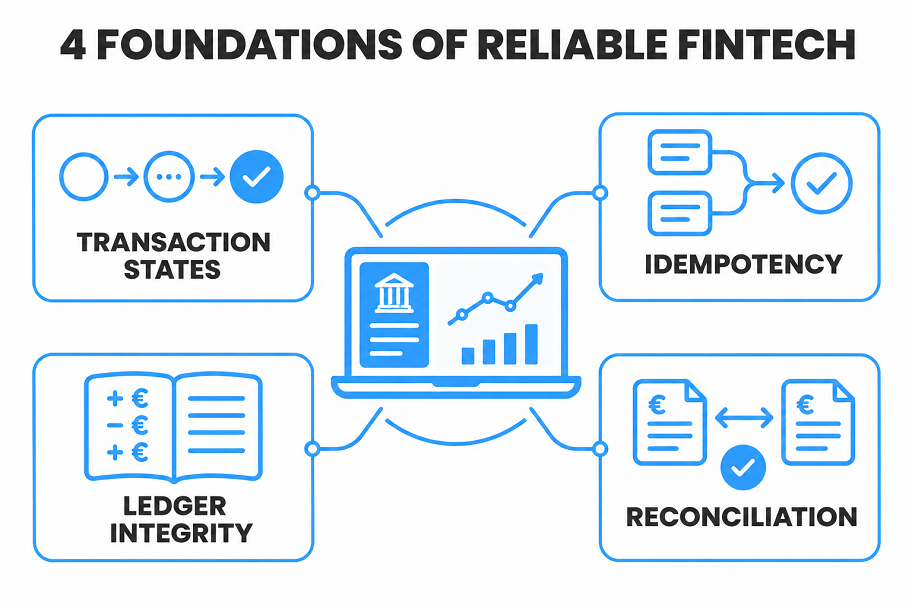
Build your architecture around five core technical and operational principles:
Transaction states. Define the transaction lifecycle and distinguish between states such as initiated, pending, authorized, completed, settled, rejected and reversed, where applicable. Do not present a final outcome when confirmation is still missing.
Idempotency. Use stable idempotency keys and provider-side idempotency where supported. After a timeout, verify the transaction status where possible and follow the provider’s documented retry policy, preserving the original idempotency key for the same operation. A missing API response does not necessarily mean the payment failed.
Ledger integrity. If your product maintains balances or financial obligations, use an appropriate accounting model, often based on double-entry principles. Ensure atomic ledger updates, consistent monetary precision and a traceable, auditable history of adjustments and corrections.
Reconciliation. Compare internal records with bank or processor statements. A successful API response does not prove that every balance agrees.
Exceptions and recovery. Define who investigates unmatched transactions, delayed callbacks and settlement discrepancies, and how corrections are approved and recorded.
Not every application needs to operate its own ledger. A provider may maintain the authoritative record. What matters is knowing where the source of truth sits, how you obtain evidence and who resolves mismatches.
The 2024 failure of financial technology intermediary Synapse exposed how difficult it can be to reconstruct customer balances when records held by intermediaries and partner banks do not align, highlighting the importance of accurate recordkeeping and reconciliation. The lesson is larger than one company: reliable records are part of the product, not merely an internal accounting concern.
Design KYC, Security and Auditability Into Customer Journeys
Identity verification, Know Your Customer (KYC) procedures, anti-money laundering (AML) controls, and fraud prevention serve distinct but interconnected purposes. Depending on the applicable regulatory framework, product characteristics, risk profile, and responsibilities of the parties involved, these processes may include customer due diligence, sanctions screening, ongoing transaction monitoring, and the identification and escalation of suspicious activity.
Map the onboarding process with legal and compliance owners. Which customer information is necessary? When does verification occur? What happens when a check fails or requires manual review? How are decisions recorded, corrected and made available to authorized reviewers?
Next, translate those decisions into engineering controls: least-privilege access, role-based permissions, segregation of duties, encryption, secure API authentication, secrets management, tamper-evident audit logs, vulnerability management, and tested recovery procedures. Apply data minimization and retention rules instead of collecting information simply because an integration makes it available.
This matters in practice. Stermedia’s identity verification case study describes software developed to recognize identity documents and support verification workflows later used in financial-sector KYC and AML processes. The value lies not only in automation but also in consistent processing and auditability.
If your product handles cardholder data or affects the cardholder data environment, assess its applicable Payment Card Industry Data Security Standard (PCI DSS) scope. Using a payment gateway does not make every security obligation disappear.
Operational Resilience in FinTech Software Development: Beyond Uptime
“99.9% uptime” sounds reassuring, but availability alone does not describe a trustworthy financial system. A service can be online while settlement records are wrong, a critical provider is failing or an incident remains undetected.
Identify critical business services and define monitoring, incident ownership, escalation paths, recovery priorities, backup testing, and customer communication procedures. Establish recovery time objectives (RTOs) and recovery point objectives (RPOs), and validate them through regular disaster recovery and business continuity testing. Include dependencies outside your own infrastructure, especially banking APIs, identity providers, and cloud services.
For financial entities within its scope, the EU’s Digital Operational Resilience Act (DORA) has applied since January 17, 2025. It addresses information and communication technology (ICT) risk management, operational resilience and third-party technology dependencies, among other topics. Its applicability and detailed obligations depend on the entity involved. Technology providers serving regulated financial institutions may also face contractual resilience and security requirements, while designated critical ICT third-party service providers can be subject to EU-level oversight. The European Banking Authority’s DORA resources provide a useful starting point.
A founder’s question should not be only, “Can we launch?” It should also be, “Can we explain what happened and restore service when something fails?”
Build or Buy? Evaluate the Dependencies You Create
FinTech software development often involves choices about payment processing, KYC, fraud tools, banking connections and financial data APIs. Building everything can drain runway. Outsourcing everything can leave you with limited control.
Evaluate each component by asking whether it creates competitive advantage and how difficult it would be to replace. Beyond price and documentation, examine:
- Whether the provider supports your target geography and use case
- What records, logs and reports you can retrieve
- How security incidents and outages are communicated
- Who owns customer-facing errors, complaints and remediation
- Whether contractual and technical arrangements support an exit
A clean integration boundary helps. Keep business rules and internal data models from becoming unnecessarily dependent on one vendor’s API terminology. Document fallback behavior and migration assumptions even if you never switch providers.
A BaaS arrangement is not a shortcut around accountability. It is a set of shared responsibilities that must be understood and reflected in the product.
FinTech Software Development Costs: Approvals, Controls and the Second Release
The cost of regulated financial software goes beyond design and coding. Depending on the business model, it can include regulatory advice, security testing, provider onboarding, audits, monitoring, integration fees, support and ongoing changes to compliance processes.
External approval timelines also matter. A development team might complete an integration quickly while bank due diligence or provider reviews take longer. Your roadmap should distinguish work the team controls from decisions made by third parties.
Ask for an estimate built around assumptions and dependencies, not just a feature list. Identify the cost of a controlled pilot, the requirements for production use and the likely work needed after real customers arrive.
For founders with limited runway, the best roadmap is often one that retires the largest uncertainty first — licensing model, partner feasibility or transaction reliability — rather than one that delivers the most screens.
What Relevant Engineering Experience Looks Like
A development partner does not replace legal counsel, a compliance function or your licensed institution. Its job is to make their requirements technically workable and to flag gaps that would otherwise become expensive rework.
Look for experience with sensitive data, third-party integrations, permissions, automated testing and systems that cannot tolerate uncontrolled changes.
Stermedia’s work offers practical examples across related environments. Our Goldsaver project involved payment security and integrations with ERP, accounting and warehouse systems. In an insurance broker platform modernization, we handled complex permissions, external integrations and continuity across a mature application. Neither project should be treated as a universal regulatory blueprint, but both show why financial workflows demand disciplined engineering.
The Founder’s Pre-Development Checklist
Before funding the full build, make sure you can answer these questions:
- Scope: What financial activity will the product perform in its first market?
- Authorization: Who has validated the regulatory and partnership model?
- Ownership: Which company is responsible for funds, customer data, verification and complaints?
- Records: Where is the authoritative transaction history, and how will you reconcile it?
- Failure: What happens after a timeout, duplicate request, provider outage or disputed transaction?
- Controls: Which security and operational measures must exist before a live pilot?
- Proof: What evidence will justify the next investment decision?
You do not need every future feature specified. You do need accountable owners, verified assumptions and a clear path from prototype to reliable operation.
A structured discovery phase should produce tangible outputs: a responsibility matrix, documented regulatory assumptions, an integration map, a preliminary transaction-state model, a risk register and clear MVP acceptance criteria. These artifacts help founders make informed investment decisions before committing to full-scale development.
Next Steps and Further Reading
Successful FinTech software development is not about adding as many features as possible. It is about making the right early decisions so your product can earn trust, pass partner scrutiny and scale without repeatedly rebuilding its foundations.
At Stermedia, we help founders and established businesses turn complex requirements into working software — from discovery and proof of concept (PoC) to secure integrations, platform modernization and long-term development.
Planning a FinTech MVP or facing challenges with banking integrations, security or transaction architecture? Talk to Stermedia’s engineering team about your next steps.
Continue reading:
- Team Extension or In-House? 7 Arguments for Startups – how founders can choose the right engineering team structure while managing costs, expertise and delivery risks.
- Software Development Partner: First 30 Days – what a well-structured development partnership should deliver during its first month.
- Legacy System Takeover Without Downtime – practical approaches to protecting business continuity while modernizing critical software systems.